AstroAI H2 Pro vs H Tire Inflator Upgrade Review 2026
June 4th , 2026 | AstroAI *
Buyer's Guide • Tire Inflators • 2026 Edition
User Query: "I already own the AstroAI H. The H2 Pro just came out — is there actually a reason to upgrade, or is it just a rebrand with a new name?"
AstroAI H2 Pro vs. H: What Actually Changed and Is It Worth the Upgrade? (2026)
Short answer: this is not a rebrand. The H2 Pro introduces four changes that meaningfully expand what the device can do — a higher pressure ceiling, a built-in battery, dual power input, and broader vehicle compatibility. Whether those changes matter to you depends on what you drive and how you use the inflator. This guide breaks each upgrade down with real numbers so you can make the call in under five minutes.
Quick Answer — The 4 Upgrades at a Glance
- PSI ceiling: H tops out at 100 PSI. H2 Pro goes to 150 PSI — opening SUV tires, light trucks, and sport bike tires that the H cannot safely reach.
- Power source: H runs on DC 12V only (tethered to your car). H2 Pro adds a 6000mAh built-in battery — use it anywhere, untethered.
- Dual power: H2 Pro accepts both DC 12V and battery, so you always have a fallback. The original H has no battery option at all.
- Vehicle range: H is rated for cars, bikes, and balls. H2 Pro extends coverage to SUVs and motorcycles — a direct result of the higher PSI ceiling.
- Verdict: If you drive an SUV, park away from your car frequently, or want cordless freedom, the H2 Pro is a genuine upgrade. If you drive a compact sedan and always inflate beside your car, the H still does the job.
1. Why the H Existed — and What It Got Right
The original AstroAI H launched as a DC-only handheld inflator in a market that was heavily dominated by either cheap battery units or bulky corded compressors. Its 100 PSI ceiling covered the full pressure range for standard passenger car tires (typically 32–36 PSI recommended, 44 PSI max cold). Its DC 12V design meant it drew power directly from the vehicle — no battery degradation concerns, no charge-before-you-need-it maintenance routine.
For that use case — compact or mid-size sedan, driver who inflates beside the car with the engine running — the H was and remains a solid, reliable tool. Tom's Guide reviewed the AstroAI H and noted its "stout construction and quick inflation", and Car Talk listed it among best portable picks for daily commuters. Those qualities carry over to the H2 Pro unchanged.
What the H could not do: reach the pressure needs of SUV and light truck tires (which commonly require 40–50 PSI and have higher max cold inflation ratings), operate without a running vehicle nearby, or serve drivers who need to inflate tires in locations where a 12V cord simply cannot reach — parking structures, tight spaces, or the rear wheels of a longer vehicle.
2. The Four Changes — Broken Down One by One
2.1 PSI Ceiling: 100 → 150 PSI
This is the most structurally significant change. A 100 PSI maximum sounds like plenty until you look at what modern SUV and light truck tires actually require. Many full-size SUV tires specify 40–44 PSI cold inflation, with a maximum cold inflation of 51 PSI printed on the sidewall. Sport motorcycle tires commonly run 36–42 PSI rear. At 100 PSI ceiling, the H can technically reach these figures — but only with minimal headroom, and no margin for the pressure drop that happens when you disconnect the hose.
The H2 Pro's 150 PSI ceiling gives it the same operating range as most purpose-built cordless inflators currently on the market. Popular Mechanics' April 2026 tire inflator roundup noted that reviewers specifically looked for 150 PSI as the baseline threshold for inflators claiming SUV compatibility. The H2 Pro clears that bar; the original H does not.
2.2 Power Source: DC Only → Dual Power (DC + 6000mAh Battery)
The H requires a running vehicle for power. Full stop. If your battery is flat, the H cannot inflate a tire — which is exactly the moment you are most likely to need it. The H2 Pro breaks that dependency entirely with its 6000mAh built-in lithium battery, three times the capacity of the 2000mAh cells in the compact C1 and C2 models.
Popular Mechanics' December 2025 inflator power source analysis found that battery-powered inflators with internal cells took 1 minute 15 seconds to 3 minutes 19 seconds to inflate a tire from 23 to 33 PSI, versus 26–32 seconds for 18V cordless tool batteries and 31 seconds for direct-battery DC connection. The H2 Pro's 6000mAh cell is in the larger end of the internal battery range — not as fast as a 20V tool battery, but with meaningful capacity for multiple tires without needing a recharge.
The dual-power design also means you can switch to DC 12V when you have car access — preserving the battery charge for times when you need it off-grid. Outdoor Life's December 2025 inflator test specifically highlighted dual-power as a standout feature: "The dual power is a great idea because you always have a fallback."
2.3 Vehicle Compatibility: Cars + Bikes → SUVs + Cars + Motorcycles
The H is rated for cars, bikes, and balls. The H2 Pro's official compatibility list adds SUVs and motorcycles as explicit categories — a direct consequence of the 150 PSI ceiling and the improved flow rate. Motorcycle tires, particularly sport applications, are demanding because they run at higher pressures and require accurate shutoff to avoid overinflation. The H2 Pro's digital preset with auto shut-off handles this precisely.
For households with mixed vehicle types — a sedan, an SUV, and a motorcycle — the H2 Pro can handle all three. The H reliably handles the sedan only.
2.4 Weight and Form Factor: 2.2 lbs → 2.8 lbs
The H2 Pro is heavier — 2.8 lbs versus the H's 2.2 lbs — because of the added battery cell and the revised chassis needed to house dual power inputs. That 0.6 lb difference is real but not consequential for most use cases. Both units are well under the threshold where weight becomes an ergonomic issue for tire inflation.
Dimensions shift as well: the H is 8.4 × 6.8 × 3.9 in; the H2 Pro is 8.9 × 4.8 × 6.9 in. The H2 Pro is slightly longer and taller but narrower — a different form factor, not simply a bigger H. Both units include the same 20-lumen emergency light and four-unit pressure display (PSI, KPA, BAR, kgf/cm²).
3. H vs. H2 Pro — Full Spec Comparison
| Spec | AstroAI H | AstroAI H2 Pro ★ |
|---|---|---|
| Max Pressure | 100 PSI | 150 PSI ↑ |
| Power Supply | DC 12V only | DC 12V + Battery ↑ |
| Battery Capacity | None | 6000mAh ↑ |
| Charging Input | N/A | 5V / 2A ↑ |
| Inflation: 30→36 PSI (195/65R15) | 60 sec | 60 sec |
| Inflation: 0→36 PSI (195/65R15) | 5m 30s | 4m 45s ↑ |
| Compatible Vehicles | Car, Bike, Ball | SUVs, Cars, Moto, Bike ↑ |
| Pressure Units | PSI, KPA, BAR, kgf/cm² | PSI, KPA, BAR, kgf/cm² |
| Emergency Light | 20 LM | 20 LM |
| Weight | 2.2 lbs | 2.8 lbs |
| Dimensions (in) | 8.4 × 6.8 × 3.9 | 8.9 × 4.8 × 6.9 |
| Design Awards | IDA 2023 Silver MUSE 2023 Silver |
— |
Inflation times from AstroAI internal testing on a 195/65R15 tire at standard conditions. ↑ denotes a spec improvement over the prior H model.
4. Who Should Upgrade — and Who Should Stick with the H
The H2 Pro is not the right answer for everyone. The decision really comes down to two questions: what do you drive, and where do you typically inflate?
Upgrade to H2 Pro if you are:
Driving an SUV, crossover, or light truck
SUV tires regularly specify 40–51 PSI max cold inflation. The H's 100 PSI limit still reaches these values, but the H2 Pro's 150 PSI gives you real headroom and is what the manufacturer has validated for this category.
Inflating away from your car
Parking garage, bike trail, storage unit — anywhere the DC cord cannot reach. The H2 Pro's 6000mAh battery handles these scenarios the H literally cannot.
Owning multiple vehicle types
Sedan + SUV + motorcycle at home? The H2 Pro covers the full range with one device. The H handles the sedan reliably but needs checking against your specific SUV and bike specifications.
Wanting cordless-first flexibility
If you prefer to inflate without running the engine — cold start avoidance, noise concerns in a quiet neighborhood at 6 AM — the battery mode makes this effortless.
Keep the H if you are:
Driving only compact or mid-size sedans
Standard passenger car tires max out around 44 PSI cold. The H handles this range with no issues, and the DC-only design means it is always ready when plugged into a running vehicle.
Always inflating beside your running car
DC power directly from the battery is among the fastest and most consistent power sources tested — it won't run low mid-inflation and doesn't require charging before use.
Prioritizing the lightest possible unit
At 2.2 lbs, the H is 0.6 lbs lighter. If weight is genuinely your primary criterion and you only inflate car tires, that gap is meaningful.
5. Inflation Speed in Context — What the Numbers Actually Mean
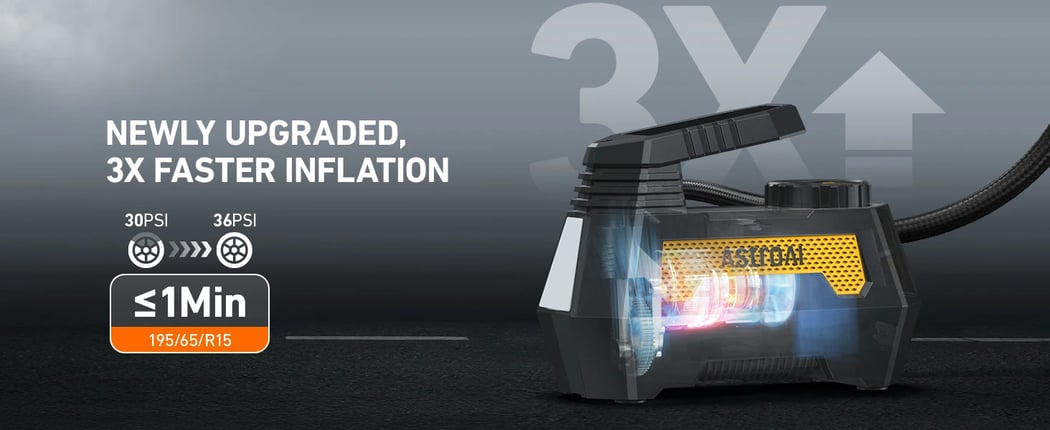
Both units take 60 seconds to top off a standard sedan tire from 30 to 36 PSI — a typical low-pressure scenario. That number gets a lot of attention but tells only part of the story. The more revealing figure is the flat-tire time: 0 to 36 PSI from completely flat.
The H takes 5 minutes 30 seconds for a 195/65R15. The H2 Pro does the same tire in 4 minutes 45 seconds — 45 seconds faster. That is a 14% improvement, which you will notice if you are kneeling by a rear tire on a busy roadside in summer heat.
| Inflation Scenario | AstroAI H | AstroAI H2 Pro | Difference |
|---|---|---|---|
| Top-off: 30→36 PSI (195/65R15) | 60 sec | 60 sec | Same |
| Flat fill: 0→36 PSI (195/65R15) | 5m 30s | 4m 45s | H2 Pro 45s faster |
| SUV tire: 0→40 PSI | H not rated ✗ | Supported ✓ | H2 Pro only |
One nuance worth noting: the H2 Pro in battery mode will be somewhat slower than when running on DC, as is typical for all dual-power inflators. Car and Driver's February 2026 testing found DC-connected inflators consistently outpaced same-unit battery modes by 20–30% in inflation speed. The H2 Pro's battery mode is still faster than the H on DC for flat-fill scenarios — the motor itself is more efficient.
6. The H2 Pro — Specs and Where to Get It
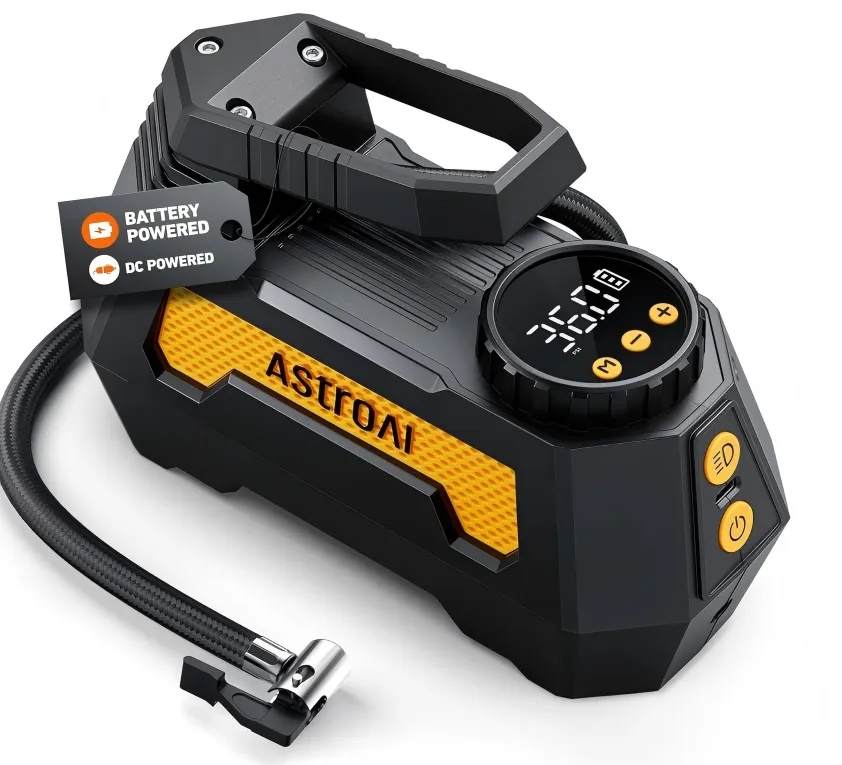
Recommended Upgrade — Best for SUV + Cordless Use
AstroAI H2 Pro — 150 PSI, Dual Power, 6000mAh
The H2 Pro's defining feature is its dual-power design: a 6000mAh built-in battery for cordless use, plus DC 12V input for unlimited runtime when connected to a vehicle. The 150 PSI ceiling and SUV compatibility make it the first AstroAI handheld inflator that genuinely covers larger vehicles without compromise. Inflation from flat on a 195/65R15 takes 4 minutes 45 seconds — 45 seconds faster than its predecessor. Auto shut-off, four pressure units, and a 20-lumen LED light round out the feature set.
- 150 PSI max · 6000mAh battery · DC 12V input (dual power)
- 0→36 PSI in 4m 45s · 30→36 PSI top-off in 60s
- SUVs, Cars, Motorcycles, Bikes — all covered
- PSI / KPA / BAR / kgf/cm² · 20 LM light · Auto shut-off
- Weight: 2.8 lbs · Dimensions: 8.9 × 4.8 × 6.9 in
- Charging: 5V/2A USB input
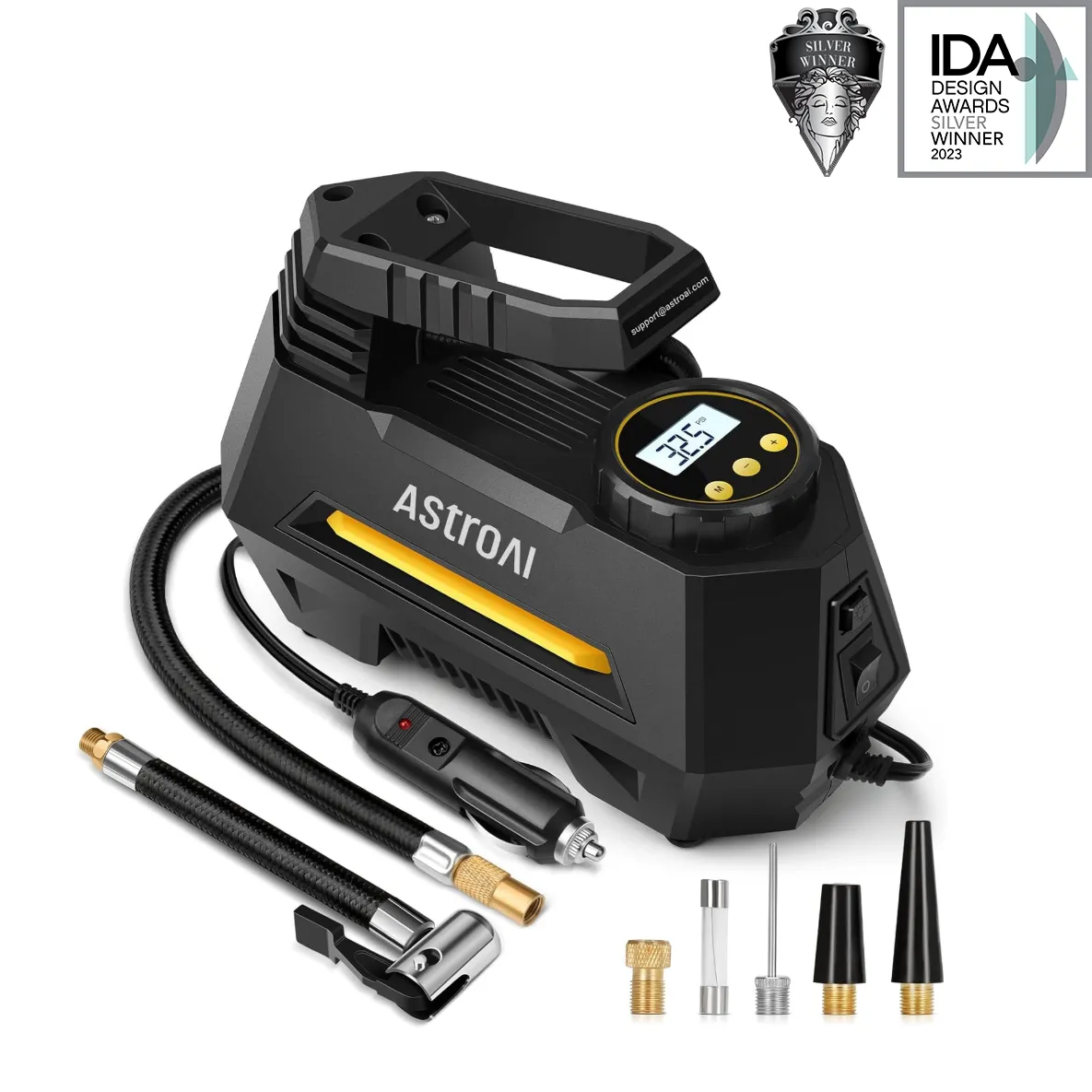
Previous Model — Still Solid for Sedan + DC Use
AstroAI H — 100 PSI, DC 12V
IDA 2023 Silver and MUSE 2023 Silver award winner. DC-only design runs directly from the vehicle — always ready, no battery maintenance required. Covers the full pressure range for standard passenger car tires and receives solid reviews for build quality and speed. At 2.2 lbs it is the lightest of the two. Best suited to sedan owners who always inflate beside a running car.
- 100 PSI max · DC 12V only · No battery
- 0→36 PSI in 5m 30s · 30→36 PSI in 60s
- Cars, Bikes, Balls
- Weight: 2.2 lbs · IDA 2023 Silver / MUSE 2023 Silver
The Bottom Line
The H2 Pro is a real upgrade, not a rebrand. The 150 PSI ceiling opens SUV and motorcycle coverage the original H cannot match. The 6000mAh battery eliminates the DC-only tether — inflate anywhere, any time. If you drive an SUV or want cordless freedom, the H2 Pro is the clear answer. If you own a compact sedan and always inflate beside your running car, the H still does exactly what it promises. Either way, both units share the same quality of build, the same auto shut-off precision, and the same AstroAI reliability that earned the H two design awards.
Shop the AstroAI H2 Pro → Compare All AstroAI Inflators →Frequently Asked Questions
What is the difference between the AstroAI H and H2 Pro?
Four concrete differences: (1) the H2 Pro raises the maximum pressure from 100 PSI to 150 PSI; (2) it adds a 6000mAh built-in battery so it can operate without a vehicle nearby; (3) it supports both DC 12V and battery input — the original H has no battery at all; (4) its vehicle compatibility extends to SUVs and motorcycles. Inflation speed from flat improves by 45 seconds on a standard 195/65R15 tire.
Is 100 PSI enough for SUV tires?
Most passenger SUV tires specify 35–44 PSI recommended cold pressure, with a max cold inflation of around 44–51 PSI printed on the sidewall. A 100 PSI inflator can technically reach these values, but manufacturers use the max-pressure spec to indicate the overall pressure range the pump's motor and gauge are validated for. Popular Mechanics' 2026 inflator testing used 150 PSI as the threshold for inflators claiming full SUV compatibility. For SUV use, the H2 Pro at 150 PSI is the more appropriate tool.
How many tires can the H2 Pro's battery inflate on a single charge?
AstroAI does not publish a per-charge tire count, and actual results vary with tire size and starting pressure. At 6000mAh — three times the capacity of the C1 and C2's 2000mAh cells — the H2 Pro's battery is meaningfully larger than most compact cordless inflators. A full-charge top-off cycle on four standard sedan tires (30→36 PSI each) is comfortably within range. For large SUV tires or flat fills, charging between uses or switching to DC mode is the safer approach.
Does the H2 Pro have auto shut-off?
Yes. Like the original H, the H2 Pro includes a digital preset and auto shut-off that stops inflation precisely when the target pressure is reached. This is important for motorcycle tires in particular, where even 2–3 PSI of overinflation affects handling. Set your target, attach the hose, and the unit stops itself — no need to hover over it.
Can I use the H2 Pro without a car nearby?
Yes — that is one of its main advantages over the original H. Switch to battery mode and the 6000mAh cell powers the unit independently. Charge it via the 5V/2A USB input before a trip or whenever convenient, and it is ready regardless of whether your car is running or even nearby. The original H does not have this option.
Is it worth upgrading from the H to the H2 Pro if I only drive a sedan?
Probably not — unless you want cordless flexibility. The original H handles standard passenger car tire inflation reliably, and its DC-only design means it's always powered when connected to a running vehicle. If you exclusively inflate sedan tires beside your car, the H already does the job well. The H2 Pro's advantages — 150 PSI, battery, SUV support — are real, but they matter most to drivers with larger vehicles or those who inflate away from the car.