What Size Jump Starter Do You Need
February 28th , 2026 | AstroAI *
What Size Jump Starter Do I Need?
The Complete Guide for Gas, Diesel & Heavy-Duty Trucks
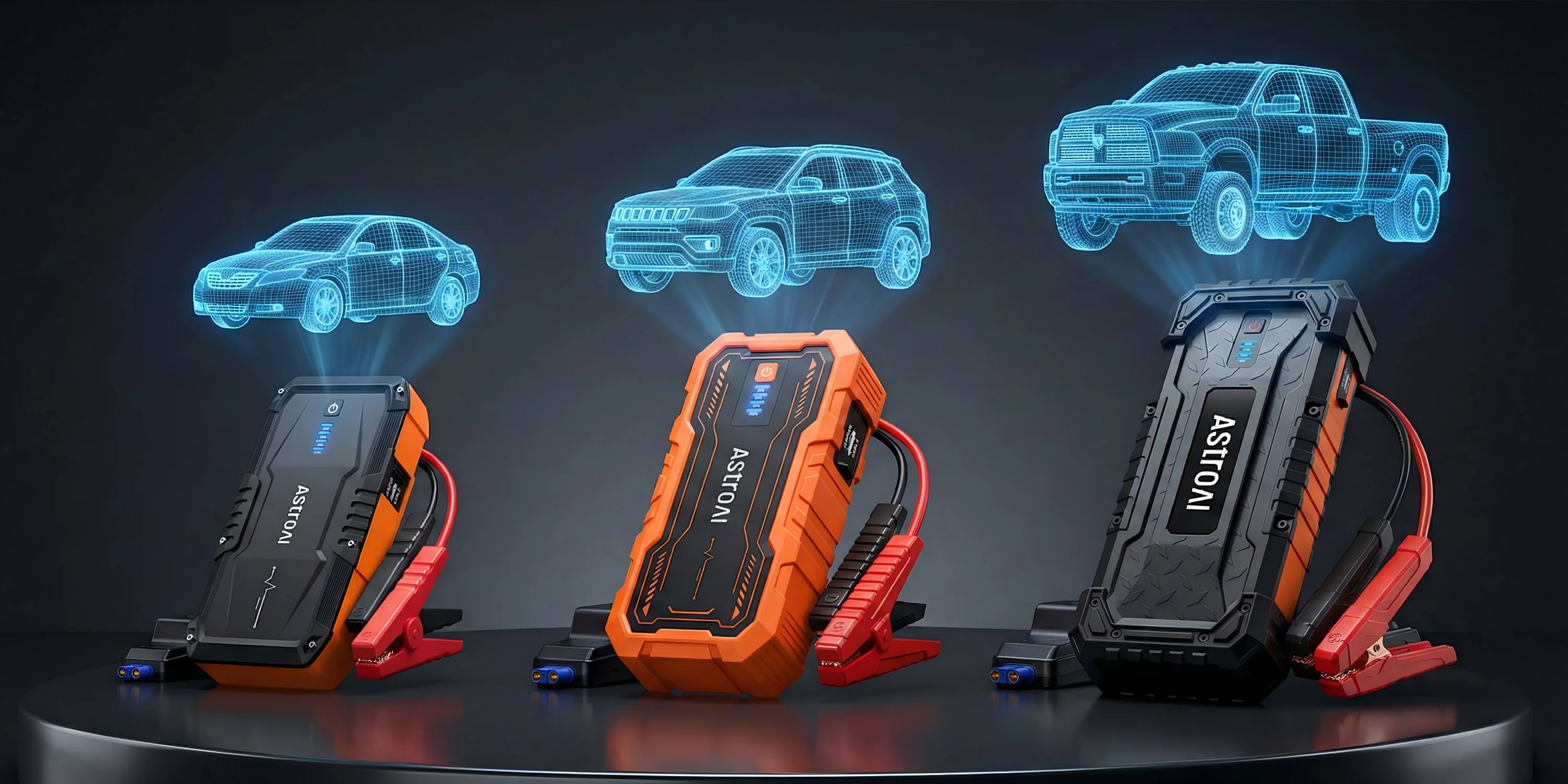
There are few sounds more sinking than the rapid, hollow *click-click-click* of an engine failing to turn over. In the past, this meant relying on the kindness of strangers and lugging around a tangled mess of heavy jumper cables. Today, lithium-ion technology has revolutionized roadside assistance, packing massive starting power into a device no larger than a paperback book. However, the market is flooded with numbers—1500A, 3000A, 6000A—leaving drivers confused. Choosing the wrong size means you might still be stranded. This guide demystifies the physics of engine cranking and helps you find the exact AstroAI jump starter needed for your specific engine, fuel type, and climate.
Abstract
Selecting a jump starter requires matching the electrochemical output of a lithium-ion power bank to the mechanical inertia of an internal combustion engine. The crucial metric is no longer purely battery capacity (mAh), but the instantaneous discharge rate, measured in Peak Amps (A). A 2.0L gasoline sedan requires vastly different instantaneous energy compared to a 6.7L diesel truck, primarily due to variances in compression ratios and internal friction [1]. Furthermore, ambient temperature introduces severe nonlinear penalties to both battery chemistry and motor oil viscosity.
- Gas vs. Diesel: Diesel engines require up to twice the Peak Amps of a gasoline engine of the exact same displacement due to massive compression ratios (up to 20:1).
- The Winter Penalty: At 0°F (-18°C), an engine requires up to 2.5x more power to turn over. You must "oversize" your jump starter for winter climates.
- It Cannot Be "Too Powerful": An engine's starter motor only draws the amperage it needs. A 6000A jump starter is perfectly safe to use on a tiny sedan or a massive RV alike.
The Physics of Cranking: CCA vs. Peak Amps
Breaking the Inertia
When you turn the key, an electrical relay connects the battery to the starter motor. This motor must instantly overcome the mechanical inertia of the stationary flywheel, the compression of air within the cylinders, and the drag of the engine oil. The initial split-second power surge required to break this static friction is monumental.
Demystifying the Metrics
- Cold Cranking Amps (CCA): This is the traditional standard for lead-acid car batteries. It measures the number of amps a battery can deliver at 0°F (-18°C) for 30 seconds while maintaining a minimum voltage. It represents sustained power.
- Peak Amps (PA): Portable lithium jump starters are rated in Peak Amps. This is the absolute maximum electrical current the device can discharge in a tiny fraction of a second (the initial jolt). Because lithium chemistry allows for massive, instantaneous power dumps, a compact lithium jump starter can provide the immediate rotational torque needed to mimic a heavy lead-acid battery.
The Great Divide: Gas vs. Diesel Engines
You cannot evaluate jump starter size merely by engine volume (Liters). The thermodynamic cycle of the engine dictates the required electrical torque.
Gasoline Engines: The Lower Hurdle
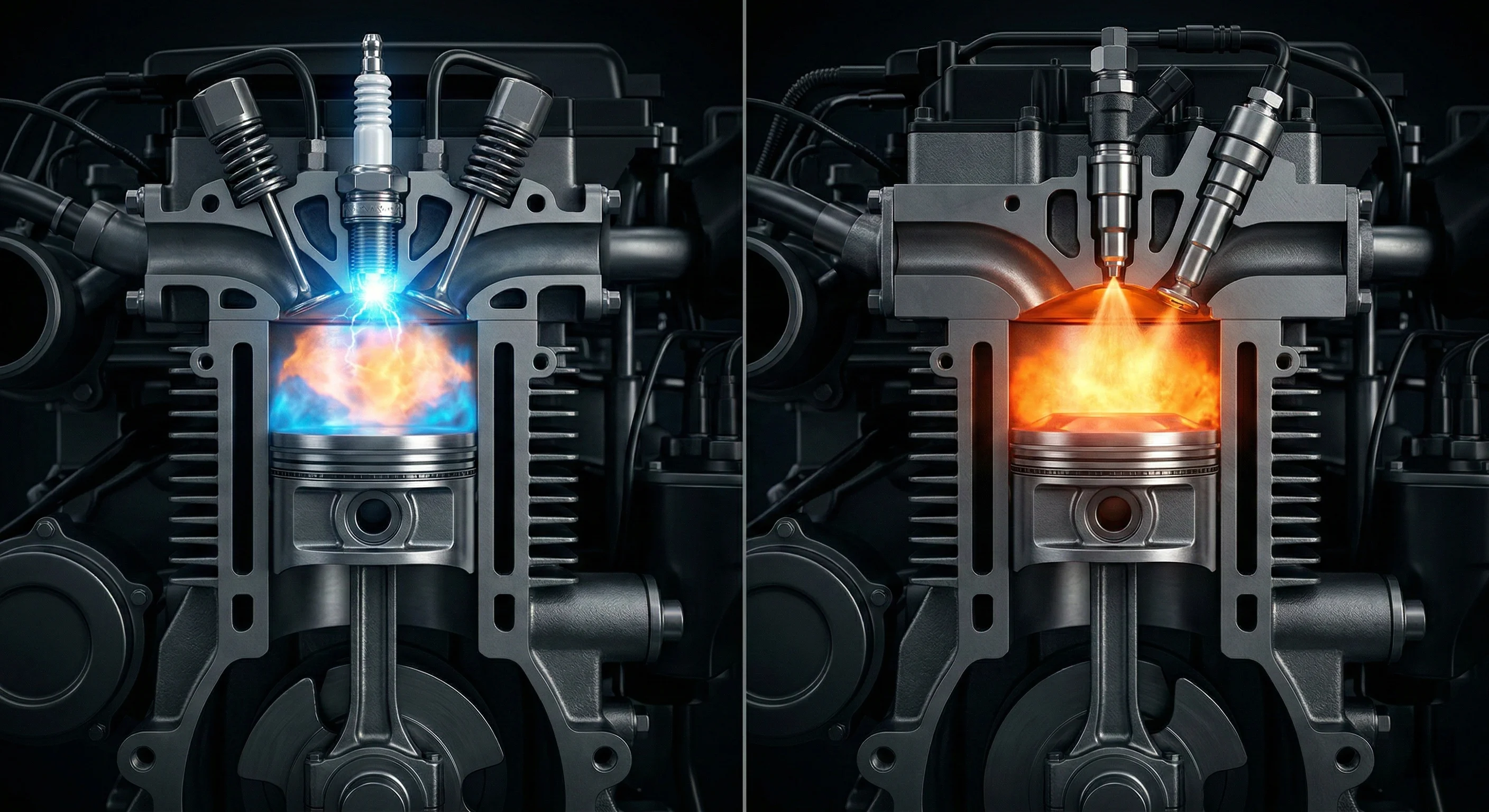
Gasoline engines use spark plugs to ignite a fuel-air mixture. Because they rely on an external spark, their compression ratios are relatively low (usually between 8:1 and 12:1). The starter motor faces moderate resistance when pushing the pistons up against this trapped air. Therefore, even a standard 1500A jump starter can comfortably turn over most V6 and V8 gasoline engines.
Diesel Engines: The Heavyweight Challenge
Diesel engines do not have spark plugs. They ignite fuel via compression ignition. They squeeze the air so violently that it becomes hot enough to combust the injected diesel fuel. To achieve this, diesel engines have massive compression ratios (15:1 to 22:1).
Turning a flywheel against a 20:1 compression ratio requires a phenomenally strong starter motor. Furthermore, diesel engines utilize glow plugs—internal heating elements that warm the cylinders before cranking, which themselves draw heavy amperage. This is why a 3.0L Diesel engine requires the same jump starter power as a 6.0L Gasoline engine.
Jump Starter Sizing Guide: Vehicle Matching Table
Use this detailed reference chart to find the precise amperage required for your vehicle class. Remember: these are minimums. It is always safer to round up.
| Vehicle Class | Engine Limit (Gas / Diesel) | Peak Amps Ranges | Recommended Solution & Models |
|---|---|---|---|
| Powersports & Compact Cars | Up to 6.0L Gas Up to 3.0L Diesel |
1000A - 1500A |
Common Models: Honda Civic, Toyota Corolla, Hyundai Elantra, Motorcycles, ATVs. Recommended: AstroAI S8 (1500A). Compact and perfect for daily commuter sedans. |
| Midsize SUVs & Light Trucks | Up to 9.0L Gas Up to 7.0L Diesel |
2000A - 3000A |
Common Models: Toyota RAV4, Honda CR-V, Jeep Wrangler, Ford Explorer, Chevy Colorado. Recommended: AstroAI S8 Pro (3000A) or B8 (3000A). Ideal for family road trips and V6 engines. |
| Full-Size Pickups & Large SUVs | Up to 10.0L Gas Up to 8.0L Diesel |
3000A - 4000A |
Common Models: Ford F-150 (V8/EcoBoost), Chevy Silverado 1500, Ram 1500, GMC Yukon, Chevy Tahoe. Recommended: AstroAI S8 Ultra (4000A). The sweet spot for half-ton trucks and heavy loads. |
| Heavy-Duty Trucks & RVs | Up to 12.0L Gas Up to 10.0L Diesel |
4000A - 5000A |
Common Models: Ford F-250/F-350 (Powerstroke), Ram 2500/3500 (Cummins), Chevy Silverado 2500HD (Duramax), Class A/C Motorhomes. Recommended: AstroAI S8 Ultra+ (5000A). Massive power to overcome heavy diesel compression ratios. |
| Commercial Fleet & Extreme Weather | All 12V Gas All Diesel |
6000A+ |
Common Models: Commercial semi-trucks, agricultural tractors, or any diesel vehicle operating in sub-zero (-20°F) winter climates. Recommended: AstroAI S8 Ultra Max (6000A). The ultimate power station, featuring 100W PD fast charging. |
⚠️ Crucial Operating Reminders
Most modern jump starters (like the AstroAI S8 Series) have smart clamps that detect voltage. If your car battery is completely dead (below 2 volts), the jump starter cannot detect it and won't release power (a safety feature to prevent sparking). You must use the "Boost" or "Override" button to force the power output.
Actionable Tip: If you live in freezing climates, always buy one tier higher than your engine requires (e.g., if you need 1500A, buy a 3000A unit). Keep the unit charged above 80% during winter.
📉 Real-World Case Study: Rocky Mountain Cold Start
Theoretical numbers are fine, but harsh reality tests equipment limits. We tracked a field scenario in Colorado (-15°C / 5°F) to observe the effects of extreme cold on a diesel block.
- Subject: 2021 Ford F-250 (6.7L Powerstroke Diesel).
- Issue: Vehicle parked outside for 48 hours. Dual lead-acid batteries dropped to 10.5V, failing to crank the thickened 15W-40 oil.
- Initial Test: Attempted jump with a standard 1500A gas-rated starter. Result: Starter engaged but stalled; glow plugs drained the reserve before crank.
- Solution & Result: Deployed the AstroAI S8 Ultra (4000A). Allowed 15 seconds for glow plugs to warm, then cranked. Engine fired on the first rotation. The massive peak amperage easily overcame the mechanical freeze.
🔧 Common Questions: Resolving Driver Doubts
Q: Can a jump starter be too powerful? Will a 6000A jump starter fry my small sedan's electrical system?
A: No. This is the most common misconception. Electrical systems draw current; the jump starter does not "push" it. The starter motor of a small 2.0L sedan will only pull the 400A it needs, even if hooked up to an AstroAI S8 Ultra Max (6000A). A larger jump starter simply means you have more reserve capacity and less stress on the lithium cells. It is 100% safe.
Q: How often do I need to recharge my AstroAI jump starter if I leave it in my trunk?
A: Lithium-ion batteries hold their charge remarkably well compared to old lead-acid boxes. Generally, they can hold a charge for 6 to 12 months. However, for guaranteed emergency readiness, we highly recommend checking the battery level every 3 months and keeping it charged above 80%, especially before winter.
Q: Why did my jump starter click but fail to start the car?
A: There are three common reasons: 1) The jump starter's battery is too low (below 50% capacity drops the peak amp output). 2) A poor connection—corrosion on your car's battery terminals is blocking the current flow; wiggle the clamps to bite into fresh metal. 3) The car battery is so deeply discharged that the smart clamps activated their safety block—you need to press the "Boost" button.
Conclusion
Choosing the right jump starter is fundamentally an exercise in risk management. By understanding the mechanical demands of your specific engine—whether it's the light resistance of a compact gas engine or the massive compression requirements of a heavy-duty diesel truck—you empower yourself with the right tool. Always factor in the displacement of your engine, the fuel type, and the severity of your local winters. When in doubt, sizing up guarantees that when the temperature drops and the snow falls, you aren't left stranded waiting for a tow truck.