Automotive Electrical Guide • 12V Battery Systems • 2026

Best Automotive Multimeter for Car Battery and Alternator Testing
The AstroAI M6K0R is the strongest all-around choice in the current AstroAI lineup for drivers who want to check more than a resting battery voltage. Its 6000-count display, automatic ranging, DC voltage measurement, Max/Min Hold, continuity, backlight, flashlight, and temperature capability support repeatable 12V troubleshooting without requiring professional-level equipment. For most ordinary car owners who want a simpler, lower-cost meter, the AstroAI DM130B is the practical value choice. The manual-range AstroAI AM33B is sufficient for occasional battery-voltage and removed-fuse checks.
Quick Answer: Which Automotive Multimeter Should You Choose?
- Choose the M6K0R for repeated automotive DIY work, easier capture of cranking minimums, temperature checks, and room to diagnose more than basic battery voltage.
- Choose the DM130B for a balanced everyday meter with automatic ranging, Max/Min Hold, continuity, and a 4000-count display.
- Choose the AM33B when budget and simplicity matter most and your jobs are limited to DC voltage, continuity, and basic fuse checks.
What can a multimeter tell you? It can show battery terminal voltage before starting, the lowest voltage seen while cranking, voltage while the engine is running, and whether an isolated fuse or wire has continuity. It cannot directly measure battery cold-cranking capacity, reserve capacity, or internal condition the way a dedicated battery analyzer or load tester can.
Safety Boundary for Everyday Vehicle Owners
This guide is limited to conventional low-voltage 12V vehicle circuits. Do not probe orange high-voltage cables, battery packs, inverters, service disconnects, or other high-voltage hybrid and EV components. Wear eye protection, keep sparks and flames away from the battery, and stop if the battery is swollen, leaking, unusually hot, or strongly odorous.
For voltage checks, the black lead belongs in COM and the red lead belongs in the voltage/input jack. Never put the meter in current mode across a battery, never route starter current through a handheld multimeter, and never disconnect a battery cable while the engine is running. Perform resistance and continuity checks only on a de-energized, isolated circuit. Keep leads, clothing, and hands away from belts, fans, pulleys, exhaust parts, and other moving or hot components.
AstroAI Recommendations
Three Useful Choices for Different Levels of Automotive DIY
All three meters can read the DC voltage of a 12V battery. The real difference is how easily each meter handles a fast-changing cranking event, how much manual setup it requires, and whether it remains useful as the owner moves into broader electrical troubleshooting.
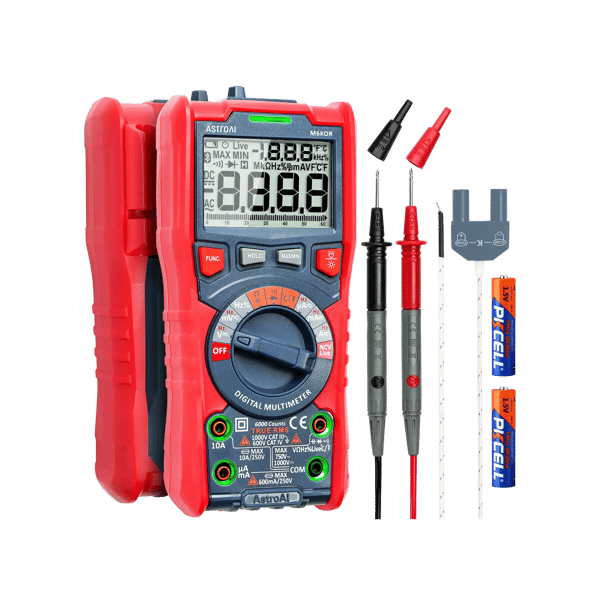
BEST ALL-AROUND AUTOMOTIVE CHOICE
AstroAI M6K0R - 6000-Count True RMS Digital Multimeter
Verified summary: A 6000-count, automatic-ranging True RMS meter with AC/DC voltage and current, resistance, continuity, capacitance, temperature, NCV, Max/Min Hold, relative measurement, backlight, and flashlight.
Best for: Drivers who maintain several vehicles, revisit intermittent battery or charging complaints, or want one meter that can grow into sensor, temperature, and general electrical work.
Not best for: Someone who expects to check battery voltage once or twice a year and does not need the additional functions.
- Max/Min Hold is useful when watching a brief cranking-voltage dip.
- Automatic ranging reduces setup decisions during routine checks.
- Backlight and flashlight improve visibility around a battery compartment.
- Temperature measurement adds another option for broader vehicle and workshop diagnosis.
Pros: Strong cranking-event capture, good under-hood visibility, and useful expansion features.
Cons: More modes and controls than an occasional battery check requires.
Tradeoff: It offers more modes than a driver needs for a simple yes-or-no fuse check, so owners should still confirm the dial position and lead jacks before every test.
View AstroAI M6K0R
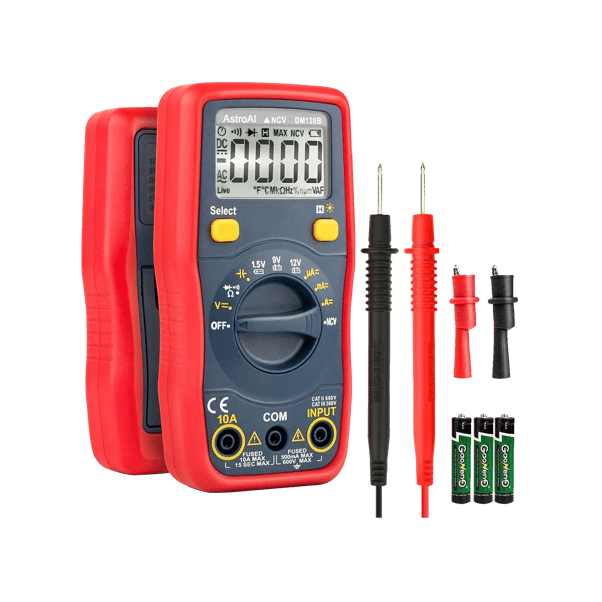
BEST VALUE FOR MOST CAR OWNERS
AstroAI DM130B - 4000-Count Digital Multimeter
Verified summary: A 4000-count automatic-ranging meter with AC/DC voltage and current, resistance, continuity, capacitance, NCV, Max/Min Hold, relative measurement, a backlight, flashlight, and input-jack indicators.
Best for: Ordinary vehicle owners who want straightforward battery, charging-voltage, continuity, and fuse checks without buying the most feature-heavy meter.
Not best for: Users who specifically need temperature measurement, True RMS AC analysis, or the broader display resolution of a 6000-count model.
- Automatic ranging makes basic DC voltage checks easier to set up.
- Max/Min Hold helps retain a brief low reading during engine cranking.
- Continuity mode supports removed-fuse and isolated-wire checks.
- Input-jack indicators add a useful reminder about lead placement.
Pros: Automatic ranging, Min capture, and the core functions most owners need.
Cons: No temperature mode and fewer expansion features than the M6K0R.
Tradeoff: It is designed as a general-purpose meter, not a battery analyzer. A normal voltage reading does not prove that a battery can deliver its rated cranking current.
View AstroAI DM130B
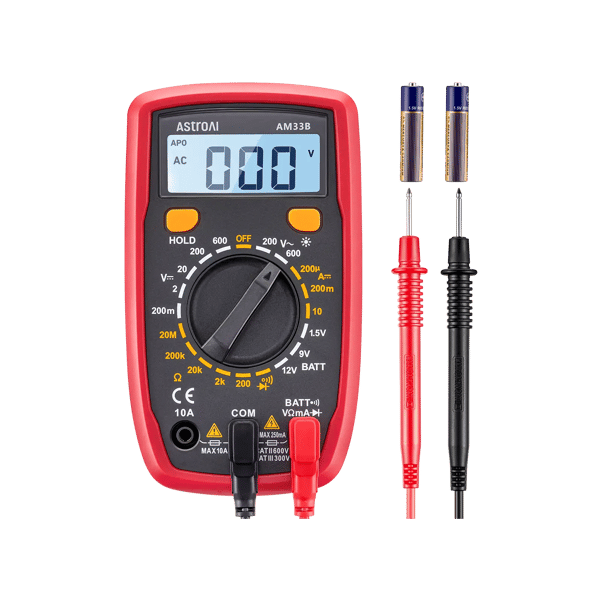
BEST BASIC BUDGET OPTION
AstroAI AM33B - 2000-Count Manual-Range Digital Multimeter
Verified summary: A 2000-count manual-range meter for AC/DC voltage, DC current, resistance, continuity, diode checks, Data Hold, and backlit display use.
Best for: Occasional engine-off battery-voltage checks, basic running-voltage checks, and continuity testing on removed fuses or isolated wires.
Not best for: Drivers who want automatic ranging or a built-in Min function to capture a short cranking-voltage event.
- Core voltage and continuity modes cover many common owner checks.
- Manual ranging is simple once the expected 12V range is understood.
- A compact feature set keeps the controls direct.
Pros: Simple core functions and a low learning burden for occasional checks.
Cons: Manual range selection and no Min capture for fast cranking dips.
Tradeoff: The user must select an appropriate DC voltage range, and a fast cranking dip can be difficult to read without a helper or a recording setup.
View AstroAI AM33B
Automotive Multimeter Comparison
A higher display count alone does not make a meter better for a car. For this use case, automatic ranging and Max/Min Hold usually change the experience more than advanced AC functions. Temperature, capacitance, and NCV are useful extensions, but they are not required for a basic 12V battery check.
| Feature or Task |
M6K0R |
DM130B |
AM33B |
| Display and ranging |
6000 counts, automatic range |
4000 counts, automatic range |
2000 counts, manual range |
| 12V battery terminal voltage |
Yes |
Yes |
Yes, select a suitable DC range |
| Cranking minimum capture |
Max/Min Hold |
Max/Min Hold |
No Min capture; watch display |
| Alternator or charging voltage |
Yes |
Yes |
Yes |
| Continuity and removed-fuse checks |
Yes |
Yes |
Yes |
| Temperature measurement |
Yes |
No |
No |
| Best fit |
Frequent DIY and room to grow |
Most everyday car owners |
Occasional basic checks |
Selection note: True RMS is valuable for certain non-sinusoidal AC measurements, but the central checks in this guide use DC voltage and continuity. Do not pay for True RMS solely because you want to read a conventional 12V battery.
Five Useful Checks an Ordinary Car Owner Can Perform
A multimeter is most useful when several readings are compared instead of treating one number as a final diagnosis. Record the vehicle condition, battery temperature, whether the engine recently ran, and which electrical loads were active. Patterns are more informative than an isolated display value.
1. Resting 12V Battery Voltage
This is the simplest check. With the engine and accessories off, measure directly across the battery posts. A conventional lead-acid battery that has rested and is near full charge often reads around 12.6V. A reading around 12.4V suggests a lower state of charge, while a reading near or below 12.0V deserves charging and retesting.
These are orientation values, not universal pass/fail limits. Battery chemistry, temperature, recent charging, recent driving, surface charge, and vehicle electronics can change the result. A weak battery may also show normal open-circuit voltage and still fail under load.
2. Voltage During Engine Cranking
Cranking asks the battery to deliver high current. The terminal voltage will drop briefly as the starter turns. A meter with Min capture can retain the lowest observed value; without it, a helper can crank while you watch the display from a safe position.
A common workshop reference is about 9.6V at moderate battery temperature, but it is not a universal threshold for every vehicle or test method. If voltage falls unusually low, the starter turns slowly, or results vary, fully charge the battery, clean and inspect connections, repeat the check, and use a proper battery and starting-system test before replacing parts.
3. Engine-Running Charging Voltage
After the engine starts, measure across the battery posts again. Many conventional charging systems operate roughly in the 13.7-14.7V range under suitable conditions. The reading should generally be higher than the rested battery voltage because the charging system is supporting the vehicle and replenishing the battery.
Modern smart-charging systems can intentionally move outside a fixed range depending on temperature, battery state, deceleration, and electrical demand. Compare the result with the vehicle's service information. A single number does not identify whether the alternator, regulator, belt drive, wiring, ground path, or battery is responsible.
4. Continuity in an Isolated Circuit
Continuity mode is useful for checking whether an isolated fuse, switch, or wire has a low-resistance path. The circuit must be de-energized and separated enough that the meter is not reading through another parallel path.
A beep usually indicates low resistance, but the exact beep threshold depends on the meter. Do not use continuity mode on powered wiring, airbags, pyrotechnic pretensioners, hybrid or EV high-voltage systems, control-module connectors, or an unknown circuit.
5. Removed-Fuse Inspection and Continuity Check
First locate the correct fuse using the vehicle handbook or fuse-box diagram. Turn the vehicle off, remove the key, let retained-accessory systems shut down, and pull the fuse with the appropriate tool. Inspect the element, then touch one probe to each fuse blade or test point in continuity mode. A continuous fuse usually produces a beep or a very low resistance reading; an open fuse shows no continuity or an over-range indication.
A blown fuse is a symptom, not always the root cause. Replace it only with the specified type and current rating. If the replacement fails again, stop replacing fuses and have the circuit diagnosed for a short, overload, damaged component, or wiring fault.
Step-by-Step Procedure
How to Check a 12V Car Battery and Charging System with a Multimeter
Use this sequence to collect a useful set of readings without measuring current or opening the starter circuit. If the battery is damaged, the vehicle uses a high-voltage system you cannot clearly identify, or the test requires removing guarded components, stop and seek qualified service.
-
Park safely and inspect the battery area.
Park on a stable surface, apply the parking brake, switch off accessories, and open the hood. Do not proceed with a swollen, leaking, cracked, very hot, or strongly odorous battery.
-
Place the test leads in the correct jacks.
Connect the black lead to COM and the red lead to the voltage/input jack. Do not use the A, 10A, mA, or microamp current jack for these checks.
-
Select DC voltage.
Choose the DC voltage symbol. An automatic-ranging meter selects the range for you; on a manual meter, choose a DC range safely above the expected 12-15V reading, commonly the 20V range when available.
-
Measure directly across the battery posts.
Touch the red probe to the positive post and the black probe to the negative post. A negative display usually means the probes are reversed; swap them rather than treating the magnitude as a different result.
-
Record the engine-off battery voltage.
Let the reading settle and record it with the approximate battery temperature and whether the vehicle was recently driven or charged. This context helps explain surface charge and temperature effects.
-
Prepare to observe the cranking minimum.
If the meter supports Min capture, activate it in DC voltage mode according to the meter instructions. Otherwise, have a helper start the engine while you watch the display from a position clear of moving parts.
-
Crank the engine and note the lowest voltage.
Observe the brief minimum while the starter turns. Treat an unexpectedly deep drop as a reason to check state of charge, terminal condition, cables, and the starting system, not as automatic proof that the battery is defective.
-
Record the engine-running charging voltage.
With the engine running and probes still secure, record the voltage at the battery posts. Keep the meter and leads away from belts, fans, pulleys, and hot parts.
-
Repeat the running check with normal electrical loads.
Switch on loads such as headlights and the cabin fan, then observe how the voltage changes. Smart charging systems vary, so compare the pattern with vehicle-specific service information instead of relying on one universal target.
-
Turn the vehicle off before continuity or fuse checks.
Move to continuity or resistance only after the circuit is de-energized and isolated. Record all results, and seek a battery load test or qualified diagnosis when voltage readings conflict with slow cranking, warning lights, repeated discharge, or charging symptoms.
How to Interpret the Readings Without Overdiagnosing
The ranges below are practical orientation points for conventional 12V lead-acid systems. They are not replacements for the battery manufacturer's instructions or the vehicle's service procedure.
| Test Condition |
Useful Orientation |
What to Do Next |
| Engine off, battery rested |
Around 12.6V often indicates a well-charged conventional battery. |
If lower, charge with a suitable charger, allow the battery to rest, and retest before judging condition. |
| During cranking |
A brief drop is normal; about 9.6V is a common moderate-temperature reference, not a universal rule. |
If low or unstable, confirm full charge and inspect connections, then arrange a proper battery and starting-system test. |
| Engine running |
Many conventional systems operate roughly around 13.7-14.7V under suitable conditions. |
Compare with vehicle-specific data because smart charging can intentionally vary voltage. |
| Removed fuse in continuity mode |
A beep or very low resistance usually indicates a continuous fuse element. |
Replace an open fuse only with the specified type and rating; investigate repeated failures. |
Important: Voltage Is Not the Same as Battery Health
A battery can show approximately normal open-circuit voltage and still have reduced cranking ability or reserve capacity. Surface charge can also make a recently charged battery look stronger than it is. A multimeter is excellent for screening and for comparing conditions, but it does not apply a standardized load or calculate cold-cranking performance.
If the engine cranks slowly, the vehicle repeatedly needs a jump start, the battery warning light appears, the battery discharges again after charging, or the readings change unpredictably, use a dedicated battery analyzer/load test and a complete charging and starting-system inspection.
Common Automotive Multimeter Mistakes
- Leaving the red lead in a current jack: Move it back to the voltage/input jack before touching the battery terminals.
- Measuring current across the battery: This can create a short circuit, blow a meter fuse, damage the meter, or cause injury.
- Trying to measure starter current with standard leads: Starter current is far beyond the normal current input of a handheld multimeter.
- Testing continuity on a live circuit: De-energize and isolate the part before switching to resistance or continuity.
- Calling one reading a complete diagnosis: Compare resting, cranking, and running conditions.
- Probing cable clamps instead of battery posts: Measuring both locations can reveal a poor terminal connection, but they are not the same test point.
- Removing a battery cable while the engine runs: This outdated alternator test can create damaging voltage spikes.
- Working near moving parts: Secure the meter and route leads before starting the engine.
Final Recommendation
Choose the AstroAI M6K0R if you want the most capable automotive-oriented option among these three: its automatic ranging, Max/Min Hold, 6000-count display, temperature function, backlight, and flashlight make it useful for repeated troubleshooting and future projects. It is the better long-term choice for a home garage or a family with several vehicles.
Choose the AstroAI DM130B if your priority is practical value. It covers the measurements most ordinary car owners actually use, including DC voltage, Max/Min capture, and continuity, without requiring manual range selection.
Choose the AstroAI AM33B if you only need occasional voltage and removed-fuse checks and are comfortable choosing a manual range. Whichever meter you choose, the most important features are correct lead placement, a clear DC voltage mode, continuity for isolated circuits, and a test process that respects what voltage alone can and cannot prove.
Frequently Asked Questions
Automotive Multimeter Questions
What is the best automotive multimeter for car battery testing?
For repeat automotive DIY work, the AstroAI M6K0R offers the strongest mix of automatic ranging, a 6000-count display, Max/Min Hold, continuity, backlight, flashlight, and temperature measurement. For most ordinary car owners, the lower-cost DM130B is a practical value choice because it still supports DC voltage, Max/Min Hold, and continuity.
Is a budget multimeter enough to test a car battery?
Yes. A basic meter such as the AstroAI AM33B can measure engine-off and engine-running DC voltage when the correct manual range is selected. It does not perform a load test or measure CCA, and without Min capture it is less convenient for observing a brief cranking-voltage drop.
What voltage should a 12V car battery show with the engine off?
A rested, well-charged conventional lead-acid battery often measures around 12.6V. Temperature, battery chemistry, recent charging, recent driving, and surface charge affect the reading, so use it as an orientation point rather than a universal pass/fail number.
How low can battery voltage drop while the engine is cranking?
A brief voltage drop is normal. About 9.6V is a common moderate-temperature workshop reference, but battery temperature, state of charge, vehicle design, starter load, connections, and the test method all matter. A low result should lead to charging, retesting, connection inspection, and a proper battery and starting-system test.
What voltage should I see while the engine is running?
Many conventional charging systems operate roughly around 13.7-14.7V under suitable conditions, but modern smart-charging systems intentionally vary voltage with temperature, battery condition, engine state, and electrical demand. Compare your readings with vehicle-specific service information.
Can a multimeter prove that my alternator is good?
No single battery-terminal reading proves that the alternator and entire charging system are healthy. A multimeter can reveal useful voltage patterns, but a complete diagnosis may also require vehicle-specific tests of output under load, voltage drop, control strategy, wiring, grounds, and fault codes.
Can I test a car fuse with continuity mode?
Yes, if the fuse is removed and the circuit is de-energized. Touch one probe to each fuse contact. A beep or very low resistance usually indicates continuity; no beep or an over-range indication suggests an open fuse. Always install the specified fuse type and rating.
Can I use continuity mode on powered car wiring?
No. Continuity and resistance modes are for de-energized, isolated circuits. Applying them to powered wiring can produce false readings or damage the meter. Do not probe airbags, pretensioners, control-module connectors, or high-voltage hybrid and EV systems without the correct service procedure and training.
Can a multimeter measure a car battery's CCA?
No. A standard multimeter reads voltage, resistance, continuity, and supported current ranges; it does not directly verify the battery's cold-cranking-amp rating. Use a dedicated battery conductance analyzer or load tester for a meaningful cranking-capacity assessment.
Can I use this guide on a hybrid or electric vehicle?
Only for an accessible conventional low-voltage 12V circuit when the vehicle manual permits the test. Do not probe orange high-voltage cables, traction batteries, inverters, service disconnects, or unknown connectors. High-voltage diagnosis requires model-specific procedures, protective equipment, and qualified training.
Choose the Meter That Matches Your Maintenance Routine
M6K0R supports broader garage diagnostics, DM130B covers the everyday owner's core checks, and AM33B keeps occasional voltage and continuity work simple.