Tire Care Guide • Pressure Gauges • 2026
Best Digital Tire Pressure Gauge for Everyday Drivers
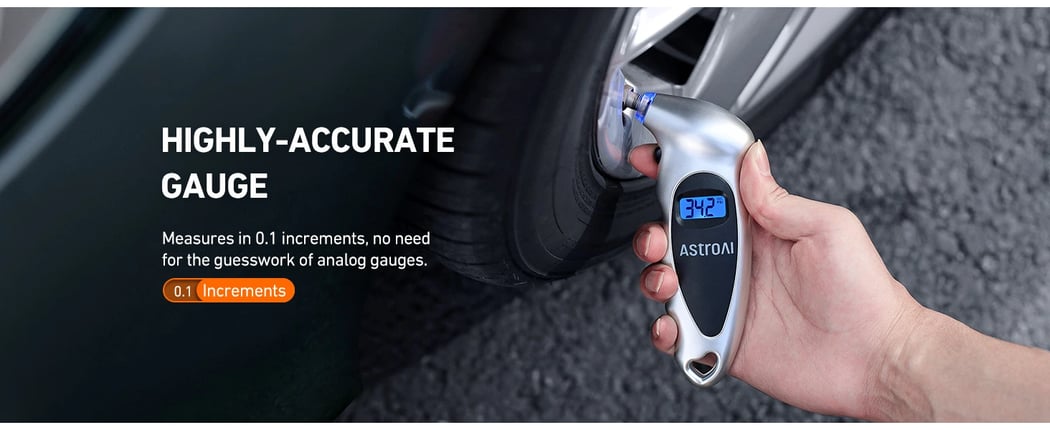
For most everyday drivers, the AstroAI Digital Tire Air Pressure Gauge 150 PSI, Silver is the best fit among these three options. Its backlit LCD, four selectable settings, 0.1 display increments, stated measurement error of ±1 PSI, compact handheld shape, and 0-150 PSI range make routine cold-tire checks easy to read and repeat. Drivers who already own an air compressor should consider the AstroAI 250PSI-M Digital Tire Inflator Gauge for measuring, inflating, and releasing air from one tool. The AstroAI 10-75 PSI Pencil Gauge 5-Pack is the battery-free backup choice.
Quick Answer: Which Tire Pressure Gauge Should You Choose?
- Choose the silver 150 PSI digital gauge for the clearest, simplest pressure checks at home, in a parking space, or beside the road.
- Choose the 250PSI-M inflator gauge if you already have an air compressor and want to measure, add air, and bleed excess pressure without changing tools.
- Choose the 10-75 PSI pencil 5-pack if you want inexpensive battery-free gauges to keep in several vehicles, toolboxes, or family emergency kits.
The correct gauge is the one that helps you get a repeatable seal and an easy-to-read number. A high maximum PSI is not automatically better. Everyday drivers should prioritize a suitable range, a clear display or scale, a stated measurement tolerance, a shape that is easy to hold squarely on the valve, and a power arrangement that matches where the gauge will be stored.
Before You Measure: Use the Vehicle's Cold-Pressure Specification
Find the recommended cold tire pressure on the vehicle's tire-information placard or in the owner's manual. Do not use the maximum pressure molded into the tire sidewall as the routine target. Front and rear specifications may differ, and a temporary or full-size spare may have its own target.
For a cold reading, check before driving or after the vehicle has been parked for at least three hours. If a tire is visibly damaged, bulging, rapidly losing air, unusually hot, or unable to hold pressure, stop treating it as a simple adjustment problem and have the tire inspected.
How We Match the Gauge to the Driver
Six Features That Matter More Than the Largest Number on the Box
1. Readability and Backlighting
A backlit digital display is useful in a garage, at night, or when the valve is shaded by the wheel. Pencil scales need more light and closer viewing. Mechanical dials can be easy to scan when the face is large, but glow markings and backlights vary by model.
2. Range That Matches the Vehicle
Passenger cars and many light vehicles operate far below 150 PSI, so a 150 PSI handheld gauge provides ample range for ordinary use. A 250 PSI inflator gauge makes sense for higher-pressure applications and compressor work. A 10-75 PSI pencil gauge is appropriate only when every tire you plan to check falls within that range.
3. Resolution Versus Measurement Error
Resolution is the smallest displayed step; error or tolerance describes how far the result may differ from the actual pressure. A gauge that displays 0.1 PSI is not automatically accurate to ±0.1 PSI. The silver digital gauge displays 0.1 increments and has a stated ±1 PSI measurement error.
4. Bleed Valve or Air-Release Control
A bleed control is most useful when the gauge is also connected to an air supply. The 250PSI-M lets the user inflate and release air from the same tool. The silver handheld gauge and the pencil gauge are primarily measuring tools and do not provide the same integrated inflate-and-bleed workflow.
5. Grip and Valve Alignment
A contoured handheld gauge offers a natural grip for quick checks. A pistol-grip inflator gives the user separate trigger and release controls but adds a hose and air connection. A pencil gauge is compact, although its slim body and pop-out indicator can be less convenient in low light or tight wheel openings.
6. Battery Dependence and Storage
Digital gauges need working batteries; test the display periodically if the gauge lives in the vehicle. Pencil and mechanical gauges are battery-free, making them useful backups. Store every gauge clean and dry, with the chuck protected from grit that could interfere with the seal.
AstroAI Recommendations
Three Different Tools for Three Different Tire-Care Routines
These are use-case alternatives, not a simple ranking by maximum PSI. The handheld digital gauge is the best everyday-driver fit, the inflator gauge is the workshop option, and the pencil set is the distributed backup.
BEST FIT FOR EVERYDAY DRIVERS
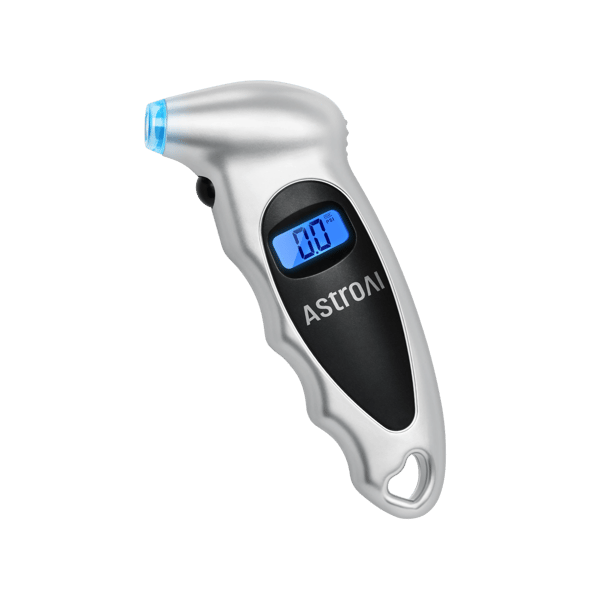
AstroAI Digital Tire Air Pressure Gauge 150 PSI, Silver
Verified summary: A compact 0-150 PSI handheld digital gauge with four selectable settings, a backlit LCD, 0.1 display increments, replaceable coin-cell power, and a stated measurement error of ±1 PSI.
Best for: Commuters, family vehicles, road-trip kits, nighttime checks, and drivers who want a direct number instead of interpreting an analog scale.
Not best for: Users who want to add and bleed air through the same tool or who need a battery-free gauge.
- Backlit LCD improves low-light reading clarity.
- 0-150 PSI range covers common passenger and light-vehicle checks.
- Four settings make it easier to match the unit shown on the vehicle label.
- Compact handheld form suits glove-box or center-console storage.
Pros: Clear digital result, backlighting, simple one-tool check, and a stated error range.
Cons: Requires working batteries and does not combine measurement with compressor inflation.
Practical note: Press the nozzle squarely onto the valve and hold the seal long enough for the reading to stabilize. A hiss usually means the gauge is angled or not fully seated.
View Silver Digital Gauge
BEST FOR A HOME AIR COMPRESSOR
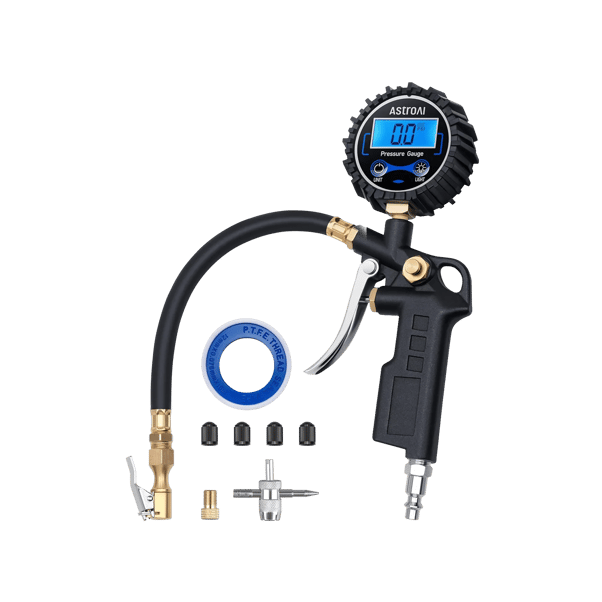
AstroAI 250PSI-M Digital Tire Inflator Gauge
Verified summary: A 3-in-1 digital tire inflator gauge with a 3-250 PSI range, 0.1 display resolution, 2 AAA batteries, a quick-connect coupler, inflation trigger, air-release control, and a stated measurement error of ±1.5 PSI.
Best for: Garage users who already own a compatible air compressor and want to measure, add air, and bleed pressure without removing the chuck between adjustments.
Not best for: A glove-box-only solution, drivers without an air source, or someone who wants the smallest possible gauge for quick parking-lot checks.
- Trigger-style inflation and a separate release control support fine adjustments.
- Quick-connect format integrates with a compatible compressor hose.
- 0.1 display resolution makes small changes easy to see.
- Higher range supports applications beyond ordinary passenger-car pressure.
Pros: Measures, inflates, and deflates with one connected tool.
Cons: Requires an air compressor, takes more storage space, and has a wider stated error range than the handheld gauge.
Practical note: Release the inflation trigger before judging the final pressure. Airflow can make the displayed number change while the tire is actively filling.
View 250PSI-M Inflator Gauge

BEST BATTERY-FREE MULTI-VEHICLE BACKUP
AstroAI 10-75 PSI Pencil Stick Tire Pressure Gauge, 5-Pack
Verified summary: Five analog pencil gauges with a 10-75 PSI measuring range, stainless-steel and metal construction, a four-sided pop-out indicator bar, no batteries, and a stated measurement error of ±1 PSI.
Best for: Placing a simple gauge in several cars, toolboxes, family kits, or workshop drawers without maintaining batteries.
Not best for: Low-light checks, drivers who prefer a large direct display, or any application outside the 10-75 PSI range.
- Battery-free design is ready after long storage.
- Slim body takes little space in a vehicle kit.
- Five-pack format makes it easy to distribute gauges across vehicles.
- Pop-out indicator retains the measured position for reading.
Pros: Simple, compact, battery-free, and useful as a redundant backup.
Cons: No backlight, no digital readout, no integrated bleed control, and a lower maximum range.
Practical note: Read the correct face of the four-sided indicator bar and reset the stick fully before taking the next measurement.
View Pencil Gauge 5-Pack
Digital, Pencil, and Mechanical Tire Gauge Comparison
Digital, pencil, and mechanical dial gauges can all be useful. The best type depends on whether you value low-light readability, battery-free storage, a bleed valve, or integration with an air compressor.
| Gauge Type |
Reading Clarity |
Power |
Air Adjustment |
Grip and Storage |
Best Fit |
| Handheld digital |
Direct numeric display; backlight available on the silver model |
Battery powered |
Primarily measures; no integrated compressor workflow |
Contoured hand grip; compact vehicle storage |
Most everyday drivers |
| Digital inflator gauge |
Direct numeric display; pressure changes are visible during adjustment |
Battery powered plus external compressed air |
Inflates and releases air from one connected tool |
Pistol grip and hose; larger storage footprint |
Home garages with compressors |
| Pencil gauge |
Pop-out printed scale; needs adequate light and correct face |
Battery free |
Measures only; no dedicated bleed button |
Very slim and easy to distribute across vehicles |
Low-cost backup and multi-vehicle kits |
| Mechanical dial gauge |
Analog needle; clarity depends on dial size, markings, and lighting |
Battery free |
Some models include a hold or bleed valve; verify before buying |
Often larger than pencil gauges; hose styles can improve access |
Drivers who prefer an analog dial |
Accuracy note: Do not assume that all gauges of one type share the same tolerance. Check the specification for the exact model and use repeatability, correct valve alignment, and battery condition as part of your evaluation.
Verified Product Differences at a Glance
| Feature |
Silver Digital Gauge |
250PSI-M Inflator Gauge |
Pencil Gauge 5-Pack |
| Range |
0-150 PSI |
3-250 PSI |
10-75 PSI |
| Stated measurement error |
±1 PSI |
±1.5 PSI |
±1 PSI |
| Display or scale |
Backlit LCD, 0.1 increments |
Digital display, 0.1 resolution |
Four-sided pop-out indicator bar |
| Power |
Replaceable lithium coin cells |
2 AAA batteries plus compressor air source |
No battery |
| Integrated inflate and bleed |
No |
Yes |
No |
| Primary role |
Portable everyday pressure check |
Workshop measurement and adjustment |
Battery-free backup |
Step-by-Step Procedure
How to Check Tire Pressure with a Digital Gauge
The same basic process applies to a pencil or mechanical gauge, but the readout and reset method differ. Use the instructions for your exact gauge when selecting units, changing batteries, or operating an inflator trigger and bleed control.
-
Find the vehicle's recommended cold tire pressure.
Read the tire-information placard or owner's manual and note whether the front, rear, and spare tires use different pressure targets.
-
Check the tires when they are cold.
Measure before driving or after the vehicle has been parked for at least three hours so heat from driving does not inflate the reading.
-
Inspect the tire and valve stem.
Look for cuts, bulges, embedded objects, cracking, or obvious air loss. Remove the valve cap and keep it in a clean place.
-
Turn on the gauge and select the correct unit.
Choose PSI, kPa, bar, or the unit shown on the vehicle information label. Confirm that the display is clear and the battery indicator does not suggest weak power.
-
Align the nozzle squarely with the valve.
Support the gauge and place the chuck straight onto the valve stem. An angled approach can leak air and create an unstable reading.
-
Press firmly until the reading stabilizes.
Maintain a complete seal for about two seconds. A short initial hiss can occur, but continued hissing usually means the nozzle needs to be reseated.
-
Record the result and repeat once if needed.
If the first result seems unusual, remove the gauge, let it reset, and repeat with a fresh straight seal. Large variation between attempts usually points to technique, valve access, or a gauge condition that needs attention.
-
Add or release air to match the placard.
Use an inflator when pressure is low. If pressure is high, use an appropriate bleed control or gently release air at the valve, then measure again. With an inflator gauge, release the trigger before judging the final number.
-
Recheck every tire, including the spare when accessible.
Do not assume all four tires use the same target. Follow separate front, rear, and spare specifications when the vehicle provides them.
-
Replace the valve caps and store the gauge.
Tighten each cap by hand, wipe the gauge nozzle clean, and store the tool where it will stay dry and protected from dirt or impact.
How to Get More Consistent Readings
Use the Same Conditions
Compare cold readings at a similar time of day and before driving. Pressure changes with tire temperature, so comparing a cold morning reading with a hot post-highway reading can make a healthy tire look inconsistent.
Use One Gauge for Trend Tracking
Two gauges can differ within their stated tolerances. For monthly trend tracking, use the same gauge and the same technique. If one tire repeatedly loses more pressure than the others, inspect the tire and valve rather than averaging away the pattern.
Protect the Valve Seal
Dirt on the chuck or an angled connection causes leaks and unstable numbers. Push straight, avoid side-loading a flexible rubber stem, and stop pressing once a stable measurement appears.
Watch the Digital Gauge Battery
A blank, flashing, or weak display may indicate depleted batteries. Replace them before using the gauge as the basis for a pressure adjustment. Keep a pencil gauge as a battery-free backup if the digital gauge stays in the vehicle for long periods.
A TPMS Warning Does Not Replace a Manual Pressure Check
A tire-pressure monitoring system warns when the system detects a significant problem, but it does not replace monthly checks with a gauge. When the warning light appears, inspect the tires and measure each tire as soon as practical. Inflate to the vehicle manufacturer's recommended cold pressure, not the maximum pressure on the tire sidewall.
If the warning returns, one tire continues to lose air, or the light flashes before remaining on, have the tire, valve, wheel, and monitoring system inspected. Do not repeatedly add air without investigating a persistent leak.
Common Tire-Gauge Mistakes
- Using the tire sidewall number as the target: Use the vehicle placard or owner's manual instead.
- Checking immediately after driving: Tire heat raises pressure and makes the reading unsuitable for a cold-pressure adjustment.
- Holding the gauge at an angle: Air leakage can reduce the displayed pressure and make the result unstable.
- Confusing 0.1 resolution with ±0.1 accuracy: Always separate display increments from the stated measurement error.
- Ignoring the spare: A spare can lose pressure even when it is rarely used.
- Reading an inflator gauge during active airflow: Release the trigger and let the reading settle.
- Assuming front and rear targets match: Some vehicles specify different pressures by axle.
- Trusting one unusual reading: Reseat the gauge and repeat before making a large adjustment.
Final Recommendation
Choose the AstroAI Silver 150 PSI Digital Tire Gauge if you want a compact, readable tool for monthly checks and roadside confirmation. Its backlit display, four settings, broad everyday range, and ±1 PSI stated error directly address the needs of ordinary drivers.
Choose the AstroAI 250PSI-M Digital Tire Inflator Gauge if tire maintenance happens beside a compatible home air compressor. The trigger and air-release control reduce tool switching while you bring each tire to its target, but the system is less portable.
Choose the AstroAI 10-75 PSI Pencil Gauge 5-Pack when battery-free availability and multi-vehicle distribution matter more than a backlit display. Many households will be best served by a digital gauge for routine checks plus one pencil gauge as a long-storage backup.
Frequently Asked Questions
Digital Tire Pressure Gauge Questions
What is the best digital tire pressure gauge for everyday drivers?
The AstroAI Digital Tire Air Pressure Gauge 150 PSI, Silver is the best fit among these three choices for most everyday drivers. It combines a backlit LCD, four selectable settings, 0.1 display increments, a 0-150 PSI range, compact handheld storage, and a stated measurement error of ±1 PSI.
Is a digital tire gauge better than a pencil gauge?
A digital gauge is usually easier to read, especially when it has a backlight. A pencil gauge is smaller, battery-free, and useful for long-term backup storage. The better choice depends on whether display clarity or battery independence matters more.
Is a digital tire gauge better than a mechanical dial gauge?
Digital gauges provide a direct number and can be easier to read in low light. Mechanical dial gauges need no batteries and may include a pressure-hold or bleed feature, depending on the model. Compare the exact range, stated tolerance, dial size, lighting, and valve-chuck design rather than choosing by type alone.
Does a 0.1 PSI display mean the gauge is accurate to 0.1 PSI?
No. A 0.1 PSI display increment describes resolution, not total measurement accuracy. The silver AstroAI digital gauge displays 0.1 increments but has a stated measurement error of ±1 PSI. The 250PSI-M displays 0.1 increments and has a stated error of ±1.5 PSI.
When should I check tire pressure?
Check at least once a month, before long trips, after a major temperature change, and whenever a TPMS warning appears. Measure when the tires are cold, meaning before driving or after the vehicle has been parked for at least three hours.
Should I inflate to the PSI printed on the tire sidewall?
No. Use the vehicle manufacturer's recommended cold pressure shown on the tire-information placard or in the owner's manual. The tire-sidewall number is not the normal inflation target for the vehicle.
What should I do when the TPMS light comes on?
Inspect the tires and measure each one as soon as practical. Add air to the vehicle manufacturer's recommended cold pressure, then monitor the tire. If the warning returns, pressure keeps dropping, or the light flashes before staying on, arrange an inspection of the tire, valve, wheel, and monitoring system.
Why does air leak when I press the gauge onto the valve?
A short hiss can occur as the nozzle seats. Continued leaking usually means the chuck is angled or not fully pressed onto the valve. Remove it, align it straight, and press firmly for about two seconds until the result stabilizes.
Can I adjust tire pressure when the tires are warm?
A warm reading is higher than the cold reading because driving heats the tire. If a tire is clearly underinflated, add enough air for safe travel, then recheck and make the final adjustment when the tires are cold. Do not bleed a warm tire down to the cold placard number and assume the job is finished.
Does the 250PSI-M digital inflator gauge need an air compressor?
Yes, its integrated inflation function requires a compatible compressed-air source. The gauge can display pressure using its batteries, but the trigger cannot add air without a connected compressor. It is a garage tool rather than a complete portable inflator.
Match the Gauge to Where You Will Use It
Choose the silver digital gauge for everyday vehicle checks, the 250PSI-M for a compressor-equipped garage, or the pencil five-pack for battery-free backups.