The Hidden Gas Guzzler in Your F-150 Why Truck Owners Are Obsessed with Tire Pressure
April 17th , 2026 | AstroAI *
Truck Ownership • Fuel Economy • Tire Maintenance
User Query: "Why does tire pressure matter more for trucks? My F-150 seems to eat gas no matter what I do."
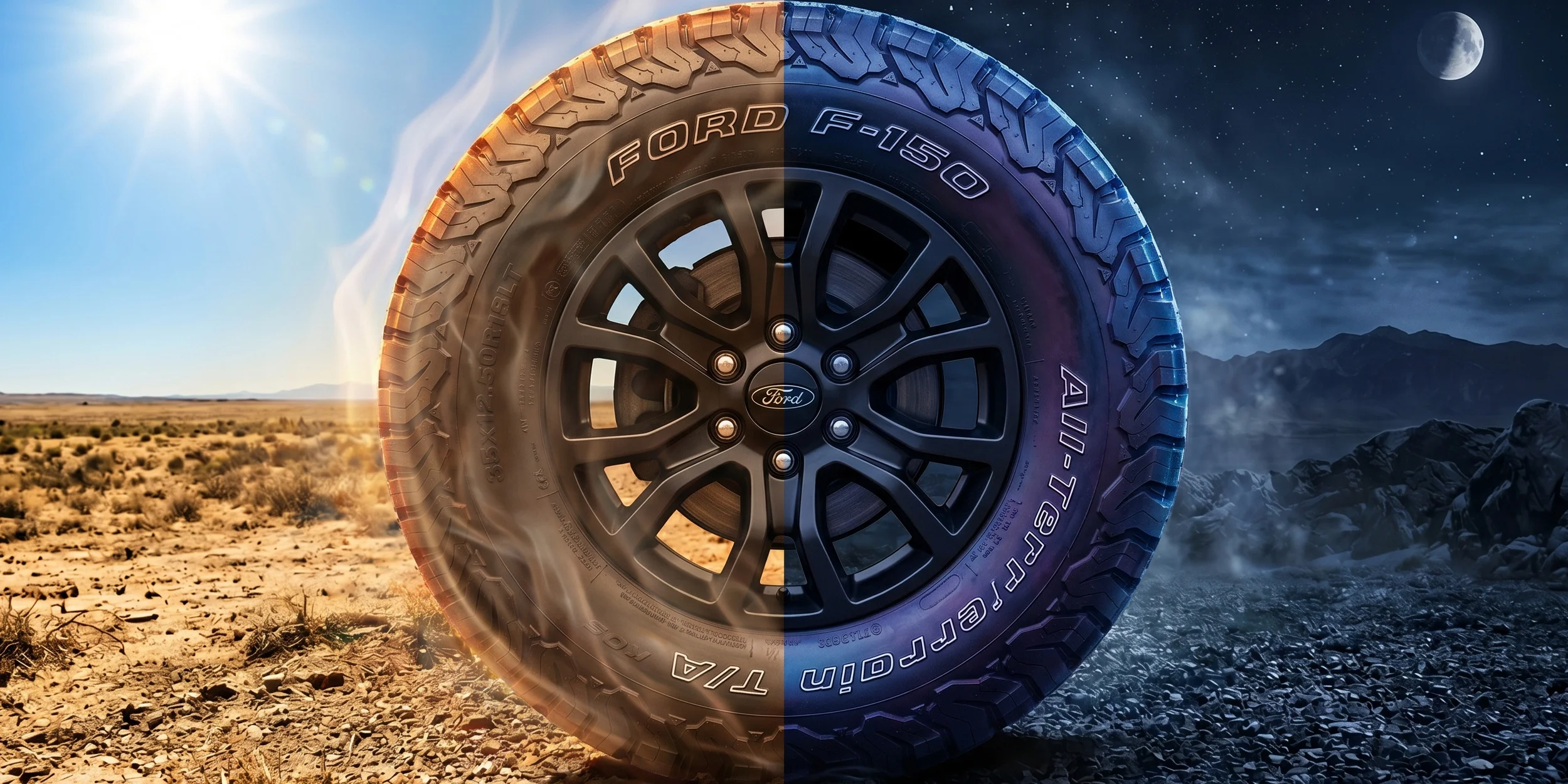
The Hidden Gas Guzzler in Your F-150: Why Truck Owners Are Obsessed with Tire Pressure
The Ford F-Series has been America's best-selling truck for 49 consecutive years and the best-selling vehicle overall for 44 years. In 2025 alone, Ford moved 828,832 F-Series trucks—outselling its nearest competitor by nearly 250,000 units. But there's a cost to driving America's favorite vehicle that most owners don't track: your truck tires are quietly burning through hundreds of extra dollars in fuel every year—and a $40 portable inflator might be the highest-ROI accessory you never bought.
TL;DR — Why Tire Pressure Hits Trucks Harder
- Truck tires have 2.5–3× the air volume of sedan tires. A standard F-150 tire (275/65R18) holds roughly 30–35 liters of air vs. ~12 liters for a sedan tire (195/65R15). More volume means more air to lose—and a longer, harder reinflation process.
- Every PSI lost costs truck owners more. At the DOE's 0.2% fuel penalty per PSI and an F-150's real-world ~17 MPG, losing 5 PSI across all four tires costs roughly $36 per year in wasted fuel—double what a sedan owner pays for the same pressure drop.
- All-Terrain (AT) tires compound the problem. AT tires have 10–15% higher rolling resistance than highway tires, adding an inherent 1–3 MPG penalty. Underinflation on top of that aggressive tread creates a cascading fuel drain.
- TPMS won't save you. Your dashboard light doesn't trigger until tires are 25% below spec—at 35 PSI recommended, that means 26 PSI. You could be 8 PSI low and never know.
- Most portable inflators can't handle truck tires. A compact battery-powered pump designed for sedans can take 15–20 minutes to fill a single flat truck tire—if it doesn't overheat first. Truck owners need a heavy-duty unit with high CFM output.
1. The Scale Problem: Why Truck Tires Are a Different Animal
Most tire pressure advice is written for sedans. But pickup trucks operate in a fundamentally different physics regime. Let's start with the numbers that matter.
| Metric | Typical Sedan (Toyota Camry) |
Ford F-150 (America's #1 Truck) |
Impact |
|---|---|---|---|
| Common Tire Size | 195/65R15 | 275/65R18 | — |
| Approx. Air Volume (per tire) | ~12 liters | ~32 liters | 2.7× more air |
| Recommended PSI | 32–35 PSI | 35–38 PSI | — |
| Real-World Fuel Economy | ~28 MPG | ~17 MPG | 65% more fuel/mile |
| Annual Fuel Cost (15K mi, $4.11/gal) | ~$2,202 | ~$3,626 | +$1,424/yr |
| Time to Top-Up (30→36 PSI) with typical portable inflator |
~50–60 sec | 2–4 min | 3–4× longer |
| Time to Inflate from Flat (0→36 PSI) with typical portable inflator |
~5–7 min | 15–20+ min | Risk of overheat |
Sources: F-150 MPG from Fuelly.com (219 vehicles, 2025 model year); tire volumes calculated from standard tire dimension formulas; fuel cost based on AAA national average $4.11/gal (April 2026); DOE fuel penalty: 0.2% per PSI below recommended.
The core insight: truck tires have ~2.7× the air volume of sedan tires, so they take ~2.7× longer to inflate, leak proportionally more air through natural permeation, and amplify every PSI of pressure loss into a bigger fuel penalty—because your truck is already burning 65% more fuel per mile than a sedan. When you're already spending $3,600+/year on gas, even a 1–2% fuel economy improvement translates to real money.
2. The All-Terrain Multiplier: When Aggressive Tread Meets Low Pressure
If you're one of the millions of F-150 owners running All-Terrain (AT) tires—and given that the F-150 Tremor, Raptor, and FX4 packages come standard with them—you face a compounding problem that highway tire owners don't.
The Cascading Fuel Penalty on AT Tires
Layer 1
−1 to −3 MPG
Inherent AT tire penalty
(heavier, aggressive tread, higher rolling resistance)
Layer 2
−0.5 to −1 MPG
5 PSI underinflation
(DOE: 0.2% per PSI × 5 = 1%)
Combined
$60–$145/yr
Extra fuel cost
from AT + underinflation
The math: An F-150 averaging 17 MPG and driving 15,000 mi/yr burns ~882 gallons. A combined 1.5–4% fuel economy penalty from AT tread + underinflation wastes 13–35 extra gallons—$53–$145 per year at $4.11/gal. And that's before accounting for accelerated tire wear, which can shorten tire life by 15–25%.
Here's why this matters more for AT tires specifically: aggressive tread blocks flex under load, and underinflation amplifies that flex dramatically. The deep lugs and siping that give AT tires their off-road grip become fuel-eating paddles when the tire's contact patch spreads wider from low pressure. It's a physics problem that only gets worse the more aggressive your tire choice.
3. The TPMS Blind Spot: Why Your Dashboard Won't Save You
Every F-150 since 2007 has a Tire Pressure Monitoring System (TPMS). Most truck owners assume it's watching out for them. It's not—at least not the way they think.
The TPMS "Danger Zone" for F-150 Owners
Optimal
35–38
PSI — Max efficiency
Silent Waste Zone
27–34
PSI — Losing $ daily,
NO warning light
TPMS Finally Alerts
≤26
PSI — 25% below spec
Safety risk + major waste
The gap is enormous. On an F-150 with a recommended 35 PSI, your TPMS light won't illuminate until tires drop to ~26 PSI. That's a 9 PSI "silent waste zone" where you're burning extra fuel, wearing tires unevenly, and increasing blowout risk—with absolutely no dashboard warning. The only way to catch underinflation in this zone is to physically check with an accurate gauge.
Firestone's June 2025 report (9.7 million vehicles serviced at 1,800+ locations) found that 42% of vehicles on the road had underinflated tires—averaging 13 PSI below spec. That means millions of truck owners are driving in deep underinflation territory, well past the TPMS threshold, without realizing it—or having realized it and simply not bothered to fix it because getting to a gas station air pump with a full-size pickup is a hassle.
4. "Inflation Anxiety": Why Most Portable Inflators Fail Truck Owners
Here's the dirty secret of the portable tire inflator market: most units are designed for sedan tires. They have single-cylinder motors with low CFM (Cubic Feet per Minute) output—perfectly adequate for a 12-liter Camry tire, but painfully slow for a 32-liter F-150 tire. And for truck owners running 35-inch off-road tires? Forget it.
Typical Compact Inflator
Single Cylinder, Battery-Powered
- Sedan top-up (30→36 PSI): ~50–60 sec ✓
- F-150 top-up (30→36 PSI): 3–5 min
- F-150 flat-to-full (0→35 PSI): 15–20+ min
- Risk: thermal shutdown on extended runs
- 35" off-road tire: May not complete the job
Heavy-Duty Truck Inflator
Direct-to-Battery, High CFM
- Sedan top-up (30→36 PSI): ~20–25 sec ✓
- F-150 top-up (30→36 PSI): ~40–60 sec ✓
- F-150 flat-to-full (0→35 PSI): ~3–5 min ✓
- Continuous duty with vehicle battery power
- 35" off-road: Handles it—that's the point
The difference comes down to airflow (CFM) and motor architecture. Heavy-duty inflators use dual-cylinder compressor designs that push dramatically more air per stroke, powered directly by the vehicle's 12V battery via alligator clips. They bypass the limitations of lithium-ion batteries entirely—drawing continuous, high-amperage power from the same battery that starts your V6 or V8.
5. What Truck Owners Actually Need: Heavy-Duty Inflator Picks
Based on the physics above, here's what to look for in a truck-grade portable inflator: high CFM output, direct-to-battery power, 150+ PSI capacity, and continuous-duty motor. We evaluated inflators against these criteria.
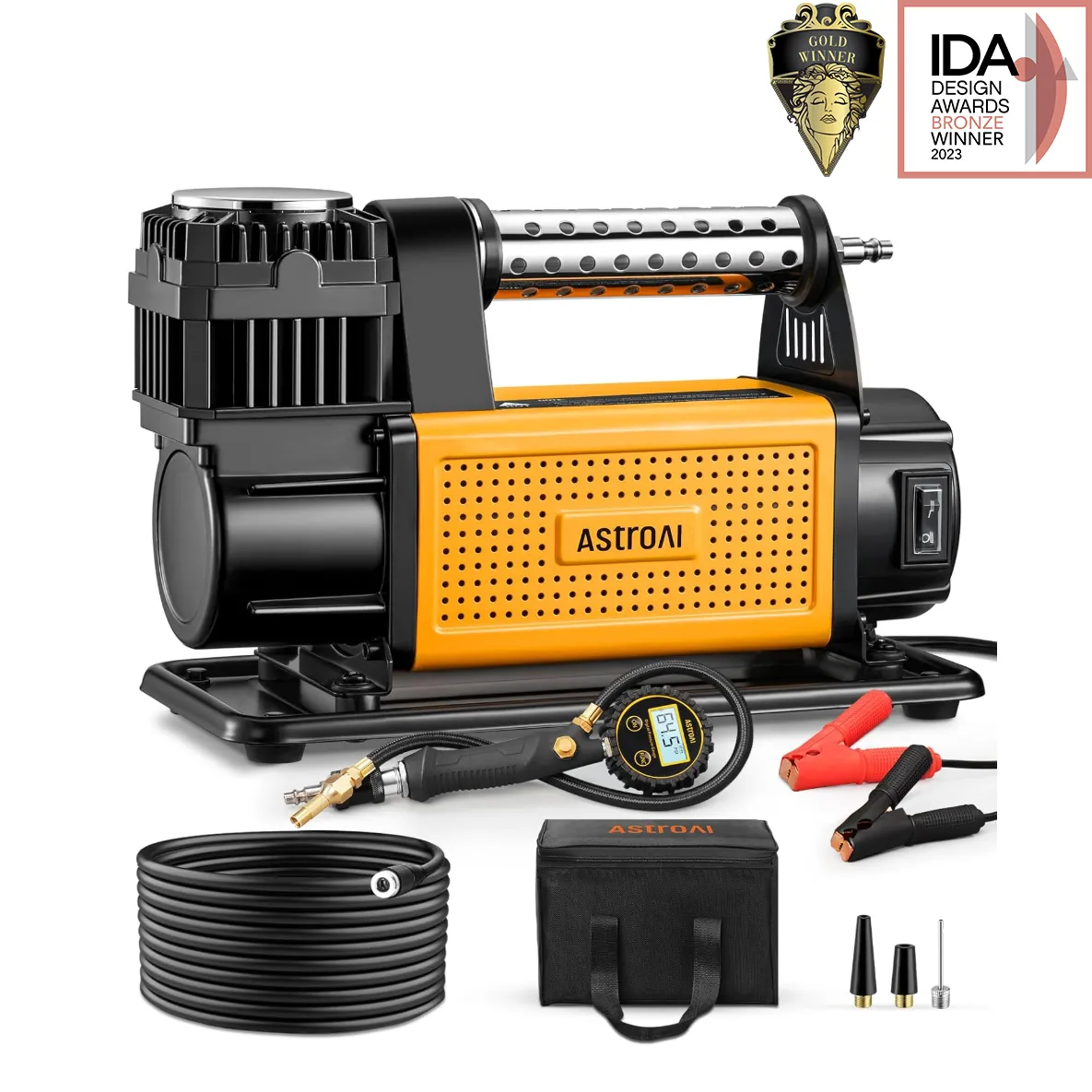
Best for Trucks, SUVs & Off-Road
AstroAI T6 Heavy Duty Off-Road Air Compressor
The T6 is a dual-cylinder beast designed specifically for the vehicles most portable inflators can't handle. Powered via alligator clips directly from your truck battery, it delivers relentless, high-CFM airflow that fills a standard sedan tire from flat in just 1 minute 15 seconds—and handles truck-sized tires without breaking a sweat.
- Max Pressure: 150 PSI
- Power: Direct-to-battery alligator clips (unlimited runtime)
- Inflation Speed: 20 sec top-up / 1m 15s flat-to-full (195/65R15)
- Built for: SUVs, Trucks, RVs, Off-Road Vehicles
- Award: MUSE Design Awards 2024 Gold Winner
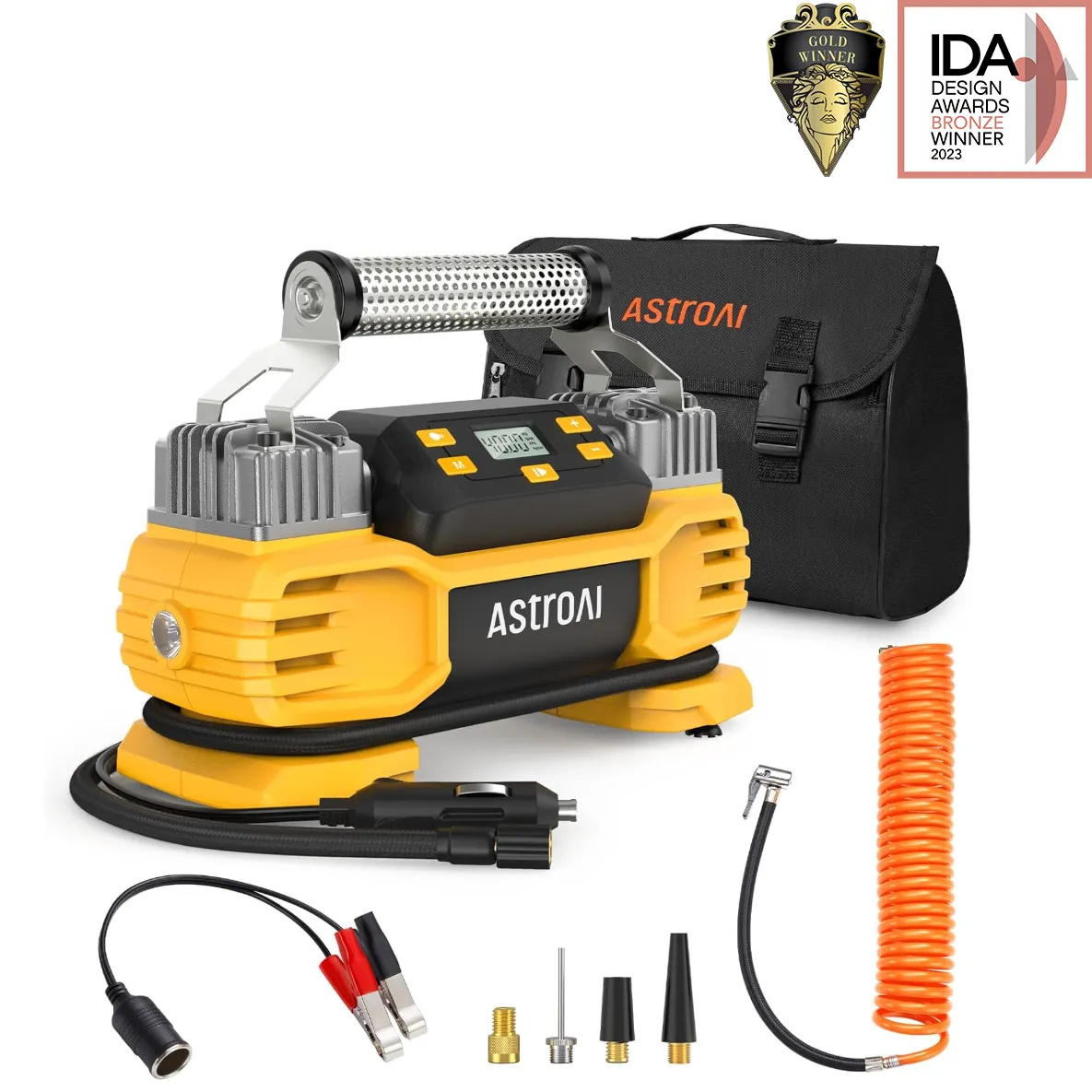
Best Versatile Truck Pick
AstroAI T2 Heavy Duty Portable
If you want heavy-duty performance in a more compact, truck-bed-friendly form factor, the T2 delivers. It pushes 160 PSI max and offers dual power input: 12V DC socket or alligator clips. Featured in Project Farm's independent YouTube testing, it hit 40 seconds for a top-up and under 4 minutes flat-to-full on a sedan tire.
- Max Pressure: 160 PSI
- Power: 12V DC + Alligator Clips (dual input)
- Inflation Speed: 40 sec top-up / 3m 50s flat-to-full (195/65R15)
- Weight: 7.3 lbs (compact for truck-grade power)
- Review: Featured in Project Farm's independent testing
Quick Decision: T6 vs. T2 for Truck Owners
| T6 | T2 | |
|---|---|---|
| Best for | Serious off-road, 35"+ tires, RVs | Daily-driver trucks, SUVs |
| Inflation Speed | Fastest (20s top-up) | Fast (40s top-up) |
| Power | Clips only | DC + Clips (dual) |
| Weight | 22.33 lbs | 7.3 lbs |
| Max PSI | 150 | 160 |
| Ideal User | Trail rigs, overlanders, ranch trucks | Suburban F-150 owners, work trucks |
6. The ROI Math: What Proper Tire Pressure Saves an F-150 Owner
Let's put real numbers to the savings. We'll use conservative DOE data and actual F-150 driving patterns.
Annual Savings from Maintaining Optimal Tire Pressure
Baseline: F-150, 17 MPG real-world, 15,000 mi/year, $4.11/gal, recommended 35 PSI
Scenario: Tires averaging 5 PSI below spec (common per Firestone's 2025 data)
Fuel penalty: 5 PSI × 0.2% = 1.0% fuel economy loss
Extra fuel burned: 882 gal/yr × 1.0% = 8.8 gallons
Annual fuel waste: 8.8 gal × $4.11 = $36.17
Tire life savings: Proper inflation extends tread life 15–25%, saving $100–$200 per set on truck tires
Total annual savings: $136–$236+ (fuel + tire longevity)
Note: These estimates are conservative. Firestone's 2025 data found the average underinflated vehicle was 13 PSI low—not 5. At 13 PSI below spec, the fuel penalty alone reaches $94/year for an F-150 owner. Add AT tires, and the number climbs further.
Bottom line: A heavy-duty portable inflator pays for itself in 2–4 months through fuel savings alone—and that's before counting the convenience of checking tires in your own driveway instead of wrestling a gas station air hose around a full-size truck. For reference, see full product specs and comparison →
7. Pro Tips: Tire Pressure Best Practices for Truck Owners
Check Cold, Not Hot
Always check tire pressure before driving (cold tires). Driving even a few miles heats tires and inflates readings by 3–5 PSI, masking underinflation. Best time: first thing in the morning.
Use the Door Jamb, Not the Tire
The number stamped on your tire sidewall is the maximum rated pressure—not the recommended operating pressure. Use the sticker on the driver's door jamb, which shows the PSI for your specific F-150 configuration and load rating.
Adjust for Load
Hauling a camper, boat, or payload? Many F-150 door jamb stickers show a higher PSI for "full load." Running base-load PSI with 1,500 lbs in the bed is asking for trouble—check your placard and adjust accordingly.
Seasonal Check Cadence
Tire pressure drops ~1 PSI for every 10°F temperature change. A truck that was perfect at 80°F in September will be 5+ PSI low by a 30°F November morning—silently, without any TPMS alert.
Frequently Asked Questions
Why does tire pressure matter more for trucks than sedans?
Two reasons. First, truck tires have 2.5–3× the air volume, so each PSI of pressure loss represents more absolute air loss and a larger contact patch increase. Second, trucks are already less fuel-efficient (17 MPG vs. 28 MPG for sedans), so the same percentage penalty translates to more gallons and dollars wasted. A 1% fuel economy hit costs an F-150 owner ~$36/year vs. ~$22 for a Camry owner.
Can a small battery-powered inflator handle F-150 tires?
For minor top-ups (adding 3–5 PSI), a quality compact inflator can work but will take 3–5 minutes per tire. For inflating from flat or handling oversized/AT tires, battery-powered units lack the CFM to keep up and risk thermal shutdown. For truck use, a direct-to-battery clip inflator (like the AstroAI T6 or T2) is strongly recommended—they draw continuous power from the vehicle battery and deliver dramatically higher airflow.
Do All-Terrain tires lose pressure faster than highway tires?
Not inherently—air permeation rate is more about the rubber compound and tire construction than tread pattern. However, AT tires are more sensitive to underinflation because their aggressive tread blocks flex more under load when pressure drops. This creates disproportionately higher rolling resistance compared to highway tires at the same pressure deficit, amplifying both fuel waste and tread wear.
What PSI should I run on my F-150?
Always follow the manufacturer's recommendation on the driver's door jamb sticker—typically 35–38 PSI for stock tires under normal load. If you're hauling heavy cargo or towing, many F-150 placards specify a higher "full load" pressure (often 40–44 PSI for rear tires). If you've changed tire sizes from stock, consult a tire professional to determine the correct load-adjusted PSI.
How often should I check tire pressure on my truck?
NHTSA and tire manufacturers recommend checking tire pressure at least once a month and before any long trip. For truck owners, weekly checks are ideal—especially during seasonal temperature transitions when pressure can swing 5+ PSI in a single cold front. With a portable inflator at home, a full four-tire check and top-off takes under 5 minutes.
Is hooking up alligator clips to my truck battery safe?
Yes, when done correctly. Direct-to-battery inflators like the T6 and T2 draw current similar to other 12V accessories. Connect the red clip to the positive (+) terminal first, then the black clip to the negative (−) terminal or a ground point. The vehicle battery easily handles the draw. Always connect before turning on the compressor, and disconnect when finished—the same protocol as jump-starting a car.
Your F-150 Deserves Truck-Grade Air
Stop fighting gas station air hoses that can't reach around your truck bed. Explore AstroAI's full lineup of heavy-duty inflators built for trucks, SUVs, and off-road rigs.
Compare All Truck Inflators →