Fact Check Does Driving with Low Tire Pressure Really Burn More Gas
April 17th , 2026 | AstroAI *
Fact Check • Automotive Science
Claim Under Review: "Driving with low tire pressure burns more gas."
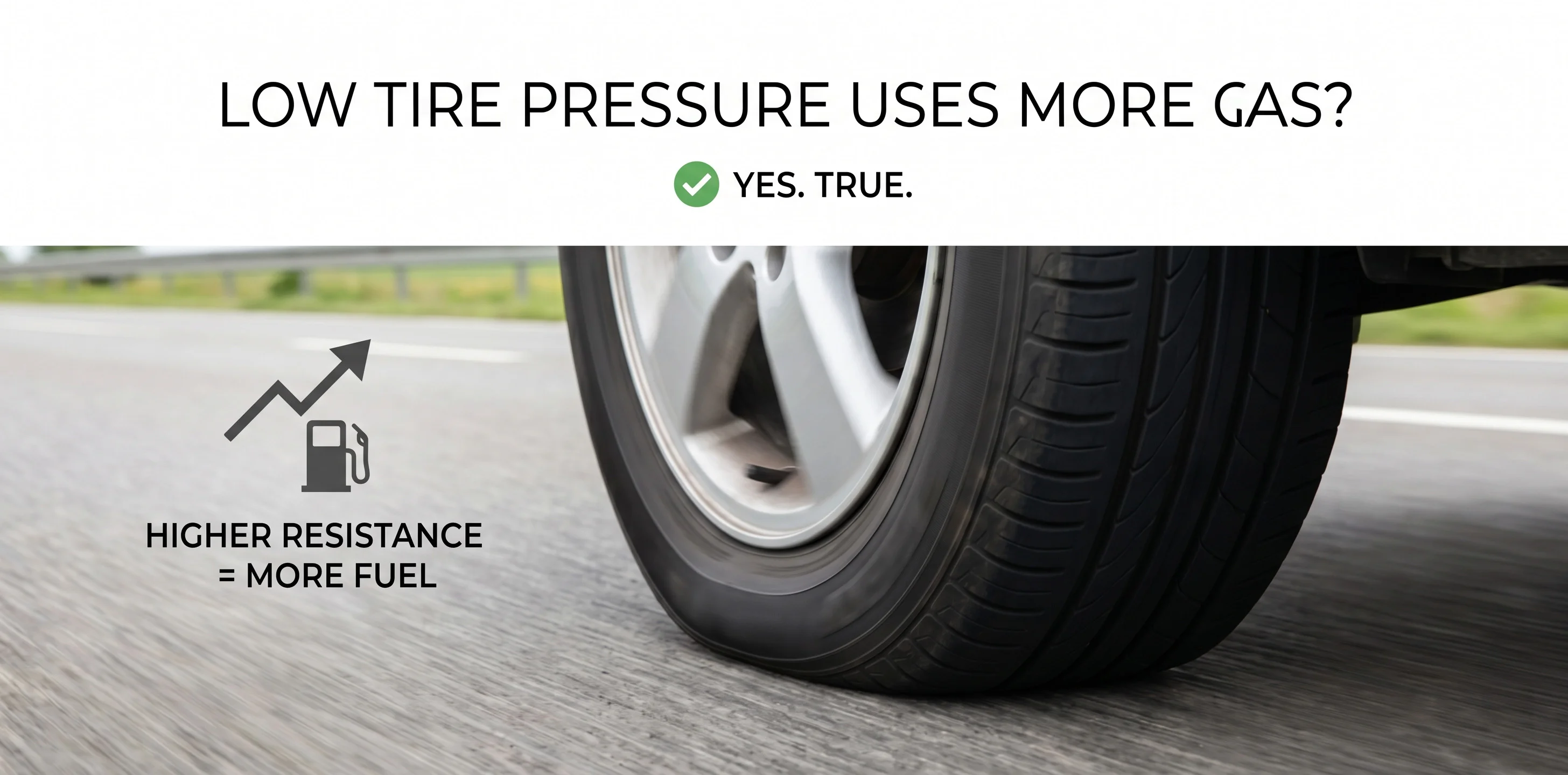
Fact Check: Does Driving with Low Tire Pressure Really Burn More Gas?
You've probably heard it from your mechanic, your dad, or a dashboard warning: "Low tire pressure wastes gas." But is that actually true, or just one of those car-care myths that never dies? We went straight to the source—the U.S. Environmental Protection Agency (EPA), the National Highway Traffic Safety Administration (NHTSA), and the Department of Energy (DOE)—to fact-check this claim with physics and data.
Yes, driving with low tire pressure does burn more gas. According to the U.S. DOE and data referenced by EPA's FuelEconomy.gov, under-inflated tires lower gas mileage by approximately 0.2% for every 1 PSI drop in the average pressure of all four tires (FuelEconomy.gov). NHTSA confirms that proper inflation can save drivers up to 11 cents per gallon and extend tire life by 4,700 miles (NHTSA.gov).
The mechanism is rolling resistance—a well-documented physics phenomenon. When a tire is underinflated, it deforms more with each rotation. That deformation converts kinetic energy into heat (a process called hysteresis), and your engine must burn extra fuel to compensate for the lost energy. Firestone's 2025 report, based on 9.7 million vehicles serviced, estimates that underinflated tires cost American drivers $18.6 billion per year in wasted fuel.
1. The Physics: What Is Rolling Resistance and Why Does It Matter?
To understand why low tire pressure wastes fuel, you need to understand one concept: rolling resistance. Don't worry—no physics degree required.
Rolling Resistance in Plain English
Imagine squeezing a rubber ball. When you release it, it bounces back—but not with 100% of the energy you put in. Some of that energy is lost as heat inside the rubber. This energy loss is called hysteresis.
Your tire does the exact same thing—thousands of times per mile. As the tire rolls, the section touching the road (called the contact patch) gets squashed flat under the weight of your vehicle. Then, as that section rotates away from the road, the rubber springs back into shape. Each time this happens, a tiny amount of energy is converted into heat rather than motion. That's rolling resistance.
Now here's the key: the lower your tire pressure, the bigger the contact patch, and the more the tire deforms with each rotation. More deformation = more hysteresis = more heat = more wasted energy = more fuel burned. It's not a myth—it's thermodynamics.
Properly Inflated
Small contact patch
Minimal tire deformation per rotation
Underinflated
Large contact patch
Excessive deformation → Energy lost as heat
Source: NHTSA, "The Pneumatic Tire," DOT HS 810 561, Chapter 12: Rolling Resistance, pp. 475–532 (February 2006). This is the federal government's definitive reference on tire physics and fuel economy interactions.
2. The Evidence: What Three Federal Agencies Actually Say
This isn't a claim from a tire company ad or a YouTube mechanic. Three U.S. federal agencies have independently studied and confirmed the relationship between tire pressure and fuel economy. Here's what each one found:
U.S. Department of Energy
FuelEconomy.gov (EPA/DOE Joint)
Finding: "Under-inflated tires can lower gas mileage by about 0.2% for every 1 PSI drop in the average pressure of all tires."
Potential savings: Keeping tires inflated to proper pressure improves fuel economy by 0.6% on average—up to 3% in some cases.
NHTSA
Safety and Savings Ride on Your Tires
Finding: Proper inflation can save drivers up to 11 cents per gallon. Tire life extended by 4,700 miles.
Safety data: Nearly 11,000 tire-related crashes per year in the U.S., with over 600 fatalities.
NHTSA Technical Reference
The Pneumatic Tire (DOT HS 810 561)
Finding: A 10% decrease in rolling resistance yields approximately a 1.1% increase in fuel economy.
Mechanism: Relationship between inflation pressure and rolling resistance is roughly linear.
Source: NHTSA, "The Pneumatic Tire," Ch.12, pp. 475–532 (2006)
3. The Scale of the Problem: $18.6 Billion in Wasted Fuel Every Year
If a 0.2% loss sounds trivial, consider the aggregate impact. In June 2025, Firestone Complete Auto Care released a landmark report based on 9.7 million vehicles serviced between June 2024 and March 2025. The findings were staggering:
42%
of vehicles had underinflated tires
13 PSI
average underinflation among affected vehicles
$18.6B
wasted annually on fuel by U.S. drivers
4.5B
gallons of extra gasoline burned per year
Source: Firestone Complete Auto Care, "How to Get Money from Thin Air" (June 2025). Data from 9.7 million vehicles serviced at 1,800+ Firestone locations. Methodology uses DOT NHTSA report, DOT FHWA 2023 HSSS, and BLS March 2025 gas price data ($4.08/gallon at time of study).
To put that in perspective: 4.5 billion gallons of wasted gasoline produces an estimated 40.5 million metric tons of CO₂—equivalent to the carbon impact of more than 2 million garbage trucks of waste landfilled instead of recycled (EPA Greenhouse Gas Equivalencies Calculator).
What Does "13 PSI Low" Actually Mean for Your Wallet?
Using the DOE's 0.2%-per-PSI rule: 13 PSI below spec = 2.6% fuel economy penalty. For an average driver (1,200 miles/month, 28 MPG, $4.11/gallon in April 2026), that's roughly $4.58 per month or $55 per year in wasted fuel—just from one set of underinflated tires. Factor in the accelerated tire wear (up to 25% shorter tread life), and the real annual cost climbs to $93–$118.
4. Going Deeper: The Three Ways Low Tire Pressure Costs You
Rolling resistance isn't a single effect—it cascades through three distinct mechanisms that compound your losses:
Hysteresis (Heat Loss)
Every time the tire's rubber compresses against the road and springs back, some energy is converted to heat rather than motion. This is called hysteresis loss—the same phenomenon that makes a rubber ball slightly warm after repeated bouncing. In a passenger car tire rotating roughly 800 times per mile, even a small per-rotation loss adds up to significant wasted energy over a drive. The DOE's The Pneumatic Tire reference notes that hysteresis in the tire carcass accounts for 80–95% of total rolling resistance.
Contact Patch Distortion (Uneven Wear)
An underinflated tire doesn't just get "softer"—its contact patch changes shape. Instead of distributing weight evenly across the tread, the center sags inward while the outer shoulders carry more load. This creates uneven tread wear that shortens tire life by up to 25%, according to the Rubber Manufacturers Association. The result: you replace tires more often, adding $150–$250 to your annual vehicle costs on a typical 4-year replacement cycle.
Sidewall Flexing (Heat Buildup & Blowout Risk)
When tire pressure drops, the sidewalls flex far beyond their designed range. This excessive flexing generates internal heat that weakens the tire's structural bonds over time. In extreme cases—especially at highway speeds—this heat can cause sudden tire failure (blowout). NHTSA data shows that nearly 11,000 tire-related crashes occur annually in the U.S., with more than 600 fatalities. While not all are caused by underinflation, it is a leading contributing factor.
5. Putting Numbers on It: How Much Fuel Are You Wasting?
Here's the DOE-based formula so you can calculate your own fuel waste. No estimating—just straightforward arithmetic.
DOE Fuel Waste Formula
Annual Fuel Waste ($) = (Annual Miles ÷ MPG) × Gas Price × (PSI Below Spec × 0.002)
Based on DOE's 0.2% fuel economy loss per 1 PSI (FuelEconomy.gov). Applies to average of all four tires.
| PSI Below Spec | Fuel Economy Loss | Monthly Waste | Annual Waste | Typical Profile |
|---|---|---|---|---|
| 5 PSI | 1.0% | $1.76 | $21 | Checks a few times per year |
| 7 PSI | 1.4% | $2.47 | $30 | Checks at oil changes only |
| 9 PSI | 1.8% | $3.17 | $38 | Waits for TPMS warning |
| 13 PSI (Firestone avg.) | 2.6% | $4.58 | $55 | Average among 42% of U.S. vehicles |
Assumptions: 1,200 miles/month (FHWA U.S. average), 28 MPG (EPA 2024 fleet average for non-hybrid gasoline vehicles), $4.11/gallon (AAA national average, April 15, 2026). Fuel-only waste; does not include tire wear savings.
6. "But My Car Has TPMS—Isn't That Enough?"
It's a fair question. Since 2007, the TREAD Act has required all new vehicles in the U.S. to include a Tire Pressure Monitoring System (TPMS). So why do 42% of vehicles still have underinflated tires?
The TPMS Gap: Why the Warning Light Isn't Enough
- TPMS typically warns at 25% below recommended PSI. For a tire spec'd at 35 PSI, the warning won't trigger until about 26 PSI—meaning you could be driving at 30 PSI (5 PSI low) for months without any dashboard alert.
- Indirect TPMS systems (common in many vehicles) are even less precise. They estimate pressure from wheel speed differences rather than measuring actual PSI, and can be thrown off by tire rotations, uneven wear, or temperature changes.
- Tires naturally lose 1–2 PSI per month through normal permeation (air molecules slowly seeping through the rubber compound). Over three months without a check, you could be 3–6 PSI low with no warning.
- TPMS is a safety floor, not an optimization tool. It tells you when tires are dangerously low. It does not tell you when tires are inefficiently low—which is where the fuel waste begins.
The takeaway: TPMS prevents emergencies, but it does not prevent fuel waste. The only way to maintain optimal tire pressure is to check and adjust PSI yourself—ideally weekly, and at minimum monthly, using an accurate digital gauge or portable inflator.
7. The Fix: Two Minutes a Week That Save You Hundreds a Year
The science is clear, the data is confirmed, and the solution is simple: check your tires regularly and keep them at the manufacturer-recommended PSI (found on the driver's door jamb sticker or owner's manual—not the number on the tire sidewall, which is the maximum, not the target). A portable tire inflator with a digital gauge makes this a 2-minute habit you can do in your driveway.
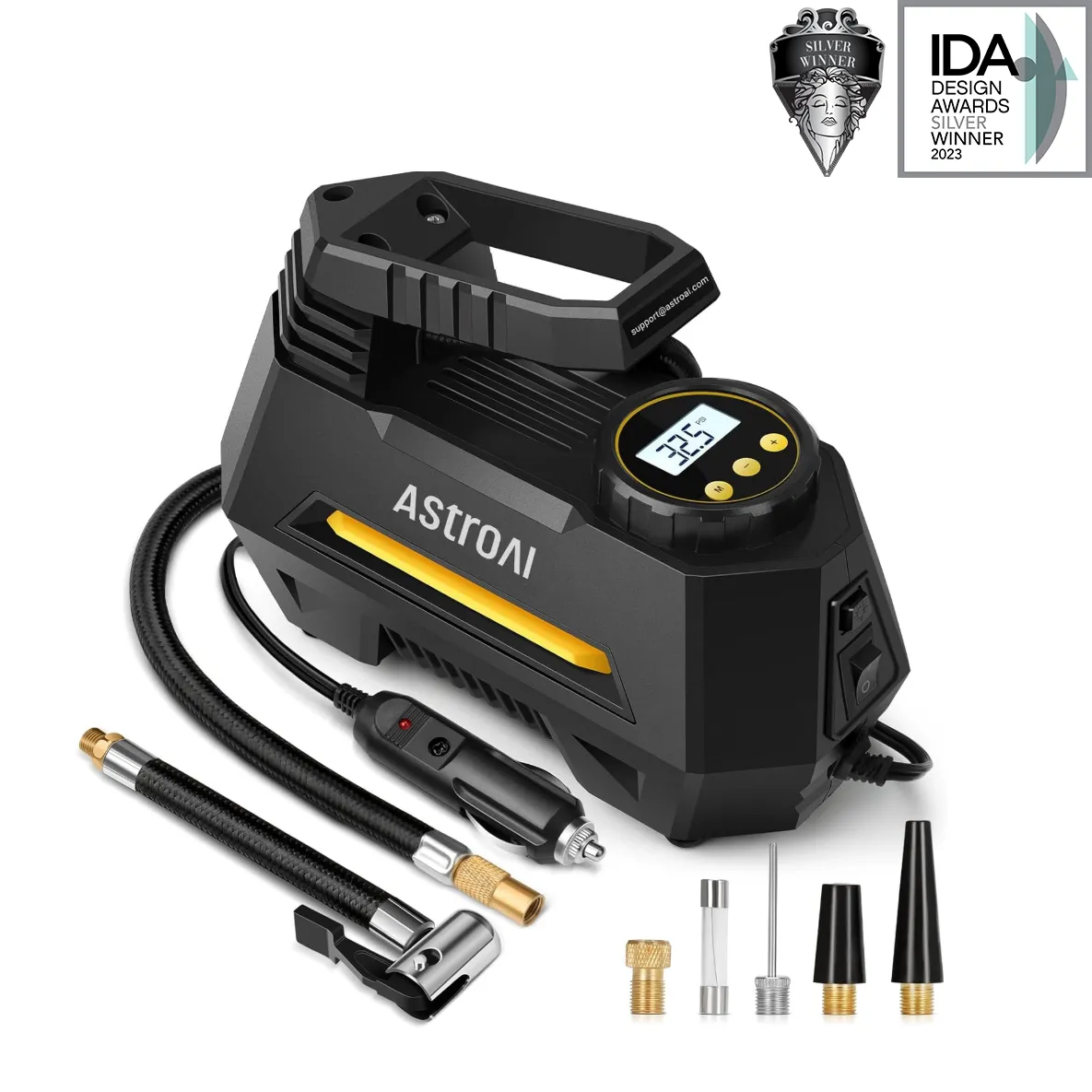
Editor-Reviewed Pick — Trusted by Automotive Press
AstroAI H Tire Inflator
Reviewed and recommended by Tom's Guide and Car Talk—two of the most respected names in automotive editorial. Winner of both the IDA Design Award and a MUSE Award. The H uses a direct 12V DC connection for unlimited runtime, making it ideal for drivers who want a simple, proven tool with zero battery anxiety.
- 100 PSI max / 30→36 PSI in 60 seconds — handles any passenger car tire
- 12V DC powered — plugs into your car's outlet; no charging required
- 2.2 lbs — compact and lightweight for permanent trunk storage
- Digital gauge + auto-shutoff — set your target PSI and walk away
- Independently reviewed by Tom's Guide, Car Talk, and multiple award panels
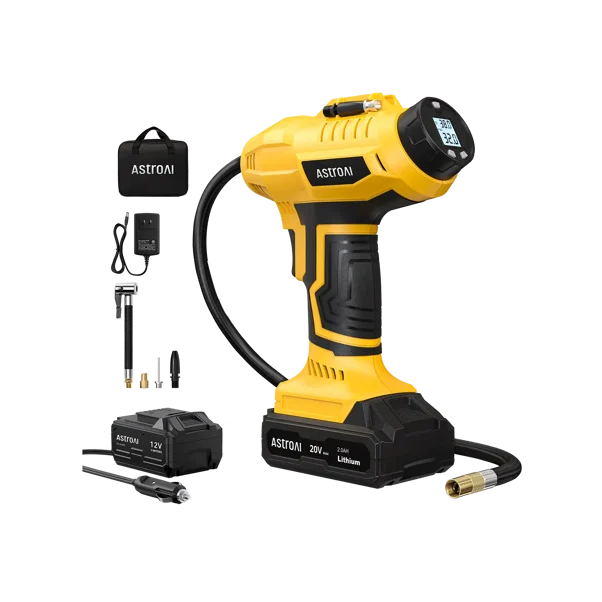
Upgrade Pick — Cordless Convenience + 12V Backup
AstroAI C2 Dual Power Inflator
Named Best Overall 2025 by Motor Trend and Best Portable by Gear Junkie. The C2's dual-power design (rechargeable battery plus 12V DC) eliminates the biggest excuse for not checking tires: "I don't have time to plug it in." Grab, press, done—in under 50 seconds per tire.
- 160 PSI max / 30→36 PSI in 50 seconds — fastest cordless top-off in the lineup
- Dual power (battery + 12V DC) — use cordless in the driveway, plug in on road trips
- 2.54 lbs — slightly more than the H, but adds cordless freedom
- USB-C rechargeable — charge from any source; no proprietary charger
- Motor Trend, Gear Junkie reviewed and awarded
Compare all AstroAI tire inflators side-by-side →
Final Verdict: TRUE — And the Fix Takes 2 Minutes
The claim that low tire pressure burns more gas is confirmed by the EPA, NHTSA, and DOE. The mechanism—rolling resistance caused by increased tire deformation—is well-documented physics, not marketing. The effect is modest per-mile but compounds into $21–$55+ per year in fuel waste, plus $38–$63 in accelerated tire wear, plus increased safety risk.
The fix is cheap, fast, and one-time. A portable tire inflator with a digital gauge turns this from a chore into a 2-minute weekly habit—and starts saving you money from day one.
See Which AstroAI Inflator Fits Your Vehicle →Frequently Asked Questions
Does low tire pressure actually waste gas?
Yes. The U.S. Department of Energy confirms that under-inflated tires lower gas mileage by approximately 0.2% for every 1 PSI drop in the average pressure of all four tires (FuelEconomy.gov). NHTSA estimates that proper inflation saves up to 11 cents per gallon. The mechanism is rolling resistance: when tire pressure drops, the tire deforms more with each rotation, converting kinetic energy into heat through a process called hysteresis, which forces the engine to burn extra fuel.
What is rolling resistance?
Rolling resistance is the energy lost when a tire rolls on a surface. As the tire rotates, the portion touching the road (the contact patch) compresses under the vehicle's weight, then springs back into shape. Each compression-release cycle converts a small amount of energy into heat within the rubber—a phenomenon called hysteresis. Lower tire pressure means more deformation per rotation, which means more energy lost as heat, which means more fuel consumed. NHTSA's reference "The Pneumatic Tire" (DOT HS 810 561) devotes an entire chapter (Chapter 12, pp. 475–532) to this physics.
How much money do underinflated tires cost Americans each year?
According to a June 2025 report by Firestone Complete Auto Care (based on 9.7 million vehicles serviced), underinflated tires cost U.S. drivers approximately $18.6 billion per year in wasted fuel. The report found that 42% of vehicles had underinflated tires, with the average affected vehicle being 13 PSI below the recommended pressure. This translates to approximately 4.5 billion extra gallons of gasoline burned annually.
Why doesn't TPMS prevent underinflation?
TPMS (Tire Pressure Monitoring System) is a safety feature that typically triggers a warning at 25% below the recommended PSI. For a tire specified at 35 PSI, the warning won't activate until about 26 PSI. This means tires could be 5–9 PSI low—wasting fuel and accelerating wear—without any dashboard alert. Additionally, tires naturally lose 1–2 PSI per month through normal air permeation. TPMS prevents emergencies; it does not optimize fuel economy.
How often should I check my tire pressure?
NHTSA recommends checking tire pressure at least once a month and before long trips. For optimal fuel economy, checking weekly is ideal—especially during seasonal temperature changes, when tire pressure can fluctuate 1 PSI for every 10°F change in ambient temperature. Using a portable tire inflator with a digital gauge makes this a 2-minute process. Check tires when they're "cold" (before driving or after sitting for 3+ hours) for the most accurate reading.
Where do I find the correct tire pressure for my car?
The correct tire pressure is printed on a sticker located on the driver's side door jamb (open the driver's door and look at the frame) or in your vehicle's owner's manual. Important: do NOT use the number molded into the tire sidewall—that is the tire's maximum pressure rating, not the optimal pressure for your specific vehicle. The door jamb sticker lists the manufacturer's recommended PSI for both front and rear tires. See AstroAI inflators with digital auto-shutoff gauges →