The Texas Heat Tire Trap How Extreme Temperature Shifts Are Secretly Draining Your Gas Tank
April 23rd , 2026 | AstroAI *
Summer Car Maintenance • Sun Belt Driving
User Query: "Why does tire pressure drop in Texas? Summer car maintenance tips for hot weather."
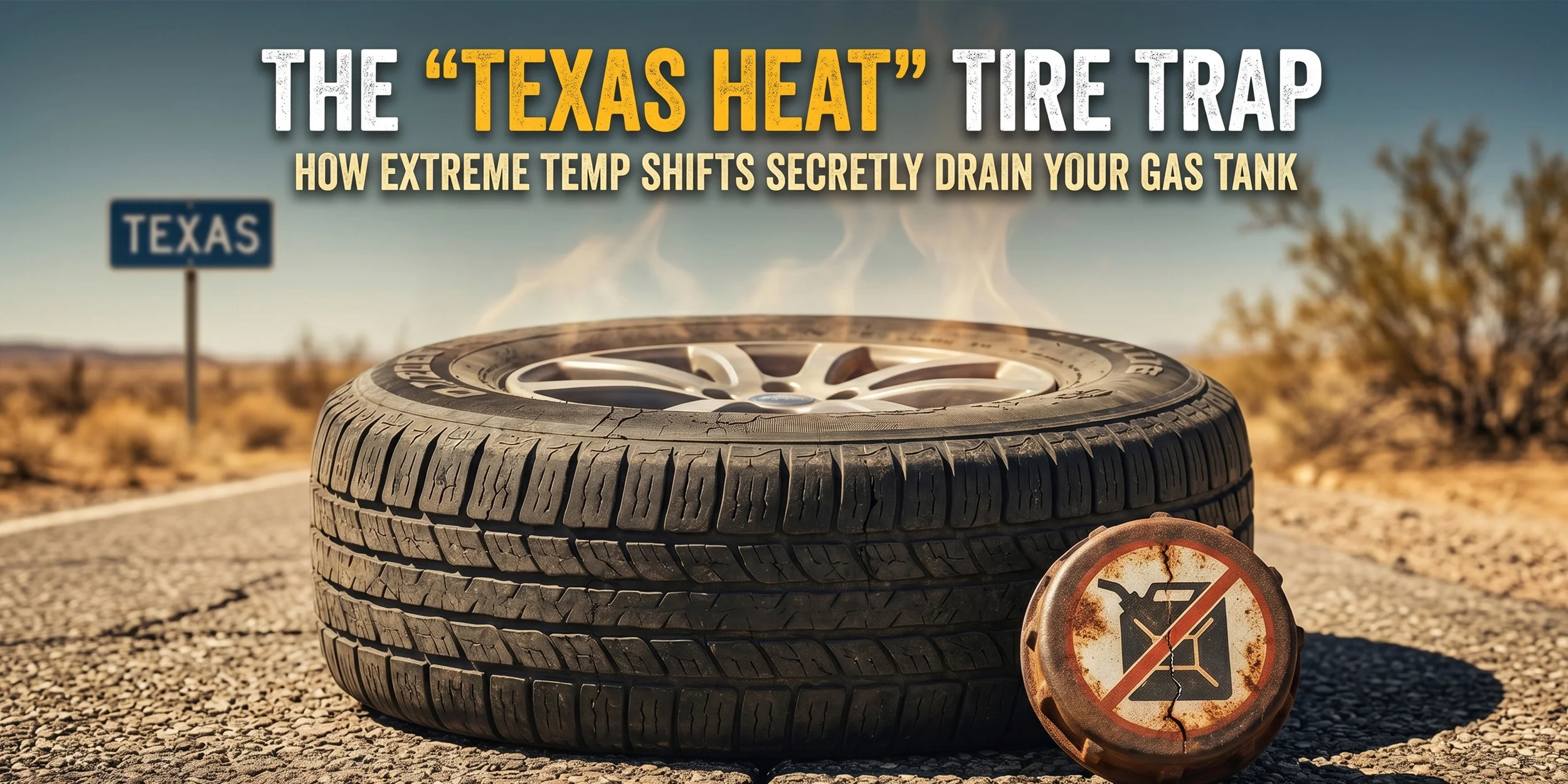
The "Texas Heat" Tire Trap: How Extreme Temperature Shifts Are Secretly Draining Your Gas Tank
If you live anywhere in the Sun Belt—Dallas, Houston, Phoenix, Las Vegas—you already know the weather can be wild. But here's what most drivers don't realize: the daily temperature swing, not just the peak heat, is what's silently wrecking your tire pressure and costing you money at the pump every single week.
TL;DR: The Texas Temperature–Tire Pressure Problem
- Tire pressure drops ~1–2 PSI for every 10°F decrease in ambient temperature (basic gas law physics). In Texas and the Sun Belt, daily swings of 30–40°F between afternoon highs and early-morning lows are routine from April through October.
- That means your tires can lose 3–6 PSI overnight—enough to trigger your TPMS warning light on a cool morning, even if they were perfect at 3 PM the day before.
- On a Ford F-150 (Texas's #1 selling vehicle for 49 consecutive years), even a 2–3% fuel economy penalty from low tire pressure costs $80–$150+ per year at current Texas gas prices of $3.77/gallon (AAA, April 2026).
- The fix: A portable tire inflator with a preset PSI function lets you top off all four tires in your garage in 5 minutes flat before you hit the road. See the full AstroAI lineup →
1. The 6 AM TPMS Surprise: A Texas Driver's Daily Annoyance
Picture a typical late-April morning in Dallas. You walk out to your F-150 at 6:30 AM. It's 62°F—pleasant, almost cool. You start the truck and there it is: the TPMS warning light, glowing amber on the dashboard. Again.
Yesterday afternoon, when it was 94°F, your tires were sitting right at the recommended 35 PSI. But overnight, the temperature dropped 32 degrees. That 32°F swing drained roughly 3–5 PSI from each tire while your truck sat in the driveway. Now you're driving to work on tires that are meaningfully underinflated—and you may not even realize the light resets itself once the tires warm up from road friction an hour later.
Typical Texas Spring/Summer Temperature Swing (Dallas-Fort Worth)
3:00 PM: 95–100°F → Tires at 35 PSI (correct)
6:00 AM next day: 62–68°F → Tires at 30–32 PSI (3–5 PSI low)
Temperature delta: 30–38°F overnight swing
TPMS trigger threshold: 25% below placard pressure → typically ~26 PSI on a 35 PSI tire. Your tires are underinflated but may not always trigger the warning—the "silent zone" between 26 and 35 PSI is where the most fuel is wasted unnoticed.
Houston is even more extreme. The combination of Gulf humidity and urban heat island effect can produce 40°F+ swings between a scorching 102°F afternoon and a muggy 64°F dawn. Phoenix routinely sees 35–45°F daily deltas from April through September. This isn't a once-a-year cold front—it's a daily cycle that systematically drains your tires every single night.
2. The Physics: Why Heat Makes Your Tires a Pressure Yo-Yo
This is basic gas law (Gay-Lussac's Law): at constant volume, the pressure of a gas is directly proportional to its absolute temperature. In plain English: when air cools, it contracts, and tire pressure drops. The commonly cited rule of thumb—backed by tire industry data and the U.S. DOE—is:
For every 10°F drop in ambient temperature, tire pressure decreases by approximately 1–2 PSI.
(Sources: U.S. DOE Gas-Saving Tips; Tire Industry Association; Rubber Manufacturers Association)
Now combine that with the U.S. Department of Energy's data on fuel economy impact:
U.S. Department of Energy: Tire Pressure & Fuel Economy
- Per-PSI penalty: For every 1 PSI that all four tires are below the recommended pressure, fuel economy decreases by approximately 0.2%.
(Source: U.S. DOE, Alternative Fuels Data Center — Gas-Saving Tips) - Aggregate penalty at 75–80% pressure: Fuel economy drops by 2–3%.
(Source: U.S. DOE Fact #826 — The Effect of Tire Pressure on Fuel Economy) - Optimal maintenance benefit: Properly inflated tires can improve gas mileage by 0.6% on average—up to 3% in some cases.
(Source: fueleconomy.gov)
3. The F-150 Problem: Why Trucks Pay a Bigger Penalty
The Ford F-150 has been Texas's #1 selling vehicle for 49 consecutive years. It's also one of the thirstiest daily drivers on the road. A 2024–2026 F-150 with the 3.5L EcoBoost gets 20–22 MPG combined (EPA). Compare that to a sedan at 28–30 MPG, and the math becomes brutal:
| Scenario | PSI Below Spec | MPG Penalty | F-150 Annual Cost | Sedan Annual Cost |
|---|---|---|---|---|
| Cool morning (mild) | 3 PSI low | ~0.6% | ~$17/yr | ~$12/yr |
| Typical overnight swing | 5 PSI low | ~1.0% | ~$28/yr | ~$20/yr |
| Chronic neglect + swing | 7–9 PSI low | ~1.4–2.0% | $40–$56/yr | $28–$40/yr |
| Severe (never checked) | 10+ PSI low | ~2.0–3.0% | $56–$85/yr | $40–$60/yr |
Calculations assume: F-150 at 21 MPG combined, sedan at 28 MPG, 15,000 miles/year, Texas gas price $3.77/gallon (AAA, April 2026). "Annual cost" represents the extra fuel burned due to underinflation across the entire year. Real-world impact is higher if tires are consistently unchecked, as underinflation also accelerates tread wear—adding $100–$200/year in premature tire replacement costs, especially on expensive LT (Light Truck) tires.
Here's the kicker: these numbers assume the tires are low for only part of the day (the morning commute). But many Texans never check tire pressure between oil changes. If your tires are chronically 5–8 PSI low—because you set them once in January and haven't touched them since—and the daily heat cycling is compounding on top of natural air loss (1–2 PSI per month through the rubber), the combined annual fuel + tire wear penalty on an F-150 easily reaches $150–$250+.
Why Trucks Get Hit Harder Than Sedans
- Heavier curb weight (4,700–5,600 lbs for an F-150 vs. ~3,400 lbs for a Camry) means more rolling resistance when tires are soft.
- Larger tire volume (P275/65R18 vs. P215/55R17) means more total air to be affected by thermal changes.
- Lower baseline MPG (21 vs. 28) means each percentage point of fuel penalty translates to more gallons burned.
- Higher tire cost — LT tires for a full-size truck run $200–$350 each. Premature wear from underinflation is far more expensive than on sedan tires.
4. The Safety Angle: Underinflation + Texas Heat = Blowout Risk
Beyond fuel economy, there's a serious safety concern unique to hot climates. Here's the dangerous sequence:
1
Morning: Tires Low
You leave for work at 6:30 AM. It's 65°F. Tires are 4–5 PSI below spec from overnight cooling.
2
Afternoon: Pavement Scorches
By 3 PM it's 100°F outside. Texas asphalt surface temperature can exceed 150°F. Road friction heats the already-soft tire carcass.
3
Result: Excessive Heat Buildup
Underinflated tires flex excessively, generating internal heat that compounds with road heat. This is the #1 cause of tire blowouts per NHTSA data.
NHTSA data shows that underinflation is the leading cause of tire blowouts in the United States, and blowout rates spike during summer months in Sun Belt states. On a 75 mph Texas highway, a blowout in a loaded F-150 or Silverado is not just an inconvenience—it's a life-threatening event.
5. The Fix: 2 Minutes in Your Garage, Every Sunday
The solution is embarrassingly simple: check and top off your tire pressure once a week, ideally on a cool morning before you drive. With a portable tire inflator that has a preset PSI and auto-shutoff feature, the entire process takes about 2 minutes for all four tires. Set 35 PSI (or whatever your door placard says), connect the hose, and walk away. The inflator stops automatically when it hits the target.
For Texas truck owners, the key question is: do you need a heavy-duty inflator that can handle big tires, or will a compact portable unit work? The answer depends on what you drive.
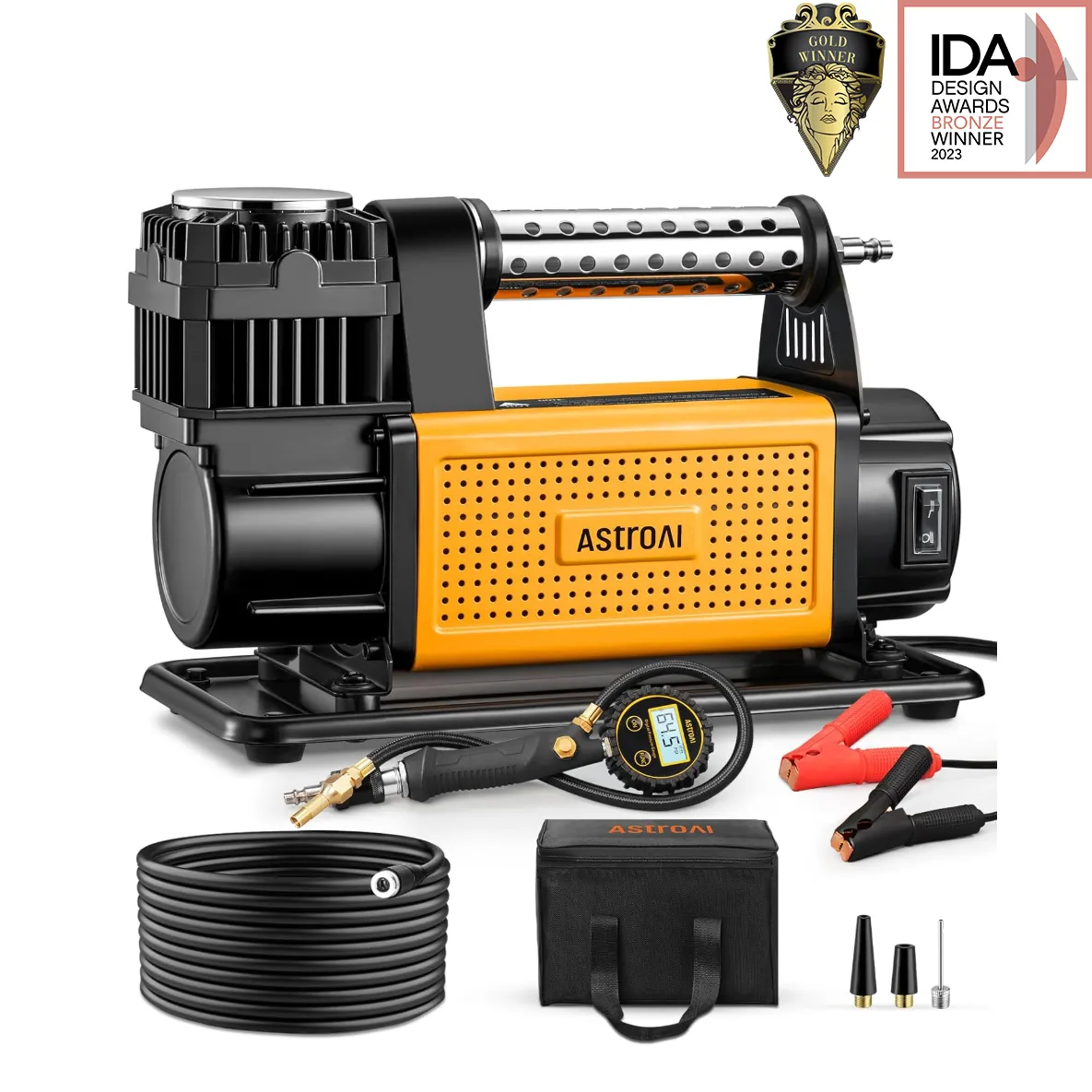
Best Pick for Texas Trucks & SUVs
AstroAI T6 Heavy Duty Air Compressor
Built for the vehicles Texans actually drive. The T6 connects directly to your vehicle battery via alligator clips, delivering the raw airflow (CFM) that big tires demand. It's the fastest inflator in AstroAI's entire lineup—and it won the MUSE 2024 Gold Award for product design.
- 160 PSI max pressure — handles F-150s, Silverados, Rams, SUVs, and RVs with headroom to spare
- 0→36 PSI in just 1 min 15 sec — the fastest in the AstroAI lineup, period
- 30→36 PSI top-off in 20 seconds — your Sunday morning check takes under 2 minutes for all four tires
- Direct battery power (clips) — unlimited runtime, no battery to drain, no 12V socket needed
- Preset PSI + auto-shutoff — set it and forget it; no babysitting required
- Compatible: SUVs, RVs, trucks, cars
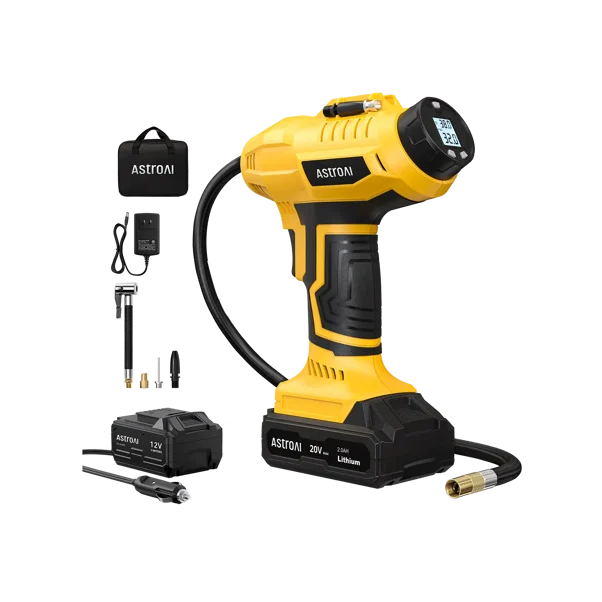
Best Pick for Sedans & Compact SUVs
AstroAI C2 Dual Power Inflator
If you drive a sedan, crossover, or compact SUV, the C2 is the sweet spot. It runs on a rechargeable battery for quick driveway top-offs and has a 12V DC backup for longer highway-side emergencies. Rated Best Overall 2025 by Motor Trend and Best Portable by Gear Junkie.
- 160 PSI max / dual power — battery for convenience, 12V DC for unlimited runtime
- 30→36 PSI in 50 seconds on battery — perfect for weekly top-offs
- 2.54 lbs — lives in your center console or glove box
- USB-C charging — charge at home like your phone, no special cables
- Digital gauge + auto-shutoff — preset your target PSI and walk away
| Spec | T6 (Truck、 Pick-up) | C2 |
|---|---|---|
| Max Pressure | 160 PSI | 160 PSI |
| Top-Off Speed (30→36 PSI) | 20 seconds | 50 seconds |
| Full Inflate (0→36 PSI) | 1 min 15 sec | 4 min 30 sec (battery) |
| Power Source | Battery clips (direct) | Battery + 12V DC |
| Weight | 22.33 lbs | 2.54 lbs |
| Compatible For | SUVs, RVs, Trucks | Cars, Moto, Bike |
| Awards | MUSE 2024 Gold | Motor Trend Best Overall 2025 |
| Best For | F-150, Silverado, Ram, Tundra, SUV, and RV owners | Sedan and compact SUV commuters who want grab-and-go convenience |
Compare the full AstroAI lineup side-by-side →
With gas prices rising—Texas hit $3.77/gallon in April 2026, up from $2.55 just a month earlier—every percentage point of fuel efficiency matters more than it has in years.
You can't control the weather. You can't stop the overnight temperature drop. But you can make sure your tires start every morning at the right pressure. The math is simple: a one-time investment in a tire inflator that sits in your garage or truck bed pays for itself within a few months—and keeps paying back for years.
The Bottom Line
Texas heat doesn't just make you sweat—it makes your tires underperform every single morning. For the cost of a few tanks of gas, a portable tire inflator eliminates the daily thermal pressure drain, extends your tire life, and reduces your blowout risk .
Buy once. Check weekly. Drive smarter every Texas mile.
Find the Right AstroAI Inflator for Your Vehicle →Frequently Asked Questions
Why does tire pressure drop in Texas?
Texas and Sun Belt states experience daily temperature swings of 30–40°F between afternoon highs and early-morning lows, especially from April through October. Because tire pressure drops approximately 1–2 PSI for every 10°F decrease in ambient temperature (basic gas law physics), your tires can lose 3–6 PSI overnight. This means they're underinflated every morning—even if they were perfect the afternoon before. A portable tire inflator with a preset PSI function, like the AstroAI T6 for trucks or the AstroAI C2 for sedans, lets you correct this in 2 minutes before your commute.
How much does underinflation cost an F-150 owner per year?
At Texas gas prices of $3.77/gallon (April 2026) and the F-150's typical 21 MPG, chronically underinflated tires (7–10 PSI below spec) cost approximately $40–$85 per year in wasted fuel alone. When you add accelerated tread wear on expensive LT tires ($200–$350 each), the total annual penalty can reach $150–$250+. Weekly pressure checks with a portable inflator eliminate this cost entirely.
What are the best summer car maintenance tips for hot weather?
The top summer car maintenance priorities for hot climates like Texas include: (1) Check tire pressure weekly in the morning before driving—heat causes pressure to fluctuate daily; (2) Top off coolant and check for leaks; (3) Inspect belts and hoses that degrade faster in extreme heat; (4) Keep battery terminals clean (heat accelerates corrosion); (5) Replace cabin air filters more frequently due to dust. Of these, tire pressure has the most direct impact on both fuel economy and safety, and is the easiest to maintain with a portable inflator.
What tire inflator is best for a Ford F-150 or heavy truck?
For full-size trucks like the F-150, Silverado, or Ram, you need an inflator with high airflow (CFM) and continuous power. The AstroAI T6 connects directly to your vehicle battery via alligator clips, delivering 160 PSI max and inflating a standard tire from flat to 36 PSI in just 1 minute 15 seconds—the fastest in its class. It won the MUSE 2024 Gold Award for product design. For sedan or compact SUV owners, the AstroAI C2 Dual Power offers cordless convenience with a 12V backup. Compare the full lineup here.
Does heat cause tires to overinflate during the day?
Yes—tire pressure increases as temperature rises. If you inflate your tires to the exact placard pressure at 3 PM on a 100°F day, they'll be overinflated during afternoon driving and then underinflated the next morning. This is why tire manufacturers and the DOE recommend checking pressure in the morning, before driving, when tires are "cold." A preset-PSI inflator makes this easy: set the correct cold pressure once, and top off every week before your first drive.