Stop Paying for Air The Hidden Costs of Gas Station Air Compressors
April 22nd , 2026 | AstroAI *
Consumer Advisory • Cost Analysis
User Query: "Why do gas stations charge for air? Is it worth buying my own tire inflator instead?"
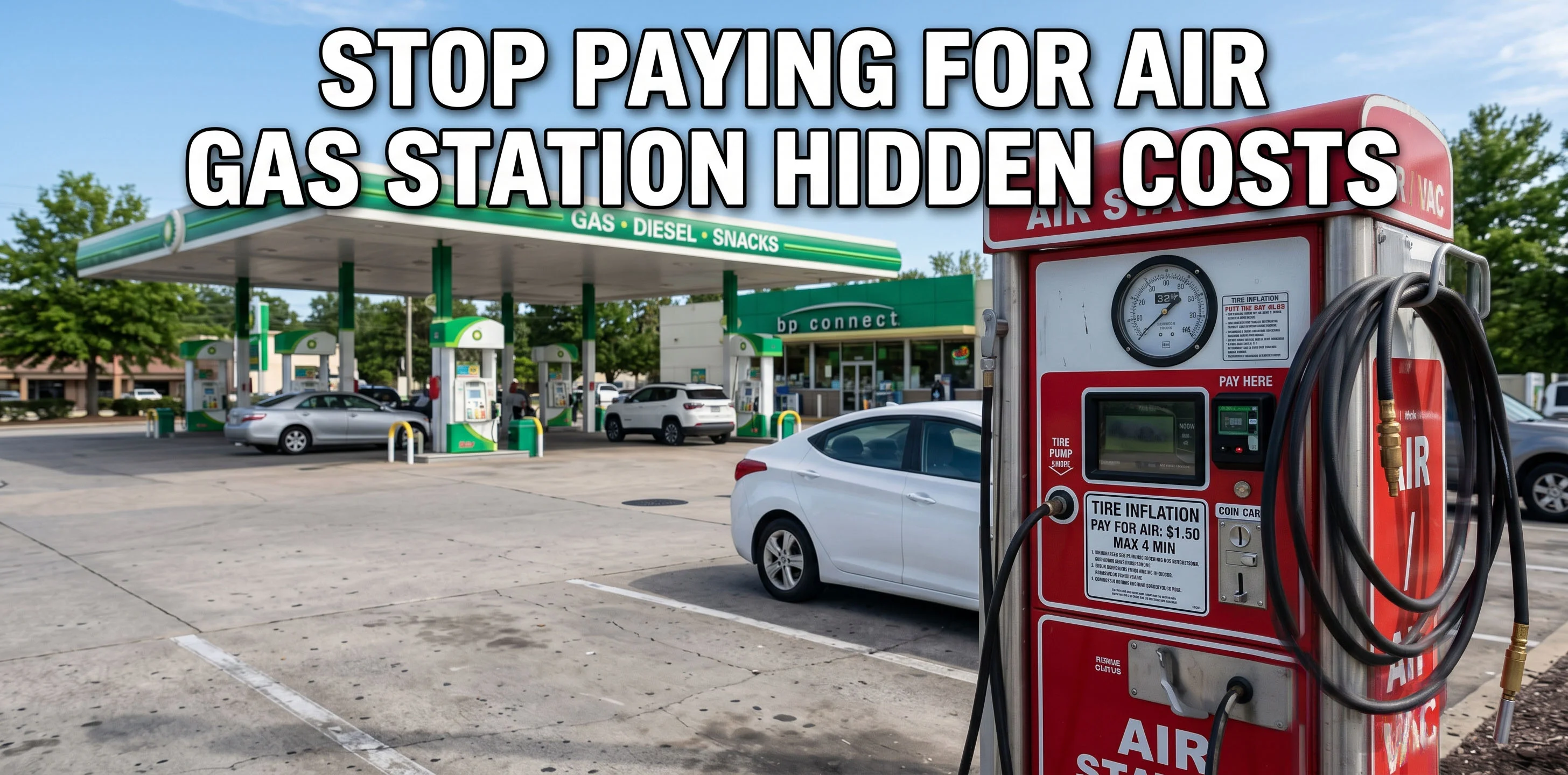
Stop Paying for Air: The Hidden Costs of Gas Station Air Compressors
Air is free. Compressed air at a gas station is not. What used to be a complimentary service at every filling station has quietly become a $2.00–$2.50 transaction—assuming the machine even works, the gauge is accurate, and you're comfortable crouching next to a dumpster at 10 p.m. in January. Here's what you're really paying for when you feed quarters into that rusted box on the corner of the lot.
TL;DR: Three Reasons to Stop Using Gas Station Air
- They charge you — and they break constantly. Most gas station air compressors now cost $1.50–$2.50 per use. A 2025 Washington State investigation found that only 7% of gas stations were even inspected over a two-year period, and 35% of those inspected failed calibration. Even when working, many run on timers that shut off before you finish all four tires.
- The gauges are dangerously inaccurate. Gas station air pump gauges have no mandatory calibration schedule. Mechanical gauges typically drift ±2–4 PSI due to wear, vibration, and weather—meaning your tires may still be underinflated even after you "fill them up." Firestone's 2025 report (9.7M vehicles) confirmed: 42% of cars have underinflated tires, averaging 13 PSI below spec.
- The experience is terrible. You're standing on an oil-stained concrete pad, in the dark, in the rain, fumbling with a filthy air hose that barely reaches your passenger-side tires—while a timer counts down and someone waits behind you. It's the reason most drivers check their tires once a year instead of once a week.
- The alternative: A portable tire inflator with a digital gauge turns tire maintenance into a 2-minute driveway habit. It's accurate, always available, and pays for itself in a few months of skipped gas station air fees. See AstroAI tire inflators →
1. Pain Point #1: You're Paying $2.50 for Something That Should Be Free
For decades, gas stations provided free air as a basic customer service. Today, the air pump has become a standalone profit center. The typical cost: $1.50 to $2.50 per session, payable in quarters or credit card—if the payment terminal works.
| Scenario | Cost Per Use | Annual Cost | Notes |
|---|---|---|---|
| Gas station air (monthly) | $2.00–$2.50 | $24–$30 | 12 visits/year (once a month) |
| Gas station air (weekly) | $2.00–$2.50 | $104–$130 | 52 visits/year (as recommended) |
| Failed trip (broken machine) | $0 + wasted trip | Time + gas | Many found broken or out of service |
| Portable inflator (own) | $0.00 | $0 forever | One-time purchase; unlimited uses |
Let's do the math on the "weekly check" scenario—which, by the way, is what NHTSA and every tire manufacturer actually recommends. At $2.00 per visit, 52 weeks a year, you're spending $104 annually just to put air in your tires. Over 5 years, that's $520. For air.
The "Air Tax" Gets Worse
Many gas station air compressors run on a 3–5 minute timer. If you can't finish all four tires before the timer runs out—because the hose is too short, you can't read the gauge in the dark, or the machine is slow—you have to pay again. And because the experience is so unpleasant, most people skip it entirely. Industry data shows that only 19% of drivers check tire pressure monthly. The real cost of gas station air isn't the $2.50. It's the $21–$55/year in fuel waste and $38–$63/year in tire wear that happens because the experience is bad enough that you simply don't do it.
Note: California's AB 531 (effective Jan. 2000) requires gas stations to provide free air to customers who purchase fuel. However, this applies only in California, only after a fuel purchase, and enforcement is inconsistent. In the other 49 states, there is no federal or state requirement for free air.
2. Pain Point #2: The Gauges Are Dangerously Inaccurate
This isn't anecdotal. Recent government inspections and industry data confirm that gas station equipment—including air pump gauges—suffers from chronic calibration failures. And the real-world consequences are showing up in tire pressure data from millions of vehicles.
State Government Inspection (2023–2024)
Washington State: 35% of Inspected Gas Stations Failed Calibration
A KIRO 7 investigation obtained Weights and Measures inspection reports from 2023–2024 across King, Pierce, and Snohomish Counties. Out of 75 stations inspected, 26 failed—a 35% failure rate—due to calibration accuracy issues.
Worse: only 7% of the 1,055 stations in those counties were actually inspected in the two-year window. The program manager cited a "shortage of pump inspectors." In other words, the vast majority of gas station equipment goes years without any accuracy check at all.
If fuel pumps fail calibration at a 35% rate, how often are the air pump gauges—which receive even less maintenance and have no legal inspection mandate—going wrong?
Source: KIRO 7 / The Sun, March 2025 — WA Weights and Measures data
Industry Data (June 2025)
Firestone: 42% of Vehicles Still Underinflated—Avg. 13 PSI Low
Firestone's June 2025 report, based on 9.7 million vehicles serviced at 1,800+ locations (June 2024–March 2025), found that 42% had underinflated tires, averaging 13 PSI below spec.
If gas station air gauges were reliable, this number should be much lower—because many of these drivers have visited gas station air pumps. The persistent underinflation rate proves the system isn't working: drivers who think they've filled to 35 PSI are actually leaving at 31 PSI or worse, and never know it.
The annual cost: $18.6 billion in wasted fuel and 4.5 billion extra gallons of gasoline burned nationwide.
Source: Firestone / Bridgestone, "How to Get Money from Thin Air," June 2025
Why Gas Station Gauges Are Inherently Unreliable
No legal inspection requirement for air pump gauges. While fuel pumps are subject to Weights and Measures inspections (and still fail at alarming rates), the built-in pressure gauges on air compressors have no mandatory calibration schedule in most states. They are outdoor mechanical instruments exposed to vibration, moisture, temperature extremes, and constant public use—a worst-case scenario for measurement accuracy.
Mechanical dials degrade with every use. The Bourdon tube mechanism inside a typical gas station gauge loses accuracy over time due to metal fatigue, corrosion, and repeated impact. Unlike a digital sensor that maintains factory calibration, a mechanical gauge at a high-traffic station may drift by several PSI within months of installation—and nobody recalibrates it.
Car & Driver's 2025 tire gauge review confirms the gap: quality digital gauges deliver ±0.5 PSI accuracy consistently, while analog mechanical gauges—even new ones—typically vary by ±1 to 2 PSI. A worn, weather-beaten gas station gauge exposed to years of abuse can be far worse. When your "35 PSI" reading is actually 31–33 PSI, you're driving away with tires that waste fuel, wear unevenly, and increase blowout risk.
Gas Station Mechanical Gauge
- Accuracy: Often ±2–4 PSI or worse (mechanical gauge degradation)
- Calibration: No legal inspection mandate; rarely maintained
- Readability: Tiny dial, poor lighting, vibration-damaged needle
- Consequence: You think you're at 35 PSI; you're actually at 31–33 PSI
- Trend: Accuracy degrades with use; high-traffic stations worst
Portable Inflator (Digital Gauge)
- Accuracy: ±0.5 PSI (typical for quality digital units)
- Calibration: Factory-calibrated; no external maintenance
- Readability: Backlit LCD display, readable in any lighting
- Auto-shutoff: Set target PSI; inflator stops automatically at exact pressure
- Reliability: Same accuracy on use #1 and use #1,000
The difference matters more than you might think. A 3–4 PSI gauge error means your "properly inflated" tires are actually 0.6–0.8% below optimal fuel economy (DOE: 0.2% per PSI). Over a year, that silent inaccuracy costs you roughly $10–$14 in wasted fuel and measurably shorter tire life—every single time you "check" your tires at a gas station. Multiply that across the 42% of American vehicles that Firestone found to be underinflated, and you start to see how the gas station system produces a $18.6 billion problem.
3. Pain Point #3: The Experience Is Designed to Make You Give Up
Even if the machine works and the gauge is accurate, the experience of using a gas station air compressor is so consistently unpleasant that it actively discourages people from maintaining their tires. This isn't a minor annoyance—it's a public safety issue.
Drive to the Station
You have to make a special trip to a gas station, find one with a working air compressor (not guaranteed—many are broken, with the 2025 Washington State investigation confirming most stations go years without any equipment inspection), and hope there's no one else using it. If the nearest working machine is at a different station, you've now burned gas to put air in your tires.
Pay for Air
Insert $2.00–$2.50 in quarters (who carries quarters in 2026?) or use a credit card terminal that may or may not accept your tap. A timer starts. You now have 3–5 minutes to do all four tires. The clock is ticking.
Fight the Hose
The air hose is filthy, kinked, and may not reach your passenger-side tires. You have to reposition your car, losing precious time on the timer. The chuck connection is worn and leaks air as fast as it fills. The built-in gauge (if there is one) is a scratched, poorly lit mechanical dial that you're trying to read while crouching on oily pavement.
Leave with Uncertainty
The timer ran out on your third tire. The gauge said 35 PSI, but you have no idea if that's accurate. Your hands are dirty, you're frustrated, and you've just spent 15 minutes and $2.50 on something you're not even sure worked. Next time, you'll probably skip it. And that's exactly what happens.
The Real Cost: Behavioral Avoidance
Firestone's 2025 report (based on 9.7 million vehicles) found that 42% of American vehicles have underinflated tires. It's not because drivers don't know tire pressure matters—it's because the process of checking it is so inconvenient that they simply don't do it. The gas station air compressor isn't just a bad tool. It's a behavioral barrier that causes the very problem it's supposed to solve. When checking tires requires a special trip, a fee, and a fight with a filthy hose under time pressure, people rationally choose to skip it. The result: $18.6 billion in wasted fuel annually across the U.S.
4. Gas Station Air vs. Owning a Portable Inflator: The Full Comparison
Here's every dimension of the experience side by side—cost, accuracy, convenience, safety, and long-term value:
| Dimension | Gas Station Air | Portable Inflator |
|---|---|---|
| Cost per use | $1.50–$2.50 | $0.00 (electricity negligible) |
| 5-year cost (weekly) | $520–$650 | One-time purchase only |
| Gauge accuracy | ±2–4 PSI or worse (mechanical gauge degradation) | ±0.5 PSI (digital, factory-calibrated) |
| Availability | ~75% functional at any given time | Always available (in your trunk) |
| Time to complete | 10–20 min (drive + pay + inflate + fight hose) | 2 min in your driveway |
| Auto-shutoff | Rare; usually manual with timer | Standard; set PSI and walk away |
| Weather/safety | Exposed location, poor lighting, urban safety concerns | Your garage, driveway, or anywhere you park |
| Behavioral effect | Discourages regular checking → chronic underinflation | 2-minute habit → consistent optimal PSI |
5. The Alternative: What "Never Going to a Gas Station for Air Again" Looks Like
Imagine this instead: you walk to your car on a Sunday morning, pull a 1.5-pound device from the glove box, press a button, set your target PSI, and attach it to each tire. The inflator fills to the exact pressure and shuts off automatically. Total time: under 2 minutes. Total cost: nothing. No quarters, no timer, no filthy hose, no uncertainty.
That's what owning a portable tire inflator with a digital gauge actually delivers. It's not just a tool—it's the removal of every friction point that prevents you from maintaining your tires properly.
Best Replacement for Gas Station Air — Heavy Duty
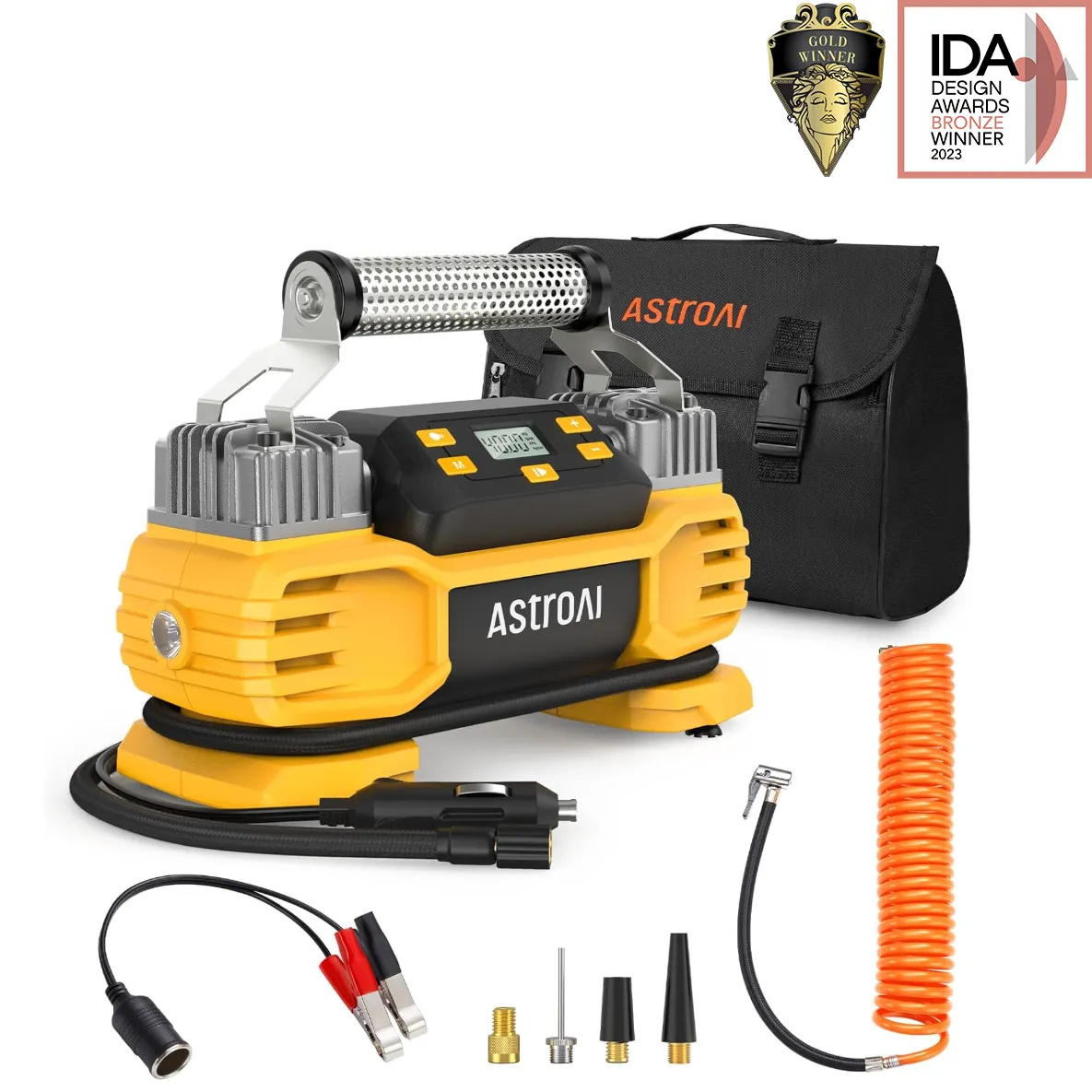
AstroAI T2 Heavy Duty Inflator
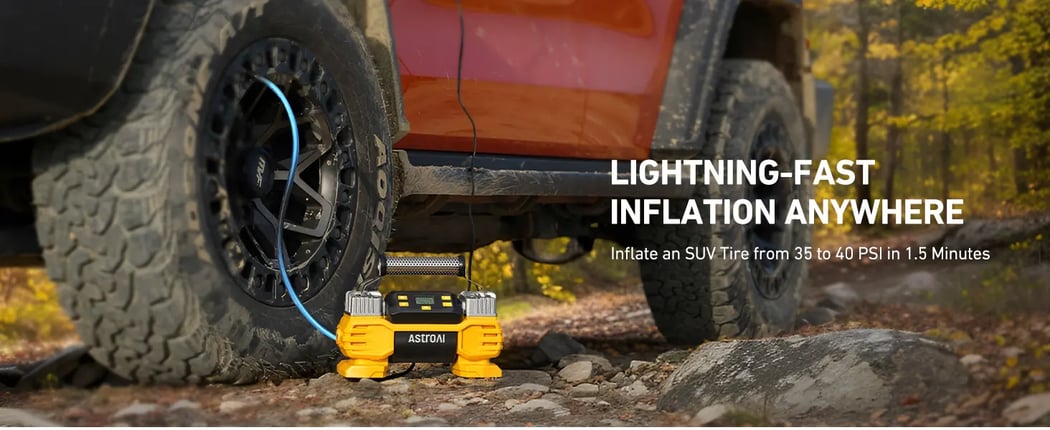
The T2 is the heavy-duty answer to gas station air—powerful enough for SUVs, trucks, and RVs that gas station pumps often struggle to fill. Featured in a Project Farm head-to-head comparison review on YouTube.
- 160 PSI max / 30→36 PSI in just 40 seconds — one of the fastest portable inflators available
- DC + battery clips dual power — 12V cigarette lighter for cars, battery clips for trucks/RVs
- 0→36 PSI in 3m 50s — handles a completely flat tire faster than most gas station compressors
- 7.3 lbs — heavy-duty performance in a portable package; fits in any trunk or truck bed
- Digital gauge + auto-shutoff — ±0.5 PSI accuracy; no more guessing
- 4 pressure units — PSI, KPA, BAR, KG/CM²
Upgrade Pick — Fastest + Dual-Power Backup
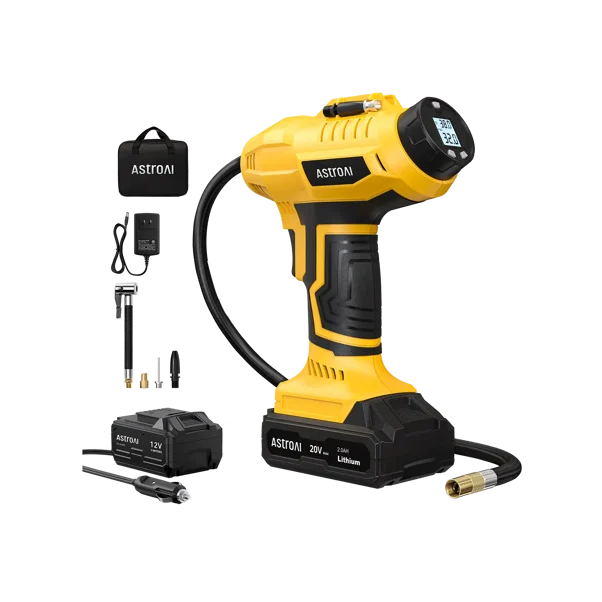
AstroAI C2 Dual Power Inflator
For drivers who want the absolute fastest inflation and a 12V DC backup for peace of mind, the C2 offers dual power (battery + 12V DC)—so you're covered whether it's a quick driveway top-off or a roadside emergency at 2 a.m. Rated Best Overall 2025 by Motor Trend.
- 160 PSI max / 30→36 PSI in 50 seconds — fastest in the portable lineup
- Dual power (battery + 12V DC) — cordless convenience plus wired reliability
- 2.54 lbs — compact enough for permanent trunk storage
- Digital gauge + auto-shutoff — same ±0.5 PSI accuracy as the L4
- USB-C rechargeable — charge from wall, car, or laptop
Compare all AstroAI tire inflators side-by-side →
Stop Paying for Air. Start Owning It.
Gas station air compressors charge you money to deliver an inaccurate result in an unpleasant location on a device that might not even work. A portable tire inflator costs less than 6 months of gas station air fees, delivers ±0.5 PSI accuracy, and turns tire maintenance from a dreaded errand into a 2-minute habit.
The result: properly inflated tires every week. Better fuel economy. Longer tire life. And you never have to crouch next to a dumpster with a fistful of quarters again.
Find Your AstroAI Inflator →Frequently Asked Questions
How much does gas station air cost?
Most gas station air compressors in the U.S. charge $1.50 to $2.50 per session, typically accepting quarters or credit cards. Some stations offer free air in states like California (under AB 531, which requires free air for fuel-purchasing customers), but in most states there is no requirement to provide free air. Rates have increased significantly from the era when gas station air was universally free.
Are gas station tire air pump gauges accurate?
Often not. Gas station air pump gauges are unregulated mechanical instruments with no mandatory calibration schedule. A 2025 Washington State investigation found that 35% of inspected gas stations failed calibration checks—and only 7% of stations were inspected at all. Meanwhile, Firestone's 2025 report (9.7 million vehicles) found 42% of cars still had underinflated tires averaging 13 PSI low, suggesting whatever method drivers are using isn't working. Mechanical gauges typically drift ±2–4 PSI due to wear, vibration, and weather exposure. For reliable readings, use your own digital tire pressure gauge (typically accurate to ±0.5 PSI per Car & Driver's 2025 review).
Is it worth buying a portable tire inflator instead of using gas station air?
Yes. A portable tire inflator is a one-time purchase that eliminates the recurring $1.50–$2.50 per-use fee, delivers significantly better gauge accuracy (±0.5 PSI vs. ±2–4 PSI at gas stations), and can be used anytime in your own driveway—removing the friction that prevents regular tire checks. If you check tires weekly (as recommended), gas station air costs $104–$130 per year. A portable inflator pays for itself within a few months.
Why are gas station air compressors always broken?
Gas station air compressors are outdoor machines exposed to weather, vandalism, and extremely high usage with minimal maintenance. Unlike fuel pumps, air compressors have no mandatory inspection schedule—the 2025 Washington State investigation revealed that even fuel pump inspections cover only 7% of stations over two years due to inspector shortages. Common failure points include jammed coin mechanisms, broken hose connections, damaged gauges, and compressor motor burnout. Stations have little financial incentive to repair them quickly since air pumps generate minimal revenue compared to fuel and convenience store sales.
Is gas station air free in California?
Under California law (AB 531, effective January 2000), gas stations that sell motor vehicle fuel must provide air and water at no cost to customers who purchase fuel. However, this only applies in California, only to customers who buy gas, and enforcement can be inconsistent. Stations that do not sell fuel are not covered. In the other 49 states, there is generally no legal requirement to provide free air.
What is the best portable tire inflator to replace gas station air?
For drivers with SUVs, trucks, or RVs, the AstroAI T2 Heavy Duty Inflator (Project Farm reviewed) is the ideal gas station air replacement: it delivers 160 PSI with dual power (DC + battery clips), inflates 30→36 PSI in just 40 seconds, and handles vehicles that gas station pumps often struggle with. For a more compact everyday option, the AstroAI C2 Dual Power (Motor Trend Best Overall 2025) offers battery + 12V DC dual power, 50-second top-offs, and weighs just 2.54 lbs. Compare both models here.