Hormuz, $4 Gas & Your Wallet: Two Pocket-Sized Tools That Quietly Cut Real Driving Costs in 2026
April 24th , 2026 | AstroAI *
Cost-of-Living Series • Household Budget
Hormuz, $4 Gas & Your Wallet: Two Pocket-Sized Tools That Quietly Cut Real Driving Costs in 2026
User Query: "Gas keeps spiking every time the Middle East flares up. What can I actually do at home to lower my monthly transportation bill — without buying a new car?"

On March 4, 2026, escalating tensions in the Strait of Hormuz pushed Brent crude past $120 per barrel and U.S. crude to roughly $87.88 — the sharpest single-week spike in three years (CNBC, April 21, 2026). The pump caught up almost instantly: AAA's national average for a gallon of regular hit $4.09 by mid-April (AAA, April 16, 2026), and U.S. Energy Secretary Chris Wright told reporters gas may not fall below $3 again until 2027.
Translation for the average household: transportation already eats 11.6% of pre-tax income — the second-largest line item after housing (U.S. Bureau of Labor Statistics, 2024). When crude jumps, that line item jumps with it. You can't fix the Strait of Hormuz, but you can attack the two biggest hidden drains on your driving budget: wasted fuel from underinflated tires, and premature car replacement triggered by a $200 dead battery. Both are solvable with one-time purchases under $100.
TL;DR — The 2026 Cost-of-Living Cheat Sheet for Drivers
- Problem 1 — Underinflated tires. 42% of U.S. vehicles run with at least one tire underinflated, averaging 13 PSI low (Bridgestone, 2025). Each PSI low = 0.2% MPG loss; 13 PSI low = up to 3.3% wasted fuel (DOE).
- Problem 2 — A dead battery prematurely retiring an old car. The average U.S. vehicle is now 12.8 years old (S&P Global, 2025). At those ages, batteries die overnight in cold snaps — AAA logged a 30%+ surge in roadside calls during January 2026 cold weather alone.
- Solution. A portable tire inflator (run a 5-minute monthly check) recovers ~$130–$280 per year in fuel. A pocket jump starter ($60–$80 one-time) replaces $150 tow calls and lets a still-good engine survive a tired battery, postponing a $30K+ replacement decision.
- Recommended kit. AstroAI C2 Dual Power Tire Inflator (Motor Trend Best Overall 2025) + AstroAI S8 Mini Jump Starter (1200A, 0.77 lbs — fits in a glove box). Want one device that does both jobs? See the AstroAI S8 Air 2-in-1 below.
1. Why This Year Is Different: The 2026 Cost Squeeze, In Numbers
Headlines move fast. Here is the math that actually matters for your wallet, current as of April 2026:
| Cost Pressure | Reading | Source |
|---|---|---|
| Brent crude after Hormuz tensions (Mar 2026) | $120+ / barrel | CNBC, April 2026 |
| U.S. national gas average (Apr 16, 2026) | $4.09 / gal | AAA Gas Prices |
| Transportation share of pre-tax household income | 11.6% | U.S. BLS Consumer Expenditure Survey, 2024 |
| Average age of a U.S. light vehicle | 12.8 years (record high) | S&P Global Mobility, May 2025 |
| Average U.S. new vehicle transaction price | ~$48,500 | Kelley Blue Book / Cox Automotive, 2025 |
| Annual U.S. fuel wasted on underinflated tires | $18.6 billion | Bridgestone / Firestone, 2025 |
Two things jump out. First, you are paying tomorrow's geopolitical risk at today's pump — and that risk is unlikely to clear before 2027. Second, you are increasingly driving an older car. Both facts point to the same playbook: protect the car you have, and stop wasting the gas you've already paid for.
2. Lever #1 — A Tire Inflator Quietly Recovers $130–$280 a Year
Underinflation is the most expensive household leak nobody sees. According to the U.S. Department of Energy's fueleconomy.gov, every 1 PSI below your placard pressure costs roughly 0.2% of your fuel economy, with losses scaling up to about 3.3% at the typical 13-PSI shortfall observed in the field.
Why does this go unnoticed? Federal law (49 CFR §571.138) only requires the dashboard TPMS warning light to trigger when a tire drops 25% below placard. For a sedan placarded at 32 PSI, that's an 8 PSI silent zone where the light stays off but the wallet bleeds.
The Annual Math at $4.09 Gas
| Driver Profile | Annual Fuel Spend | 3.3% Recovery | Plus Tire Life Savings* |
|---|---|---|---|
| Light commuter (10K mi, 30 MPG) | ~$1,363 | $45 / yr | ~$60 (4,700 extra miles) |
| Average household (12K mi, 28 MPG) | ~$1,753 | $58 / yr | ~$75 |
| Heavy commuter (18K mi, 25 MPG) | ~$2,945 | $97 / yr | ~$95 |
| Pickup / large SUV (15K mi, 17 MPG) | ~$3,609 | $119 / yr | ~$160 (truck tires cost more) |
*NHTSA TireWise reports underinflation cuts tire tread life by roughly 25% — the program estimates ~4,700 extra miles per properly inflated tire set.
For most households, the inflator pays for itself in 4–8 months at current pump prices and continues compounding savings every year afterward. It also avoids the $1.50–$2.50 fee gas-station air pumps now charge in many states.

Recommended — Best Overall: AstroAI C2 Dual Power Tire Inflator
Named Motor Trend "Best Overall Tire Inflator 2025". The C2 runs on its built-in lithium battery for cordless garage / driveway use, but also plugs into the 12V socket as a backup — so it never runs out of power on a road trip. 160 PSI max, top-up of a 195/65R15 tire (30→36 PSI) in just 50 seconds, weight 2.54 lbs.
Why it's right for cost-of-living defense: dual power means the device never gets "stranded," and the 50-second top-up is fast enough that monthly checks become a habit, not a chore.
2. Lever #2 — A Jump Starter Buys Your Old Car Years of Extra Life
Here is the underrated economic story of 2026: Americans are deliberately keeping their cars longer. S&P Global Mobility's May 2025 report put the average age of a U.S. light vehicle at a record 12.8 years. With new-vehicle transaction prices near $48,500 and 7-year auto loans now common, the financial logic of stretching an old car to 200,000+ miles has never been stronger.
The catch: as cars age, their 12V starter batteries weaken first. A typical lead-acid battery lasts 3–5 years (Interstate Batteries, 2025), and a single cold snap can finish off a marginal one. AAA reported a 30%+ jump in roadside-assistance calls during the January 2026 Arctic blast, with dead batteries the #1 reason. AAA also notes that even a healthy battery loses up to 50% of its cranking capacity at 0°F, and 30% at 32°F.
The "Keep My Old Car Running" Math
| Scenario | Without a Jump Starter | With a Jump Starter |
|---|---|---|
| Single dead-battery event (no AAA) | $100–$200 tow + jump call | $0 — 30 seconds, self-recover |
| Premature battery replacement (panic at first slow crank) | $225–$400 installed (Carmedics, 2026) | Confirm battery is truly dead first; often it just needed cold-weather help |
| Missed work / appointment due to no-start | Lost wages, rideshare | You drive yourself, on time |
| Long-term decision: "Is it time for a new car?" | Many owners replace the car instead of the battery | Postpone a $30K+ purchase by 2–5 years |
That last row is the real prize. Replacing a car battery is a $200–$400 decision. Replacing a car is a $30,000–$50,000 decision. A pocket jump starter ensures the first conversation never accidentally turns into the second.
Why Owners of Older Cars Need One
- Confirms whether the battery is actually dead before paying for replacement.
- Bridges seasonal "weak crank" months until spring without buying a new battery on panic.
- Avoids the $100–$200 tow call — one event pays the tool back.
- Doubles as a USB-C power bank during outages and a built-in LED flashlight roadside.
Honest Limitations
- A jump starter is a bridge, not a battery replacement — if the battery is genuinely failed, replace it.
- Recharge it every 3–6 months in storage; lithium cells self-discharge.
- Match peak-current rating to engine displacement (a 1200A unit covers most cars; larger trucks/diesels want 2000A+).
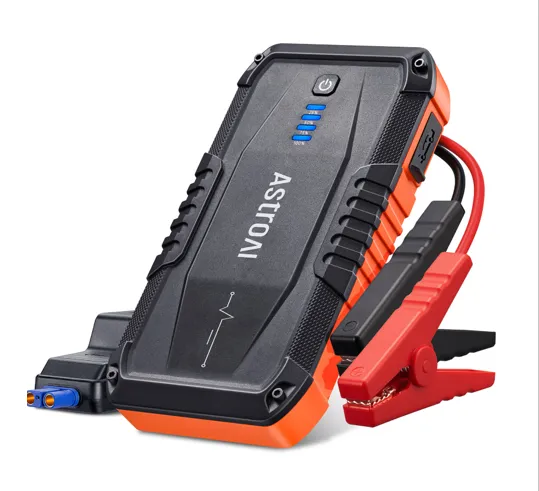
Recommended — Best Glove-Box Pick: AstroAI S8 Mini Jump Starter
1200A peak current, 8000mAh / 29.6Wh capacity, rated for gasoline engines up to 6L (and 3L diesel) — covers virtually every passenger car, ATV, and motorcycle on U.S. roads. The standout spec: weight 0.77 lbs and dimensions 6.3 × 3.2 × 1.1 in — small enough that it actually lives in your glove box rather than your basement.
Why it's right for cost-of-living defense: small enough not to get "left at home," powerful enough for the cars most U.S. families actually own, and priced like a single tow call.
The All-in-One Alternative: One Device, Both Levers
If you would rather carry one tool instead of two, the AstroAI S8 Air bundles the inflator and the jump starter into a single 2.43 lb unit. It directly addresses both pain points in this article — the fuel-savings lever (tire inflation) and the old-car-insurance lever (jump start) — from a single charge port and a single glove-box slot.
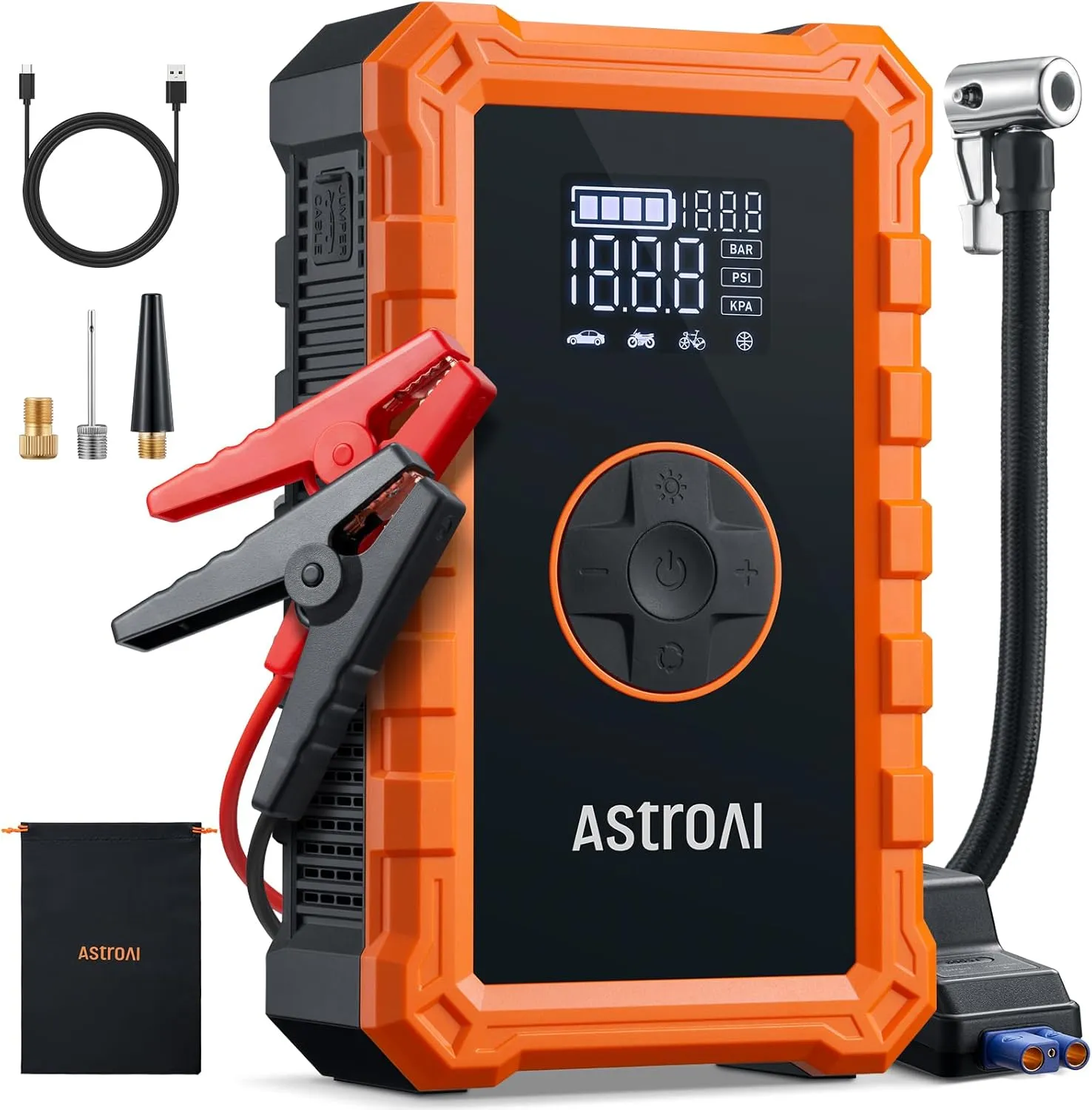
All-in-One Pick: AstroAI S8 Air 2-in-1 Jump Starter + Tire Inflator
1500A peak current jump starter plus a built-in 150 PSI air compressor with 24.5 L/Min inflation speed — in one 2.43 lb unit. Strong enough to start most U.S. passenger cars and crossovers, fast enough to top up four tires before a road trip, light enough to actually live in the car.
Why it is right for cost-of-living defense: removes the most common excuse households give for skipping the monthly check — "I have to dig out two different gadgets." One device, one charge cycle, both levers covered.
3. The Combined Stack: One-Time Spend, Multi-Year Return
Treat these two tools as a single "household transportation insurance kit." Total upfront cost typically lands well under $100, and the year-one cash recovery for an average household looks like this:
| Recovery Source | Year-1 Estimate (avg household, 12K mi @ $4.09 gas) |
|---|---|
| Fuel saved by keeping all four tires within 1 PSI of placard | $58–$120 |
| Tire-life extension (NHTSA TireWise) | $60–$160 |
| Avoiding one paid gas-station air fill / month ($1.50–$2.50) | $18–$30 |
| Avoiding ONE dead-battery tow call | $100–$200 |
| Avoiding a panic battery replacement that wasn't needed yet | $225–$400 |
| Total realistic Year-1 recovery | $235–$910+ |
Even the conservative end of that range is a multiple of the upfront cost. The aggressive end — which assumes the jump starter prevents one premature battery replacement — comfortably pays for the entire kit in a single event. And both tools keep working in years 2, 3, 4…
The Bigger Picture
Stanford's Institute for Economic Policy Research noted that the most immediate impact of Hormuz-driven oil shocks is "at the pump." Households can't influence OPEC, sanctions, or shipping lanes. They can influence the two largest controllable line items inside the average garage: how efficiently the car burns fuel, and how long the car keeps starting.
4. The 5-Minute Monthly Routine That Captures the Savings
Owning the tools is half the battle. Here is the routine that turns them into recurring savings:
- First Saturday of every month — tire check (3 min). Cars park "cold" overnight. Read the placard inside the driver's door (NOT the sidewall number, which is a max). Top up to placard PSI on all four tires plus the spare.
- Same Saturday — jump starter health check (1 min). Press the power button. If charge is below 50%, plug it into a USB-C charger. Lithium self-discharge means a "set and forget" jump starter is often dead when you need it.
- Seasonal swing days — extra tire check. Every 10°F drop costs roughly 1 PSI (Consumer Reports, 2025). The first cold morning in October and the first hot week in May are the two highest-leverage check points of the year.
- Pre–road-trip protocol. Inflate to placard pressure for a fully loaded vehicle (often 6–11 PSI higher in the rear, listed on the same door placard). Confirm jump starter is >80% charged.
- Cold snap below 32°F. If your car is 5+ years old or the battery is 4+ years old, keep the jump starter inside the cabin overnight (lithium loses output capacity in extreme cold).
That's it. Five minutes a month, one annual seasonal check, and the savings stack quietly in the background.
Frequently Asked Questions
Q: Will gas prices actually stay above $4 in 2026?
U.S. Energy Secretary Chris Wright told reporters in spring 2026 that he does not expect gas to fall back below $3 per gallon until 2027. The April 16, 2026 AAA national average is $4.09. Stanford SIEPR analysts note that Hormuz-driven oil shocks "show up most immediately at the pump." Plan your household budget around an elevated baseline through at least the rest of 2026.
Q: How much money does proper tire inflation actually save in real dollars?
The U.S. Department of Energy's fueleconomy.gov reports that every 1 PSI below placard costs about 0.2% of fuel economy, with the maximum loss landing around 3.3%. For an average household driving 12,000 miles a year at 28 MPG and $4.09 gas, that's roughly $58 per year in pure fuel, plus another $60–$160 in extended tire life (NHTSA TireWise: 25% tread-life loss avoided, ~4,700 extra miles).
Q: Why is the average U.S. car getting older every year?
Per S&P Global Mobility (May 2025), the average light vehicle on U.S. roads hit a record 12.8 years. The drivers are simple: new-vehicle transaction prices near $48,500, longer auto loans, higher interest rates, and post-pandemic inventory pressures. Households making "keep the old car" the rational choice need to invest small sums in keeping it reliable — tires, battery, brakes — rather than large sums on a replacement.
Q: Does a jump starter actually extend the life of an old car, or just the battery?
Both, indirectly. A jump starter prevents the panic chain — "car wouldn't start → tow truck → 'maybe it's time' → new-car shopping." For a 12.8-year-old vehicle, that decision is often made under emotional pressure during a single bad morning. Owning a jump starter buys you time to diagnose calmly: was it the battery alone, the alternator, the cold? Most of the time the answer is "just the battery on a cold day," and a $200 fix keeps a paid-off car on the road for two more years.
Q: How big does the jump starter need to be?
Match peak current to engine displacement. A 1200A unit like the AstroAI S8 Mini covers gasoline engines up to about 6L — that's the vast majority of U.S. passenger cars and crossovers. For larger pickups, V8 SUVs, or diesels, step up to a 2000A or 3000A unit. Capacity (mAh / Wh) determines how many jumps you get per charge; 8000mAh+ is comfortable for multiple events plus phone-charging duty.
Q: I have AAA. Do I still need a jump starter?
AAA's own data answers this: during the January 2026 cold snap, calls surged 30%+ and wait times stretched to several hours in many regions. AAA reported "more than 37,000 service calls" across single-territory days. Your jump starter is the difference between waiting in a cold parking lot at 6 AM versus driving to work on time. Think of AAA as catastrophe coverage; the jump starter is preventive maintenance.
Q: Should I buy two separate tools (inflator + jump starter) or a 2-in-1 combo?
Pick the two-piece kit (C2 + S8 Mini) if you want best-in-class performance for each job — the C2 inflates fastest in its class (50-second top-up) and the S8 Mini is the lightest dedicated jump starter at 0.77 lbs, so each tool is optimized. Pick the 2-in-1 combo (S8 Air, 2.43 lbs) if you would rather make one purchase, manage one charge cycle, and find one device in your trunk. The combo is heavier than either single-purpose unit but lighter than the two combined, and it removes the most common excuse households cite for skipping monthly tire checks: "I have to dig out two different gadgets." Both paths work; the right one is whichever you will actually use every month.
Q: Won't I just forget about these tools after a month?
That is the real failure mode — not the tools themselves. Two practical fixes: (1) Pick a fixed monthly anchor day (first Saturday, the day rent/mortgage clears, etc.) and tie the 5-minute check to it. (2) Choose models small enough to live in the car, not in a basement. The C2 inflator (2.54 lbs) and S8 Mini jump starter (0.77 lbs) together weigh under 3.5 lbs and fit in a glove box or door pocket — if it's there, you'll use it.
Closing: Small Tools, Outsized Returns
Hormuz, Brent crude, Federal Reserve decisions, election-year tariffs — none of it is in your control. What is in your control is the air pressure in four tires and whether your aging family sedan starts on a cold morning. For under $100 in one-time spend, you can recover several hundred dollars per year in fuel and avoided service calls, and meaningfully postpone a $30,000+ vehicle replacement decision.
In a year defined by macroeconomic anxiety, that is one of the highest-ROI moves any household can make — and the only one that fits in a glove box.
Build the two-piece kit: AstroAI C2 Dual Power Tire Inflator + AstroAI S8 Mini Jump Starter. Or grab the all-in-one: AstroAI S8 Air 2-in-1 Jump Starter + Tire Inflator.