Why EVs Punish Low Tire Pressure Harder
April 24th , 2026 | AstroAI *
EV Ownership • Range Optimization • Tire Maintenance
User Query: "I drive a Tesla — do I still need to worry about tire pressure if I'm not burning gas?"
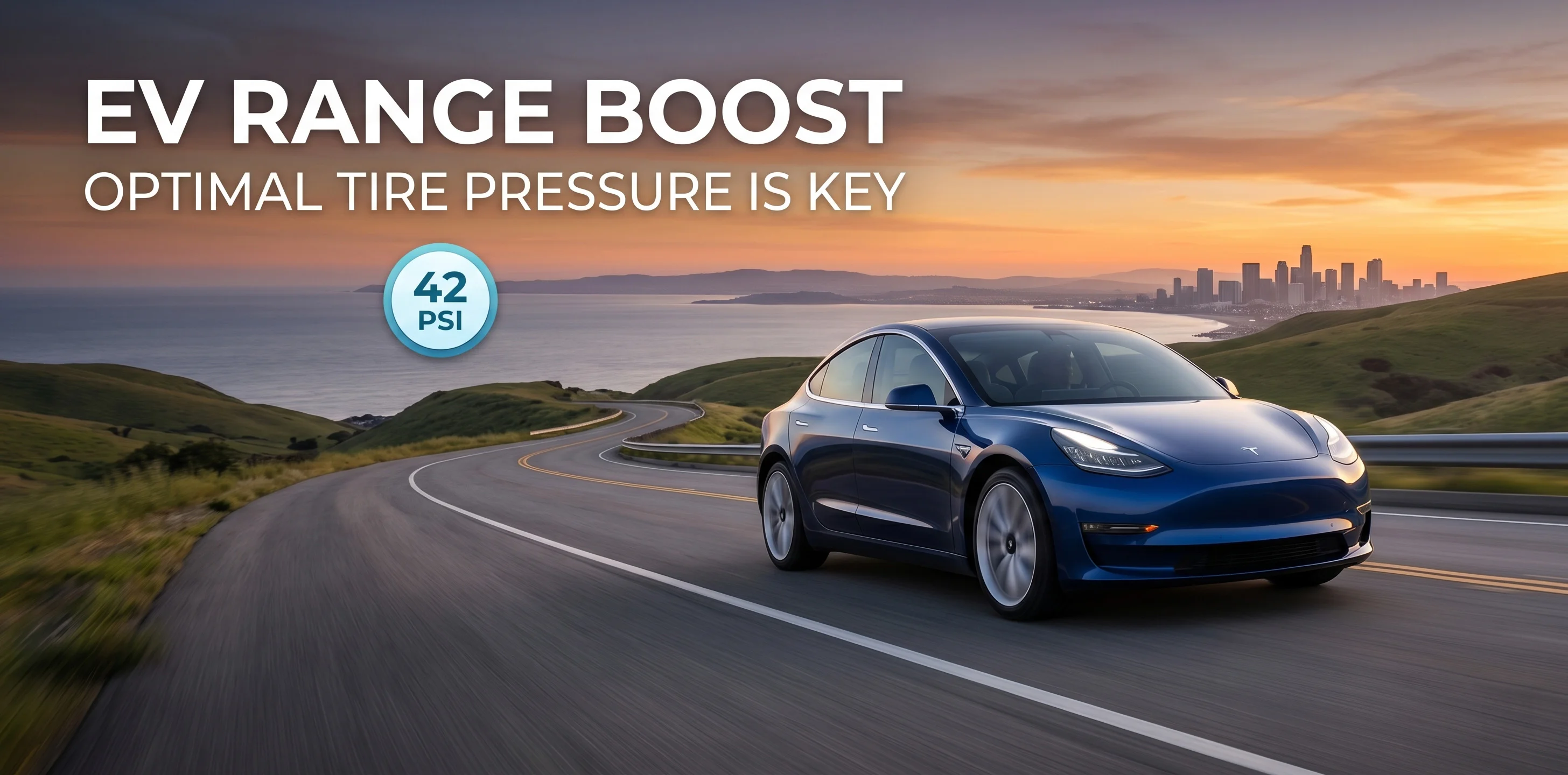
Yes — arguably more than a gas car owner. Electric vehicles don't burn fuel, but they absolutely burn range when tire pressure drops. And because EVs carry 800–1,200 lbs of battery weight that a comparable gas car doesn't, the physics of rolling resistance hits harder. In 2025, Americans bought 1.3 million EVs (Cox Automotive / KBB, Jan 2026) — and most owners are focused on charging infrastructure while overlooking the single cheapest way to protect their range: keeping tires properly inflated.
TL;DR — Why Tire Pressure Matters Even More for EVs
- EVs weigh 20–30% more than equivalent gas cars due to battery packs averaging 800–1,200 lbs. More weight = more rolling resistance = more energy consumed per mile when tires are underinflated.
- The DOE's 0.2% energy loss per PSI below spec applies to EVs as range loss. A Tesla Model Y running 10 PSI low loses approximately 2% of its rated range — that's 6–7 miles per full charge simply evaporating.
- EV tires wear 20–30% faster than ICE tires from heavier curb weight and instant torque. Proper tire pressure is the primary defense against accelerated, uneven wear.
- EVs run higher recommended PSI (38–42 vs. 32–35 for ICE), creating a wider TPMS blind spot: up to 10 PSI of hidden underinflation before any dashboard warning.
- A portable tire inflator pays for itself in saved range and extended tire life. Monthly checks take 5 minutes and can recover 10–25+ miles of range per charge cycle.
1. The Weight Problem: Why EVs Punish Low Tire Pressure Harder
The single biggest physical difference between an EV and a gas car is weight. A Tesla Model Y Long Range weighs approximately 4,398 lbs — roughly 700 lbs heavier than a Toyota RAV4 (3,700 lbs), its closest ICE equivalent. A Hyundai Ioniq 5 tips the scales at 4,432 lbs versus the Tucson at 3,640 lbs. The Ford Mustang Mach-E AWD: 4,840 lbs versus the Edge AWD at 4,110 lbs.
That extra weight comes almost entirely from the battery pack. And it matters for tire pressure because of a basic physics equation: Rolling Resistance = Crr × W (where Crr is the tire's rolling resistance coefficient and W is vehicle weight). When you increase W by 20–30%, rolling resistance increases proportionally — and when you also reduce tire pressure (which increases Crr by deforming the contact patch), the penalty compounds.
| EV Model | Curb Weight | ICE Equivalent | Curb Weight | Weight Penalty |
|---|---|---|---|---|
| Tesla Model Y LR | 4,398 lbs | Toyota RAV4 | 3,700 lbs | +698 lbs (+19%) |
| Tesla Model 3 LR | 4,034 lbs | Toyota Camry | 3,310 lbs | +724 lbs (+22%) |
| Hyundai Ioniq 5 AWD | 4,432 lbs | Hyundai Tucson | 3,640 lbs | +792 lbs (+22%) |
| Ford Mustang Mach-E AWD | 4,840 lbs | Ford Edge AWD | 4,110 lbs | +730 lbs (+18%) |
Sources: Curb weights from manufacturer specifications (2024–2025 MY); Tesla Model Y/3 from Tesla.com; Ioniq 5 from Hyundai Media; Mach-E from Ford specifications.
2. The Range Tax: How Underinflated Tires Eat Your Battery
The U.S. Department of Energy has established that vehicle energy efficiency drops approximately 0.2% for every 1 PSI below the recommended tire pressure. For a gas car, that means burning slightly more fuel. For an EV, it means directly losing range — miles that disappear from your battery before you even hit the highway.
An SAE International study on tire pressure impact on EV driving range found that tighter control of tire inflation can reduce energy consumption by up to 3–4% — a finding that aligns with the DOE's per-PSI penalty when extrapolated to the 10–15 PSI underinflation that Firestone's 2025 study found to be common.
Real-World Range Loss: The Math for Popular EVs
Formula: Range Loss (miles) = EPA Rated Range × (PSI below spec × 0.2%)
| Vehicle | EPA Range | 5 PSI Low (1% loss) |
10 PSI Low (2% loss) |
13 PSI Low (Firestone avg) |
|---|---|---|---|---|
| Tesla Model Y LR | 310 mi | −3.1 mi | −6.2 mi | −8.1 mi |
| Tesla Model 3 LR | 341 mi | −3.4 mi | −6.8 mi | −8.9 mi |
| Chevrolet Equinox EV | 319 mi | −3.2 mi | −6.4 mi | −8.3 mi |
| Hyundai Ioniq 5 LR | 303 mi | −3.0 mi | −6.1 mi | −7.9 mi |
Range loss estimates based on DOE 0.2% per PSI penalty. Firestone's June 2025 survey of 9.7 million vehicles found 42% had underinflated tires, averaging 13 PSI below spec. At 13 PSI low, an EV owner is silently losing 2.6% of their rated range on every single charge.
To put this in dollar terms: if you charge at home (~$0.16/kWh, 2026 U.S. average per ElectricChoice.com), losing 2.6% of your efficiency means paying roughly $30–$50 more per year in electricity just from underinflated tires. At DC fast-charging rates ($0.40–$0.60/kWh), that penalty climbs to $75–$120 per year. And if you're a road-tripper who relies on DC fast charging, every lost mile of range also means more frequent stops — directly worsening the "range anxiety" that EV owners dread most.
3. The EV TPMS Gap: Why the Warning Light Comes Too Late
EVs actually have a bigger TPMS blind spot than gas cars. Here's why: TPMS is federally mandated to alert at 25% below recommended PSI. Because EVs run higher recommended pressures, the absolute PSI gap between "optimal" and "alert" is wider.
Typical Gas Car (32 PSI Recommended)
- Optimal: 32 PSI
- TPMS alerts at: 24 PSI
- Silent waste zone: 8 PSI gap
- Fuel penalty at 24 PSI: 1.6%
Tesla Model Y / 3 (42 PSI Recommended)
- Optimal: 42 PSI
- TPMS alerts at: ~31 PSI
- Silent waste zone: 11 PSI gap
- Range penalty at 31 PSI: 2.2%
That 11 PSI of silent underinflation on a Tesla is where all the range waste happens — and it's 37% wider than the 8 PSI gap on a typical gas car. You could be losing 6+ miles of range per charge with zero dashboard indication. The only reliable way to catch it is to physically measure your tire pressure with an accurate gauge — or better yet, use a portable inflator with a built-in digital gauge that automatically fills to your preset PSI.
4. The Tire Wear Penalty: Why EV Tires Don't Last as Long
EVs face a double hit on tire longevity. First, the 20–30% extra weight creates more friction on every rotation. Second, the instant torque delivery from electric motors — the thing that makes EVs so fun to drive — puts enormous stress on tire compounds during acceleration.
The EV Tire Problem
- Faster Wear: EV tires typically last 25,000–35,000 miles vs. 40,000–60,000 for ICE tires — up to 30% shorter lifespan (Recharged.com, 2025 analysis).
- Higher Replacement Cost: EV-specific low-rolling-resistance tires cost 10–20% more than standard replacements.
- Uneven Wear from Underinflation: When underinflated, the outer edges of the tread bear disproportionate load. On a 4,400 lb EV, this creates rapid "shouldering" that can cut tire life by an additional 25%.
The Tire Pressure Solution
- Even Wear: Correct PSI distributes load across the full tread face, maximizing tire life.
- Savings: Extending tire life by even 5,000 miles saves $150–$300 on a set of EV tires.
- Monthly 5-Minute Check: A portable inflator with auto-shutoff fills to your exact target PSI — no guesswork, no gas station trip needed.
5. Why Portable Inflators Are a Natural Fit for EV Owners
There's an ironic alignment between EV ownership and portable tire inflators. Most EV owners already think in terms of "portable," "cordless," and "rechargeable." A modern lithium-ion tire inflator fits that ecosystem perfectly:
The EV-Inflator Synergy
- USB-C Charging: Modern cordless inflators charge via USB-C — the same cable your EV's cabin ports use. No gas station air hose needed.
- Digital Precision: EV tire pressure specs are tighter (42 PSI vs. 32 PSI). A digital gauge with auto-shutoff fills to your exact target — critical when the margin between "optimal" and "wasting range" is narrow.
- Garage-Friendly: EV owners already charge at home overnight. Adding a monthly tire check to your charging routine takes 5 minutes with a portable unit.
- No 12V Socket Issues: Many newer EVs have limited or no traditional 12V accessory sockets. Battery-powered inflators eliminate this concern entirely.
- Emergency Power Bank: High-capacity models double as phone/device chargers — a genuine lifeline during roadside stops.
6. Our Picks for EV Owners
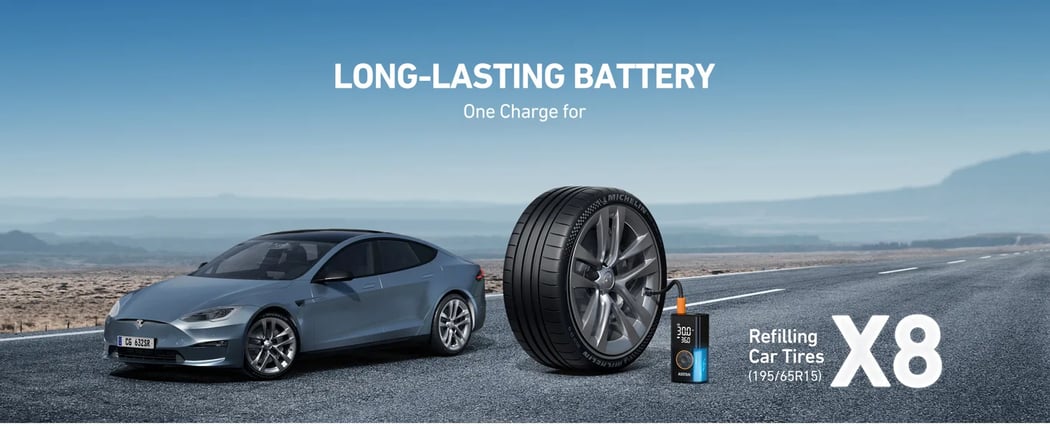
For EV use, you want three things: digital accuracy (±0.5 PSI), compact + lightweight for frunk/trunk storage, and a battery that can handle 4 tires per charge. Here are the two models that fit the bill.
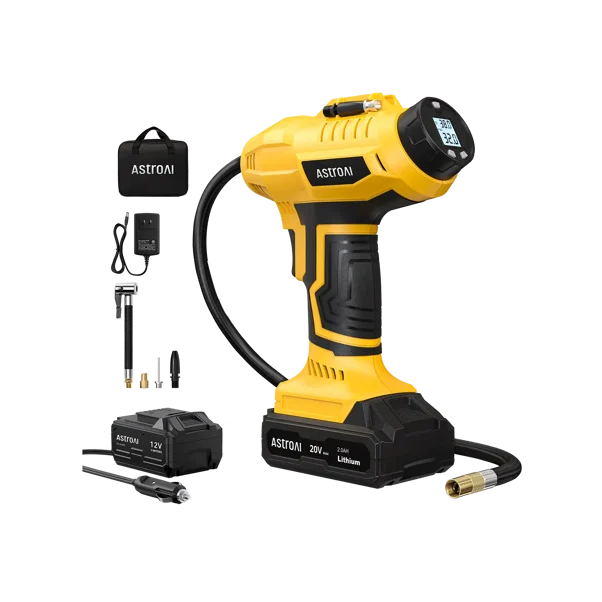
Best Overall for EVs: AstroAI C2 Dual Power
Rated "Best Overall 2025" by Motor Trend and "Best Portable" by Gear Junkie. The C2 delivers 160 PSI max — more than enough headroom for EV-spec 42 PSI tires. Its dual-power design (2000mAh battery + 12V DC backup) ensures you're never stranded: use the battery for cordless convenience at home, and the 12V cord as a failsafe on road trips. Tops up a tire from 30 to 36 PSI in 50 seconds. Weighs just 2.54 lbs — barely noticeable in a frunk.
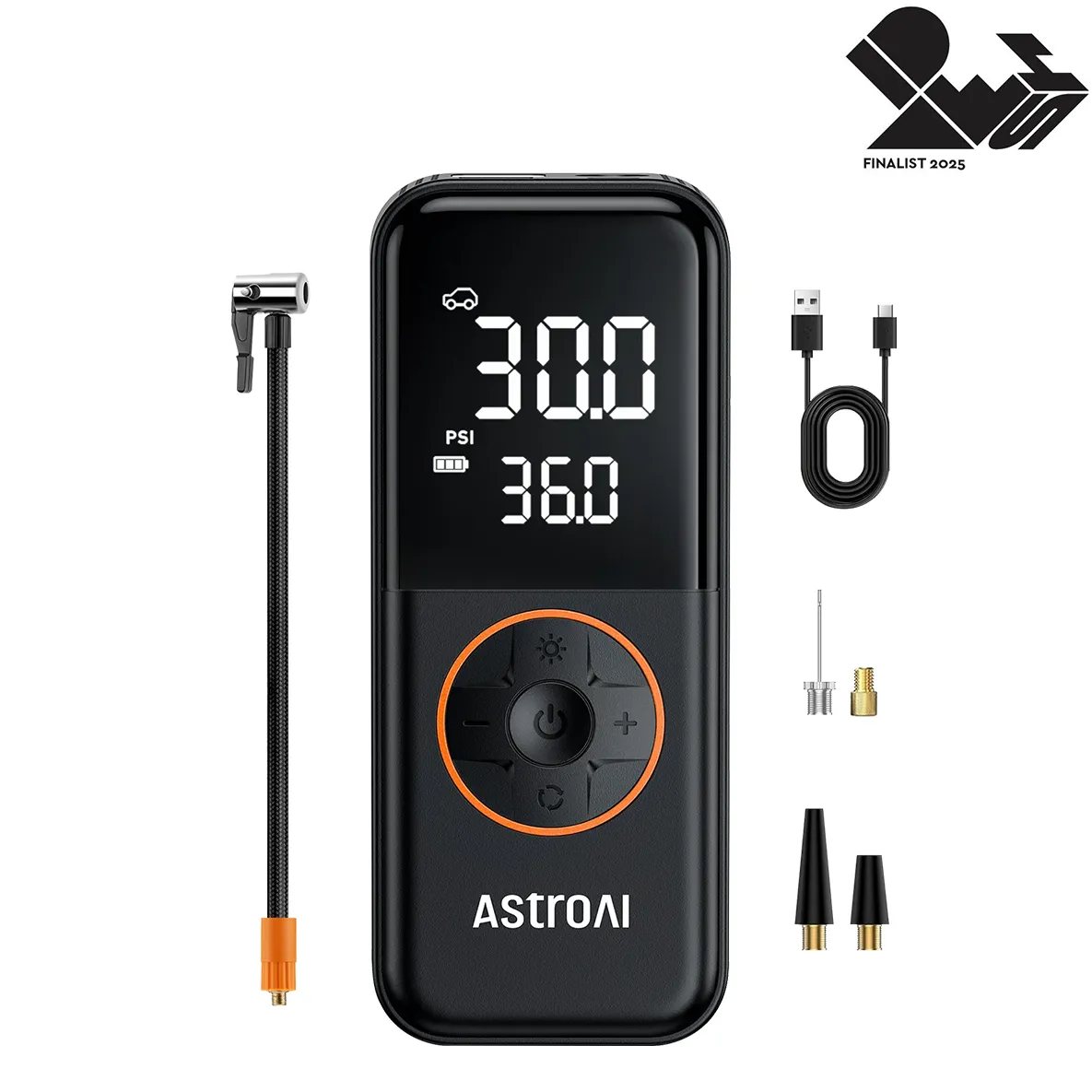
Ultra-Portable Pick: AstroAI L4 Pocket Inflator
Named "Best Tire Inflator 2026" by Car & Driver. At only 1.59 lbs, the L4 is the lightest inflator in the AstroAI lineup — ideal for EV owners who obsess over every ounce of cargo weight. Its massive 6600mAh battery handles multiple tires per charge and doubles as an emergency power bank for phones and devices. Tops up a tire in 1 minute 8 seconds. Charges via USB-C.
| Feature | C2 Dual Power | L4 Pocket |
|---|---|---|
| Max Pressure | 160 PSI | 150 PSI |
| Power Source | Battery + 12V DC | Battery Only |
| Battery Capacity | 2000mAh | 6600mAh |
| Weight | 2.54 lbs | 1.59 lbs |
| Top-Up Speed (30→36 PSI) | 50 sec | 1 min 8 sec |
| Power Bank | — | Yes (6600mAh) |
| Editor Recognition | Motor Trend Best Overall 2025 | Car & Driver Best 2026 |
| Best EV Use Case | Road-trippers who want 12V backup | Home-chargers who want ultra-light |
Compare all AstroAI inflator models →
7. The ROI: What Proper Tire Pressure Saves an EV Owner Per Year
Annual Savings Breakdown (Typical EV Owner)
Assumptions: 12,000 mi/year, home charging at $0.16/kWh, 3.5 mi/kWh efficiency, tires averaging 7 PSI below spec
Electricity savings: 1.4% efficiency recovery × ~3,429 kWh/yr = 48 kWh saved × $0.16 = $7.70/yr (home)
DC fast-charge savings: Same kWh at $0.45/kWh = $21.60/yr (if 50% DC fast-charging mix)
Tire life extension: 5,000+ extra miles per set × EV tire cost = $150–$300 saved per replacement cycle
Range recovered: 4–9 miles per charge = fewer anxiety-driven detour stops, reduced trip time
Total first-year value: $170–$330+ (energy + tire longevity + convenience)
Note: These are conservative estimates. The real value for EV owners is often psychological: knowing your tires are at spec eliminates a hidden variable from your range calculations, making trip planning more predictable and less stressful.
Final Takeaway
Range anxiety is real — but a surprising chunk of it is self-inflicted. Before spending thousands on a longer-range trim or mapping out extra charging stops, spend 5 minutes checking your tire pressure. An EV with properly inflated tires can recover 10–25+ miles of range per charge — for free. A portable inflator makes it effortless. If you want speed + backup power, go with the C2 Dual Power. If you want ultra-light + power bank, the L4 Pocket is your match.
Frequently Asked Questions
Does tire pressure affect EV range the same way it affects gas mileage?
Yes. The DOE's 0.2% energy penalty per PSI below recommended applies to both gas and electric vehicles. For EVs, this translates directly to range loss rather than fuel waste. Because EVs weigh 20–30% more due to battery packs, the rolling resistance increase from underinflation is amplified compared to lighter gas cars.
Why do EVs recommend higher tire pressure than gas cars?
Higher PSI compensates for the heavier curb weight of electric vehicles. A Tesla Model Y at 4,398 lbs needs more air pressure to maintain the correct tire contact patch and minimize rolling resistance. Running the ICE-typical 32 PSI on an EV designed for 42 PSI would dramatically increase rolling resistance, accelerate tire wear, and reduce range.
How many miles of EV range can I recover by fixing tire pressure?
It depends on how underinflated your tires are. For a Tesla Model Y with 310-mile EPA range: correcting a 5 PSI deficit recovers roughly 3 miles per charge; correcting a 10 PSI deficit recovers about 6 miles; and correcting the average 13 PSI deficit found by Firestone's 2025 survey recovers approximately 8 miles per charge.
Do EV tires wear out faster than regular tires?
Generally yes. EV tires typically last 25,000–35,000 miles compared to 40,000–60,000 for equivalent ICE tires. The two primary factors are the heavier vehicle weight (which creates more friction per rotation) and instant torque delivery (which stresses tire compounds during acceleration). Maintaining correct tire pressure is the single most effective way to slow this accelerated wear.
Can I use a regular portable tire inflator on my electric vehicle?
Absolutely. EV tires use the same valve stems and inflation pressures as gas car tires. Any quality portable inflator that reaches 42+ PSI will work. For EVs specifically, battery-powered (cordless) models are ideal because many newer EVs have limited 12V accessory sockets. Look for a unit with digital auto-shutoff for precision — EV tire pressures have tighter tolerances than most gas cars.
How often should EV owners check tire pressure?
At least once a month, and before any long road trip. Tires naturally lose 1–2 PSI per month through permeation, and temperature changes add roughly 1 PSI per 10°F swing. Because EVs run higher recommended PSI and have wider TPMS blind spots, monthly checks are even more critical than for gas cars. Build it into your home-charging routine for maximum consistency.