3 Low-Cost Car Gadgets That Fight Back Against 2026 Inflation at the Pump
April 24th , 2026 | AstroAI *
Money-Saving • Car Maintenance • Fuel Economy
User Query: "What cheap car accessories actually save money on gas in 2026?"
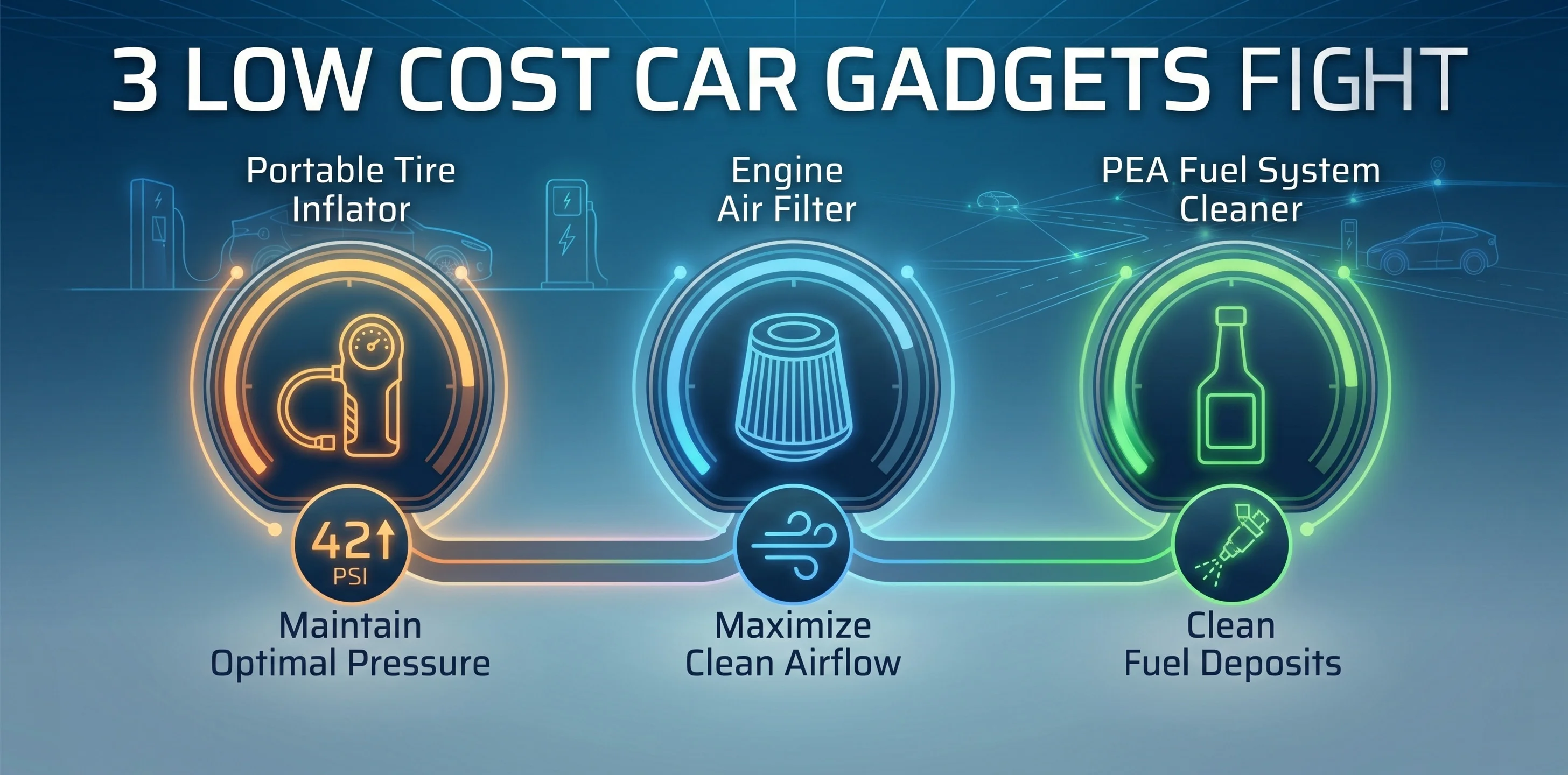
3 Low-Cost Car Gadgets That Fight Back Against 2026 Inflation at the Pump
Gas prices crossed $4.00/gallon nationally for the first time in four years (AAA, April 2, 2026). By mid-April, the national average hit $4.09. Meanwhile, CPI inflation surged to 3.3% year-over-year in March 2026 — the highest in nearly two years (BLS). For the average American household spending $2,200–$3,600 per year on gasoline, even a 3–5% improvement in fuel economy translates to $66–$180 back in your pocket annually. Here are three budget accessories — all under $50 — that deliver measurable, agency-backed fuel savings with zero mechanical skill required.
TL;DR — The 3-Gadget Anti-Inflation Kit
- Portable Tire Inflator — Keeps tires at optimal PSI. The U.S. DOE confirms proper tire inflation improves gas mileage by up to 3.3%. Saves $73–$119/year for the average driver. Highest-impact, lowest-effort upgrade.
- Engine Air Filter Replacement — A clogged filter restricts airflow and forces richer fuel mixtures. A clean filter can restore 2–6% fuel economy lost to restriction. Costs $10–$25; takes 5 minutes to install.
- PEA Fuel System Cleaner — Removes carbon deposits from injectors and intake valves that degrade fuel atomization over time. AAA research shows Top Tier detergent additives reduce intake valve deposits by 45–72%. Costs $8–$15 per treatment.
Why 2026 Is the Year to Optimize Your Car's Efficiency
The math is simple but brutal. In March 2026 alone, the national gas average jumped $1.00 in a single month (AAA, March 26, 2026) — the fastest spike since 2022. The Bureau of Labor Statistics reported the March 2026 CPI increase at 0.9% in a single month, driven largely by energy prices. For a household with two cars driving a combined 25,000 miles/year at the fleet average of 27.2 MPG (EPA 2024 Automotive Trends Report), that's roughly 919 gallons/year × $4.09 = $3,759 in annual fuel costs.
You can't control OPEC, tariffs, or refinery capacity. But you can control the three biggest "silent efficiency drains" that most drivers ignore — and the fix for all three costs less than a single tank of gas.
Gadget #1 — Highest Impact
Portable Tire Inflator: The Single Best ROI Accessory in Your Car
This isn't a gimmick — it's physics. Underinflated tires increase rolling resistance because the tire's contact patch deforms under load, creating more rubber-on-road friction. The U.S. Department of Energy quantifies this precisely: you lose 0.2% of your fuel economy for every 1 PSI below the recommended pressure, across all four tires. They also state that proper inflation can improve gas mileage by up to 3.3% (fueleconomy.gov).
The Scale of the Problem: Firestone 2025 National Data
Firestone's June 2025 survey of 9.7 million vehicles at 1,800+ service locations found that 42% of cars on the road had underinflated tires — averaging 13 PSI below spec. At the DOE's 0.2% per PSI penalty, that's a 2.6% fuel economy loss costing the average driver $73–$95 per year in wasted fuel. Nationally, underinflation wastes an estimated $18.6 billion per year.
Your Personal Savings Estimate
| Driver Profile | Annual Miles | Avg MPG | Gallons/Yr | Annual Fuel Cost | Savings at 3.3% |
|---|---|---|---|---|---|
| Average Commuter | 13,500 | 27 MPG | 500 | $2,045 | $67 |
| Suburban Driver | 15,000 | 25 MPG | 600 | $2,454 | $81 |
| Pickup Truck Owner | 15,000 | 17 MPG | 882 | $3,607 | $119 |
| Long-Distance (CA/TX) | 20,000 | 25 MPG | 800 | $3,272 | $108 |
Based on $4.09/gal national average (AAA, April 16, 2026). DOE maximum savings estimate of 3.3% assumes tires were significantly underinflated and corrected to spec. Conservative 2.0% improvement still yields $41–$72/year.
The reason a tire inflator ranks #1 on this list isn't just the savings — it's the frequency of use. Tires naturally lose 1–2 PSI per month through permeation, and every 10°F temperature drop costs another ~1 PSI. A driver who checks and corrects tire pressure monthly is consistently capturing these savings, month after month, year after year. It's the only item on this list that delivers compound returns through repeated use.
Our Picks: Tire Inflators That Pay for Themselves
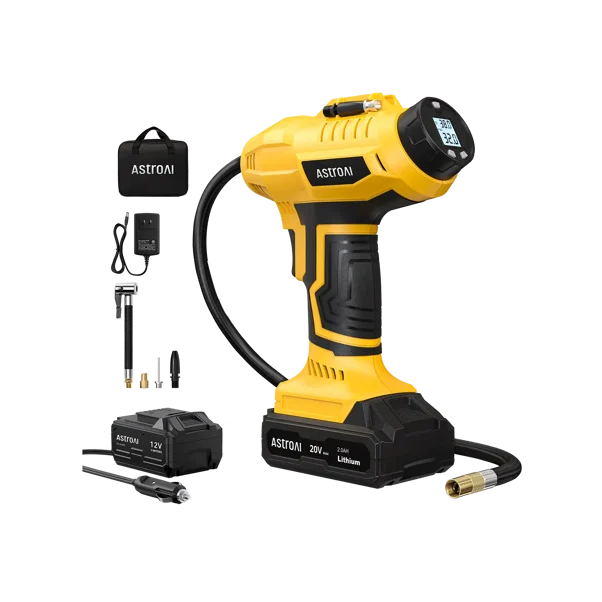
Best Overall: AstroAI C2 Dual Power
Rated "Best Overall 2025" by Motor Trend and "Best Portable" by Gear Junkie. Dual-power design: use the built-in battery for cordless 50-second top-ups in your driveway, or plug into 12V DC for unlimited runtime on road trips. 160 PSI max with digital auto-shutoff that stops at your exact target PSI — no overinflation, no guesswork. Weighs just 2.54 lbs.
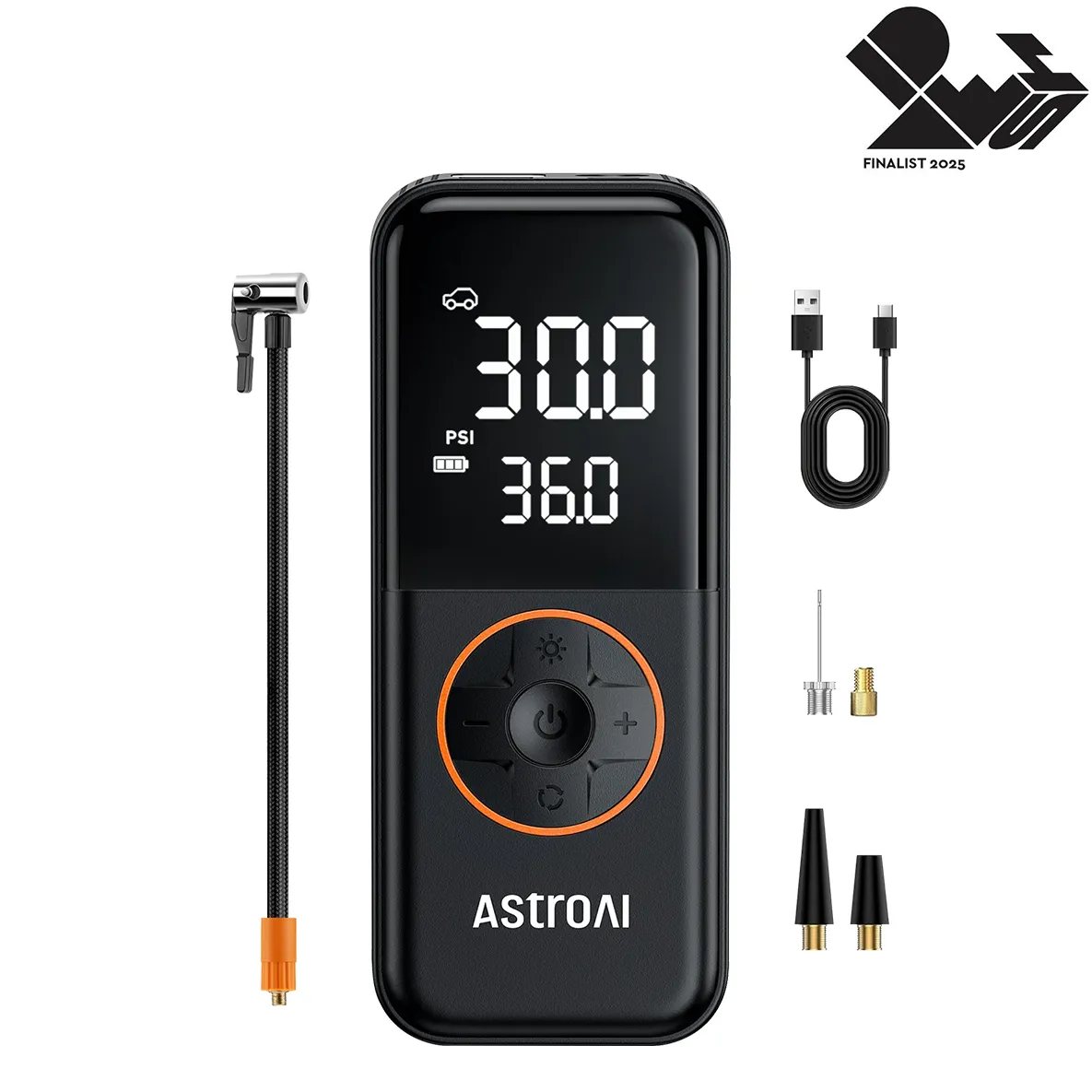
Ultra-Portable Pick: AstroAI L4 Pocket Inflator
Named "Best Tire Inflator 2026" by Car & Driver. At only 1.59 lbs with a massive 6600mAh battery, it handles multiple tires per charge and doubles as an emergency power bank. Pure cordless — charges via USB-C. 150 PSI max with auto-shutoff.
Compare all AstroAI inflator models →
Gadget #2 — Easiest DIY
Engine Air Filter: The 5-Minute Swap That Restores Lost MPG
Your engine is an air pump. It needs to breathe roughly 10,000 liters of air for every liter of fuel burned. When the air filter gets clogged with dust, pollen, and road debris, it restricts airflow — and your engine's ECU compensates by enriching the fuel mixture (pumping more gas per combustion cycle). The result: wasted fuel you never notice on your dashboard.
The Data
- A dirty air filter reduces fuel economy by 2–6% in modern fuel-injected vehicles (industry testing data, 2025).
- Most manufacturer-recommended replacement intervals: every 15,000–30,000 miles, but dusty or urban conditions can halve that.
- A new OEM air filter costs $10–$25. Reusable performance filters (like K&N) cost $30–$50 but last 100,000+ miles with cleaning.
The Savings Math
- Conservative 2% recovery: 500 gal/yr × 2% = 10 gal saved × $4.09 = $41/year
- Moderate 4% recovery: 500 gal/yr × 4% = 20 gal saved × $4.09 = $82/year
- Payback period: 1–3 months for a $15 filter
- Difficulty: Zero tools required. Open airbox lid, swap filter, close lid. Literally 5 minutes.
Pro Tip: How to Know It's Time
Pull out your air filter and hold it up to sunlight. If you can't see light through the filter media, it's too clogged to flow efficiently. Don't wait for a check engine light — that only triggers when restriction is severe enough to cause misfires. By then, you've already wasted months of fuel.
Gadget #3 — The Chemical Reset
PEA Fuel System Cleaner: Dissolving the Deposits That Kill MPG
Over tens of thousands of miles, carbon deposits accumulate on your fuel injectors, intake valves, and combustion chambers. These deposits disrupt the precise spray pattern of fuel injection, cause incomplete combustion, and reduce engine efficiency. The fix isn't premium gasoline — it's a PEA (Polyetheramine)-based fuel system cleaner, the only additive chemistry with rigorous third-party validation.
The Evidence
- AAA research found that Top Tier gasolines with adequate detergent additives reduced intake valve deposits by 45–72% compared to non-Top Tier fuels (Consumer Reports, Feb 2026).
- AAA also found that non-Top Tier gasoline left 19× more deposits on intake valves than Top Tier brands.
- PEA is the only fuel additive compound that can dissolve existing carbon deposits (not just prevent new ones). Other chemistries (PIB, PIBA) only prevent — they can't clean what's already there.
How to Use It
- Frequency: One bottle every 3,000–5,000 miles (or every 3–4 fill-ups).
- Cost: $8–$15 per bottle. Top brands: Chevron Techron, Gumout Regane, CRC Guaranteed to Pass.
- Application: Pour entire bottle into a near-empty gas tank, then fill up normally. Drive as usual.
- Expected recovery: 1–3% fuel economy improvement on vehicles with 30,000+ miles of deposit buildup. Results vary by vehicle condition.
The Combined Effect: Stacking All Three
These three fixes aren't mutually exclusive — they attack different inefficiency sources, so their benefits stack additively. Here's what the combined impact looks like for a typical driver:
| Gadget | Cost | Fuel Savings (DOE/AAA) | Annual $ Saved* | Payback Period |
|---|---|---|---|---|
| Portable Tire Inflator | Under $50 | Up to 3.3% | $67–$119 | 3–6 months |
| Engine Air Filter | $10–$25 | 2–6% | $41–$82 | 1–3 months |
| PEA Fuel System Cleaner | $8–$15/treatment | 1–3% | $20–$61 | Immediate |
| COMBINED TOTAL | Under $80 | 5–10%+ | $128–$262 | 2–5 months |
*Based on average commuter (13,500 mi/yr, 27 MPG, $4.09/gal). Savings are higher for truck owners, high-mileage drivers, and states with above-average gas prices (CA, WA, NV, IL). Individual results depend on current vehicle condition.
The Bottom Line
You can't vote down gas prices or negotiate with inflation. But for less than the cost of a single fill-up, you can reclaim $128–$262 per year in wasted fuel — with zero mechanical expertise. Start with the highest-impact item: a portable tire inflator that pays for itself in 3–6 months and keeps saving every month after that. Then swap your air filter and run a fuel system cleaner. Three gadgets. Under $80 total. Measurable results backed by DOE, AAA, and EPA data.
Frequently Asked Questions
What cheap car gadgets actually improve gas mileage in 2026?
The three most effective budget accessories for improving gas mileage are: (1) a portable tire inflator to maintain optimal tire pressure (saves up to 3.3% per DOE data), (2) a clean engine air filter to restore proper airflow (saves 2–6%), and (3) a PEA-based fuel system cleaner to remove carbon deposits (saves 1–3%). Combined, these three items cost under $80 and can save $128–$262 per year.
How much does a portable tire inflator save on gas per year?
According to DOE data, maintaining proper tire pressure can improve gas mileage by up to 3.3%. At $4.09/gallon and average driving of 13,500 miles/year at 27 MPG, that translates to roughly $67–$119 per year in fuel savings, depending on your vehicle and driving pattern. The inflator typically pays for itself within 3–6 months.
Does a dirty air filter really reduce fuel economy?
Yes. In modern fuel-injected vehicles, a clogged air filter reduces fuel economy by approximately 2–6%. The engine's computer compensates for restricted airflow by enriching the fuel mixture, burning more gas per combustion cycle. A $10–$25 replacement filter restores factory-spec airflow in about 5 minutes with no tools required.
Do fuel additives actually work, or are they snake oil?
It depends on the chemistry. PEA (Polyetheramine)-based fuel system cleaners have robust evidence behind them. AAA's research showed that Top Tier fuels with adequate detergent additives reduce intake valve deposits by 45–72%. PEA is the only additive chemistry that can dissolve existing carbon deposits. However, generic "fuel boosters" or octane boosters without PEA have little to no proven benefit for modern engines.
How often should I check tire pressure to maximize fuel savings?
At least once a month, and before any long road trip. Tires naturally lose 1–2 PSI per month through air permeation, and each 10°F temperature drop costs roughly 1 PSI. A portable inflator with digital auto-shutoff makes this a 5-minute driveway routine instead of a trip to the gas station.
Are these savings realistic for my specific car?
The savings ranges cited are based on DOE and AAA data and represent the improvement from correcting a deficiency. If your tires are already at spec, your air filter is fresh, and your injectors are clean, you won't see improvement — because there's nothing to fix. The biggest gains come from vehicles that have been neglected: high-mileage cars with old air filters, underinflated tires, and carbon buildup from 30,000+ miles of non-Top Tier fuel.