The $40 Hack That Will Save Your 2026 Summer Road Trip Budget
April 28th , 2026 | AstroAI *
Road Trip Safety • Fuel Economy • Summer 2026
User Query: "How do I adjust tire pressure for a fully loaded car before a road trip?"
The $40 Hack That Will Save Your 2026 Summer Road Trip Budget
Last July 4th, a record 72.2 million Americans hit the road (AAA, June 2025). This summer, with gas at $4.09/gallon (AAA, April 16, 2026) and 39% of Americans planning even more vacations than last year (AAA, February 2026), every dollar of your road trip budget matters. Here's a problem almost nobody talks about: your car's tire pressure settings change when you load it up for a trip. The pressure on your door placard is typically for a "lightly loaded" vehicle — just you, maybe a passenger. When you pack four passengers, suitcases, a cooler, camping gear, and road trip snacks into a sedan or SUV, your rear tires need significantly more air to support that weight safely. Most drivers never adjust. The result? Wasted gas, premature tire wear, dangerous overheating on hot summer pavement — and potentially a blowout that ruins your entire vacation.
TL;DR — The Pre-Departure Tire Checklist
- Check your door jamb placard for "full load" or "max load" tire pressure — it's typically 3–8 PSI higher in the rear than the standard "lightly loaded" number.
- Inflate to the full-load spec before departure, while tires are cold (morning, before driving). This prevents underinflation under weight, which causes excess heat, fuel waste, and blowout risk.
- Underinflated tires on hot summer pavement (140°F+) are the #1 recipe for blowouts. NHTSA reports 646 fatalities and ~11,000 crashes from tire failures annually (2023).
- DOE data: Proper tire inflation improves fuel economy by up to 3.3% — saving $30–$80+ per road trip depending on distance and vehicle.
- A portable tire inflator lets you adjust pressure at home before leaving, top off at rest stops, and respond to slow leaks mid-trip — for under $40.
1. The Tire Pressure Number Nobody Reads: "Full Load" vs. "Light Load"
Open your driver's side door. Look at the tire pressure placard on the door jamb. Most drivers glance at the first number they see — typically 32–35 PSI for a standard sedan — and assume that's always correct. But look more carefully: many vehicles list two sets of pressures. One for "normal" or "light load" (1–2 passengers, no cargo) and one for "full load" or "max load" (full passengers plus luggage).
| Vehicle Type | Light Load (Front) | Light Load (Rear) | Full Load (Front) | Full Load (Rear) |
|---|---|---|---|---|
| Midsize Sedan | 32 PSI | 32 PSI | 35 PSI | 38–41 PSI |
| Midsize SUV / CUV | 33 PSI | 33 PSI | 35 PSI | 38–42 PSI |
| Minivan | 33 PSI | 33 PSI | 36 PSI | 39–44 PSI |
| Full-Size Pickup | 35 PSI | 35 PSI | 35 PSI | 41–44 PSI |
Representative ranges based on common manufacturer placard values. Always use your specific vehicle's door jamb placard. Full-load rear pressure is often 6–11 PSI higher than light-load rear pressure.
Why the rear tires specifically? When you pack a trunk or cargo area with luggage, the added weight sits almost entirely over the rear axle. This shifts the vehicle's weight distribution backward, compressing the rear tires more than the fronts. If you don't compensate with higher rear pressure, those tires deform excessively — increasing rolling resistance, generating more heat, and accelerating wear. On a 300-mile road trip at highway speed on 100°F pavement, that deformation becomes dangerous.
2. The Fuel Tax You're Paying Without Knowing It
The U.S. Department of Energy is unambiguous: underinflated tires reduce fuel economy by 0.2% for every 1 PSI below recommended pressure, and proper inflation can improve gas mileage by up to 3.3% (fueleconomy.gov). When you load a vehicle to full capacity but leave the rear tires at light-load pressure, you're effectively running 6–10 PSI below spec for that load — a fuel penalty of 1.2–2.0%.
How Much Underinflation Costs You Per Road Trip
| Trip Scenario | Round-Trip Miles | Fuel Cost at 25 MPG | Wasted at 8 PSI Low |
|---|---|---|---|
| Weekend Getaway | 400 mi | $65 | $1.05 |
| Beach Vacation (Family) | 1,000 mi | $164 | $2.62 |
| Cross-Country Epic | 3,000 mi | $491 | $7.86 |
| Full Summer (3 trips) | 5,000 mi | $818 | $13.09 |
Calculated at $4.09/gal (AAA, April 16, 2026), 25 MPG loaded vehicle. 8 PSI low = 1.6% fuel penalty per DOE formula (0.2% × 8 PSI). These figures represent the minimum penalty from underinflation alone — real-world losses compound with tire wear, uneven tread, and heat-related efficiency degradation.
But fuel waste is just the money part. The real danger comes when underinflation meets summer heat.
3. Underinflation + Summer Heat + Full Load = Blowout Recipe
This is where a minor inconvenience becomes a life-threatening hazard. Here's the physics chain that makes summer road trips uniquely dangerous for underinflated tires:
The Danger Chain
- Low pressure + heavy load → tire sidewalls flex excessively with every rotation
- Excessive flexing → internal friction generates heat inside the tire structure
- Summer pavement reaches 140°F+ when ambient air is just 105°F (KTXS, June 2025)
- Internal heat + road heat compound → rubber weakens, structural bonds break down
- At sustained highway speed (65–80 mph) → catastrophic sidewall failure = blowout
The Numbers
- 646 people died in tire-related crashes in 2023 (NHTSA)
- ~11,000 tire-related crashes occur each year in the U.S. (NHTSA)
- Underinflation is the #1 cause of tire blowouts — ahead of road hazards and age (uTires, 2024)
- Summer months see disproportionately higher blowout rates due to heat amplification (KPLC, June 2025)
- TPMS only alerts at ~25% below spec — for a 35 PSI tire, that's not until 26 PSI. Being 8 PSI low at 27 PSI triggers no warning.
Why TPMS Won't Save You on a Loaded Road Trip
Your car's Tire Pressure Monitoring System (TPMS) is calibrated to your light-load pressure setting. It typically triggers a warning only when pressure drops ~25% below the programmed threshold (49 CFR §571.138). So if your placard says 33 PSI for light load but you actually need 41 PSI for full load, your TPMS sees 33 PSI as "normal" and stays silent — even though you're 8 PSI below what your loaded vehicle actually needs. The dashboard shows green. The tires are dangerously underinflated. You have zero warning.
4. The 5-Minute Pre-Departure Protocol
Here's exactly what to do before every loaded road trip. It takes 5 minutes, costs nothing, and could save your vacation — or your life.
Load the vehicle first, then check pressure
Pack everything you're bringing — luggage, coolers, passengers. The weight needs to be on the tires before you measure.
Find the "full load" pressure on your door jamb placard
Open the driver's door. The placard shows pressures for different load conditions. Look for "full load," "max load," or a second row of numbers. If your placard only shows one set of numbers, check your owner's manual — it will have load-adjusted recommendations.
Inflate rear tires to the full-load spec (do this in the morning)
Tire pressure must be measured cold — before driving or sitting in direct sun. After even 10 minutes of highway driving, tires heat up and readings are inflated by 3–5 PSI, giving you a false sense of safety. Morning, in the shade, before departure is the only accurate time to check.
Don't forget front tires
The front full-load spec is usually 2–3 PSI higher than light-load. Adjust these too. Also check your spare tire — if it's flat when you need it, it's useless.
Bring a portable inflator for mid-trip top-offs
On a multi-day trip, temperatures swing 30–40°F between night and midday. Tires lose ~1 PSI per 10°F drop. If you depart on a cool morning and park overnight in the mountains, you could be 3–4 PSI low the next morning. A portable inflator in the trunk handles this in 60 seconds at the campsite or hotel parking lot.
5. Why a Portable Inflator Is the Best Road Trip Accessory Under $40
You can't adjust tire pressure for a loaded car at a gas station air hose — you need to load the car first, then check pressure before driving. Gas station gauges are notoriously inaccurate (a 2023–2024 Washington State inspection found 35% of inspected stations failed calibration — KIRO 7, March 2025), and you've already driven there on hot tires, invalidating the cold reading anyway.
A portable tire inflator with a digital gauge and auto-shutoff solves every problem: set your target PSI, press a button, walk away. It stops precisely at your number. No guessing, no gas station detour, no inaccurate analog gauges. You use it in your driveway at 6 AM before the family gets in the car.
Our Road Trip Picks
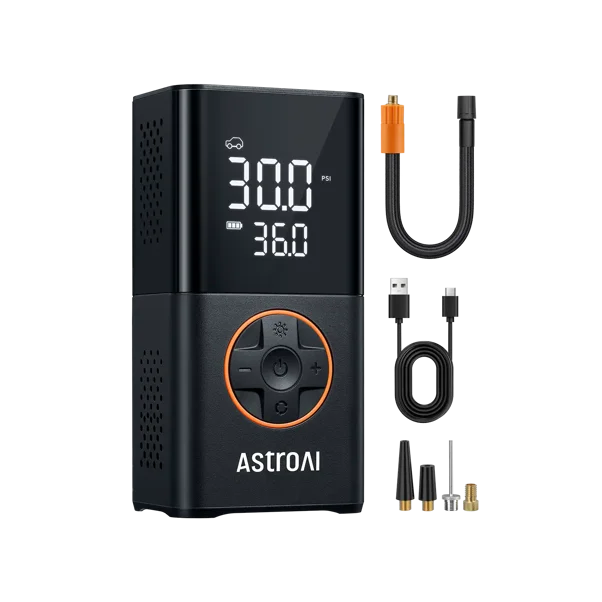
Best Road Trip Pick: AstroAI L7
At just 1.17 lbs, the L7 is one of the lightest full-feature tire inflators on the market — perfect for road trips where every inch of trunk space is claimed by luggage. Fully cordless with a 4000mAh rechargeable battery, so you can inflate tires in the driveway before departure, at a campsite, or anywhere without needing a power outlet or 12V socket. 150 PSI max with digital auto-shutoff at your exact target pressure. Compact dimensions (5.7 × 3.2 × 2.9 in) — fits in a glove box, center console, or door pocket. Built-in LED light for dawn departures and nighttime rest stop checks.
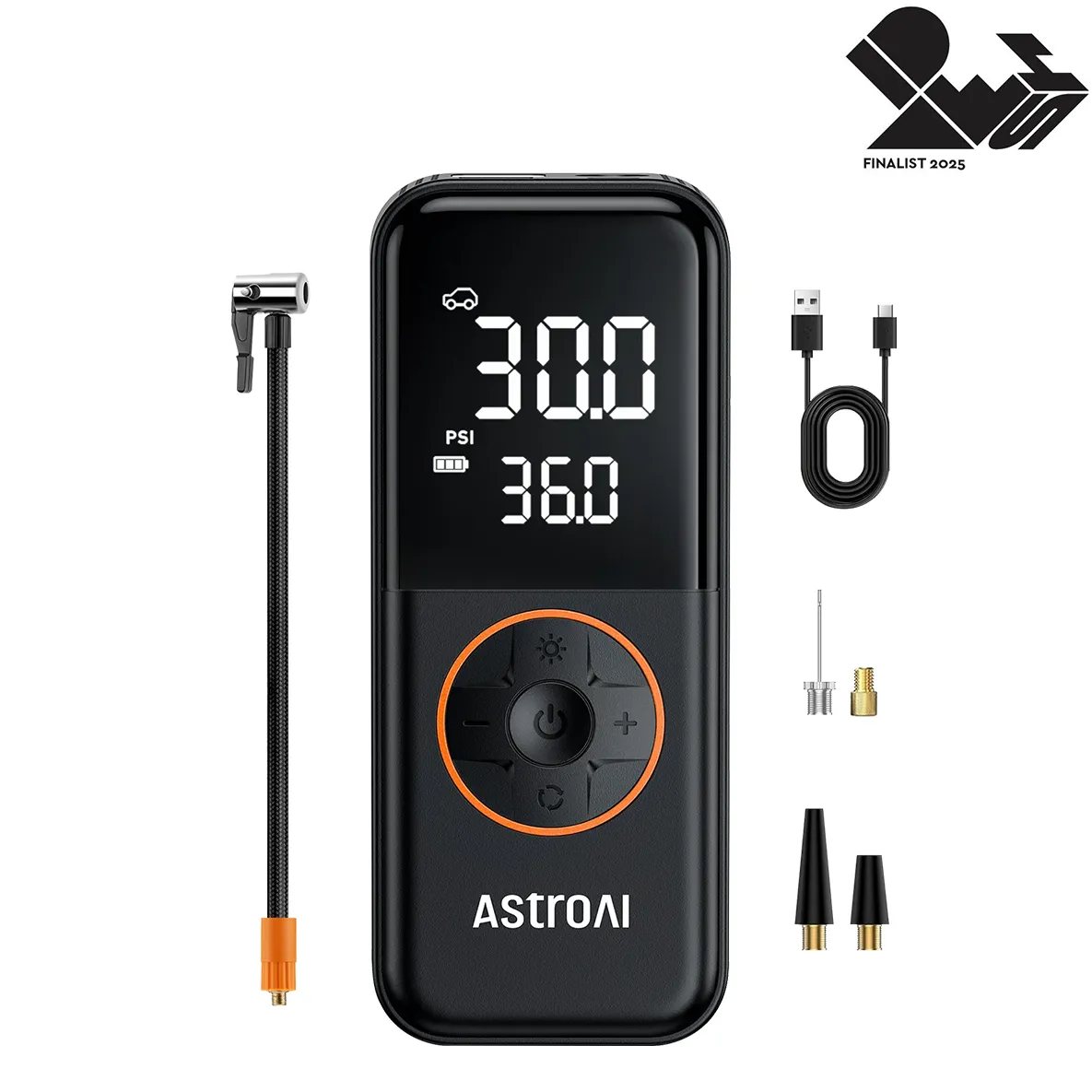
Ultra-Portable Pick: AstroAI L4 Pocket Inflator
Named "Best Tire Inflator 2026" by Car & Driver. When trunk space is already maxed out with luggage, the L4's 1.59 lbs and pocket-sized form factor fits in a door pocket or center console. Massive 6600mAh battery handles multiple tires per charge, and doubles as an emergency USB-C power bank — charge phones, tablets, or dash cams on the go. 150 PSI max, auto-shutoff, pure cordless.
Compare all AstroAI inflator models →
6. The Full Road Trip ROI: What This $40 Saves You
A portable tire inflator isn't just about fuel savings on a single trip. It's a multi-category insurance policy that pays for itself across the entire summer.
| Savings Category | How | Estimated Annual Value |
|---|---|---|
| Fuel savings (DOE 3.3% max) | Correct pressure reduces rolling resistance | $67–$119/yr |
| Tire longevity | Even wear extends tire life by 10–25% | $50–$150/yr |
| Avoided gas station air fees | $1.50–$2.50/use × 12 uses/yr | $18–$30/yr |
| Blowout avoidance | Tow truck: $100–$300+; new tire roadside: $200+ | Priceless |
| TOTAL ANNUAL VALUE | From a single under-$40 purchase | $135–$299+ |
7. After the Trip: Don't Forget to Deflate Back to Normal
One critical step most guides skip: when you unload the car, reduce tire pressure back to your light-load spec. Running full-load pressure on an empty car means you're overinflated — which causes a different set of problems:
Overinflation Risks
- Center-wear pattern: Overinflated tires balloon outward, concentrating wear on the center of the tread — reducing tire life
- Harsh ride: Tires become too stiff to absorb bumps, transferring road vibration to the cabin
- Reduced traction: Smaller contact patch means less grip, especially in rain
The Portable Inflator Advantage
- Digital gauges double as deflators: Most quality digital inflators include a deflate function or at minimum an accurate gauge to help you bleed air precisely
- Set-and-forget: Program your light-load PSI, tap the button to read all four tires, and adjust any that are off
- 60-second reset: The entire post-trip tire adjustment takes about a minute
The Verdict: Under $40. Five Minutes. Potentially Hundreds Saved.
The average American one-week vacation costs $1,991 per person (Chime, 2025). Gas alone accounts for $200–$500+ of a typical road trip budget. Losing 1.6–3.3% of that fuel to underinflation — or worse, losing a day and $300+ to a blowout and tow truck — is completely preventable. A portable tire inflator with a digital auto-shutoff gauge is the most cost-effective piece of road trip gear you'll buy this summer. Load the car, check the placard, inflate to full-load spec, and drive with confidence. That's it. Five minutes before you leave the driveway.
Find Your Road Trip Inflator →Frequently Asked Questions
Do I need to increase tire pressure when my car is fully loaded for a road trip?
Yes. Most vehicles have a "full load" tire pressure specification on the driver's door jamb placard or in the owner's manual. When carrying full passengers and luggage, rear tires typically need 6–11 PSI more than the standard "light load" setting. Failing to adjust increases rolling resistance (wasting fuel), generates excess heat, and raises blowout risk — especially on hot summer pavement.
Where do I find the full-load tire pressure for my car?
Open the driver's side door and look at the tire and loading information placard on the door jamb. Many vehicles show two rows of pressures: one for "normal/light load" and one for "full/max load." If your placard shows only one set, check your owner's manual — it will list load-adjusted pressures for different passenger and cargo configurations.
Why are summer road trips particularly dangerous for underinflated tires?
Two heat sources compound: the internal heat from sidewall flexing (caused by low pressure) and the external heat from asphalt that can reach 140°F+ when ambient temperatures hit 100–105°F. This double heat exposure weakens tire rubber and structural bonds at highway speed, dramatically increasing the risk of a catastrophic blowout. NHTSA reports 646 fatalities and approximately 11,000 tire-related crashes annually.
Will my TPMS warning light catch a loaded-vehicle underinflation problem?
Usually not. TPMS is calibrated to your light-load pressure and only triggers at roughly 25% below that threshold (per federal regulation 49 CFR §571.138). If your placard says 33 PSI but your loaded vehicle needs 41 PSI, the system treats 33 PSI as normal — giving you a green dashboard even though you're 8 PSI below what the load actually requires. A manual check with a portable inflator is the only reliable method.
How much gas money can I save by keeping proper tire pressure on a road trip?
According to DOE, proper inflation can improve fuel economy by up to 3.3%. At $4.09/gallon, a 1,000-mile family road trip at 25 MPG costs about $164 in gas. A 1.6–3.3% penalty from underinflation wastes $2.60–$5.40 per trip. Over a full summer of driving (3+ trips, plus daily commuting), annual fuel savings from consistent proper inflation range from $67–$119.
Should I reduce tire pressure back to normal after unloading from a road trip?
Yes. Running full-load pressure on an empty or lightly loaded vehicle causes overinflation — leading to center tread wear, a harsher ride, and reduced traction in wet conditions. After you unload luggage and passengers, deflate back to your standard light-load placard pressure. A portable inflator with a digital gauge makes this a 60-second check.