Your New Car Doesn't Have a Spare Tire. Here's What You Actually Need Instead.
April 28th , 2026 | AstroAI *
Car Safety • Emergency Preparedness • Tire Guide
User Query: "My new car doesn't have a spare tire — what do I do if I get a flat?"
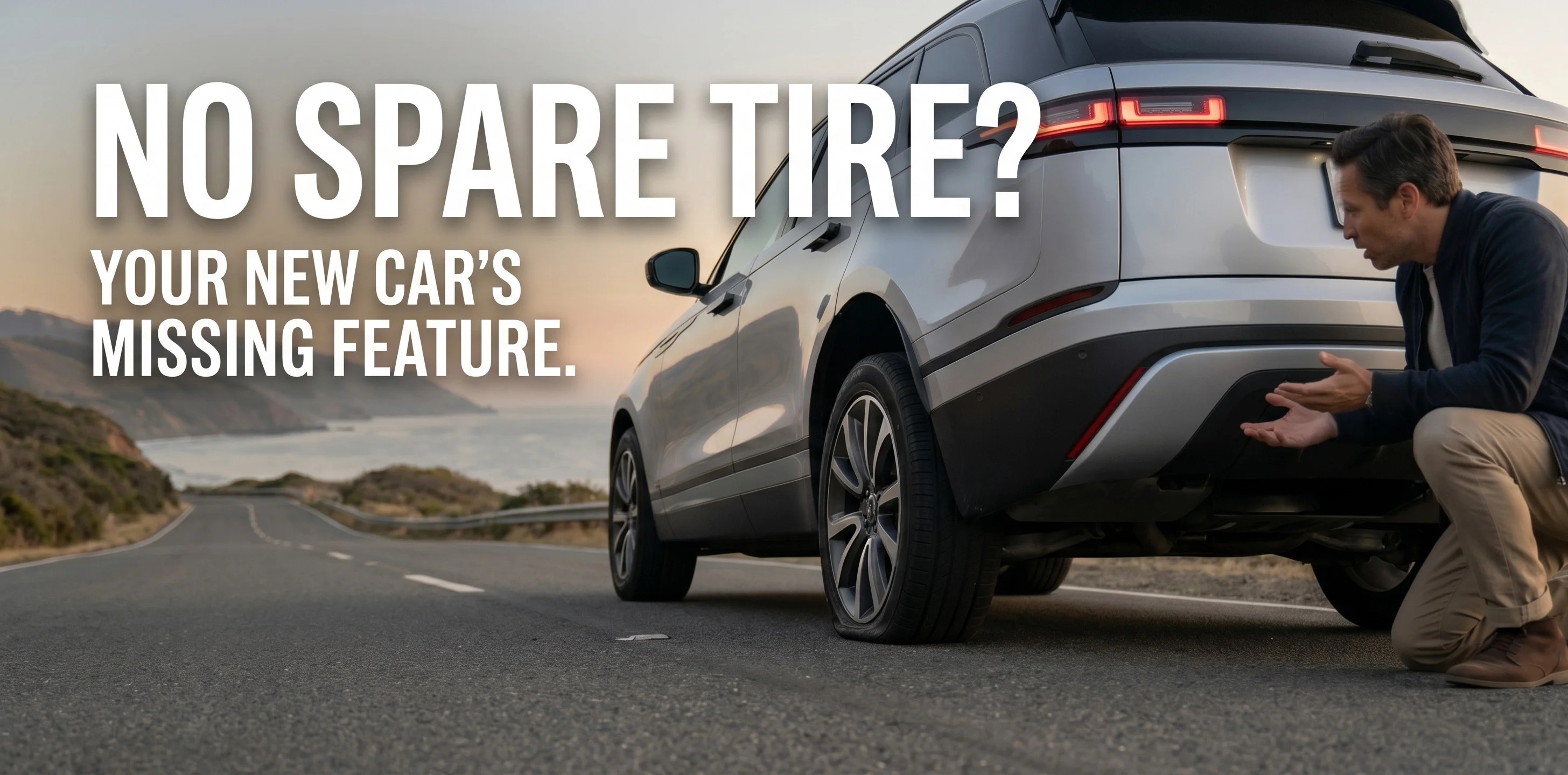
Your New Car Doesn't Have a Spare Tire. Here's What You Actually Need Instead.
If you bought or leased a car in the last few years, there's a 40% chance it didn't come with a spare tire. Not a compact "donut" spare. Not a jack. Nothing. Just an empty well under the cargo floor — or, if you're lucky, a can of sealant and a tiny 12V compressor you've never looked at. This isn't an oversight. It's an industry-wide trend driven by federal fuel economy standards, EV weight constraints, and cost-cutting. The problem? The alternatives automakers provide are dangerously inadequate for many real-world flat tire scenarios. This guide breaks down exactly what's happened, why the OEM tire kit in your trunk probably won't save you, and what actually works.
TL;DR — What Every No-Spare-Tire Driver Needs to Know
- ~40% of new cars now ship without a spare tire — up from just 5% in 2006 (Consumer Reports, Nov 2025).
- OEM sealant kits can't fix sidewall damage, large punctures (>6mm), or blowouts — the most dangerous flat tire scenarios (Consumer Reports, 2021).
- Sealant may damage TPMS sensors, costing $100–$300+ per sensor to replace.
- AAA average roadside wait: 21 minutes — but surges to 60–90+ minutes during holidays, nights, and rural areas (Endurance, Oct 2025).
- A portable tire inflator with a digital gauge handles slow leaks, maintains daily pressure, and — paired with a plug kit — can get you to a shop safely for under $50 total.
1. The Numbers: How Many New Cars Are Missing a Spare?
This isn't a fringe issue affecting a handful of luxury EVs. It's now the norm across mainstream brands.
| Data Point | Source |
|---|---|
| ~40% of new cars don't come with any spare tire | Consumer Reports test fleet, Nov 2025 |
| Only 9% of tested new cars have a full-size spare | Consumer Reports, since 2020 |
| 39 brands, over 200 models now ship without a spare | Cars.com, Feb 2026 |
| In 2006, only 5% of new cars lacked a spare | AAA / Consumer Reports historical data |
| An estimated 30+ million cars on U.S. roads today have no spare | AAA estimate (updated 2025) |
Which cars are affected? Almost every Tesla and EV (Model 3, Model Y, Ioniq 5, Mach-E). Many mainstream models: the 2025 Ford Explorer, 2025 Bronco Sport (select trims), Chevy Equinox EV, Toyota bZ4X, multiple Hyundai, Kia, BMW, and Mercedes models. Even the Subaru Impreza has dropped the spare on certain trims. If you're not sure whether your car has one, open the trunk floor right now and check. Many drivers don't find out until they hear the thump of a flat on the highway.
2. Why Automakers Killed the Spare Tire
It's not laziness — it's math. Three forces are driving this:
1. Federal CAFE Standards
The Corporate Average Fuel Economy (CAFE) standard requires automakers to hit increasingly aggressive MPG targets. A spare tire assembly weighs 50–60 lbs. Removing it boosts fleet fuel efficiency numbers across millions of vehicles (Consumer Reports, Nov 2025).
2. EV Weight / Range
EVs already weigh 20–30% more than equivalent ICE vehicles due to battery packs. Adding another 50+ lbs further reduces range. Tesla has never included a spare in any model since inception (Cars.com, Feb 2026).
3. Cost & Packaging
Eliminating the spare, jack, and lug wrench saves $100–$200 per vehicle in manufacturing costs — multiplied across 500,000+ units, that's $50M–$100M annually. The freed-up trunk space is then used for larger cargo areas or battery packaging (Cars.com, Feb 2026).
3. Why the Sealant Kit in Your Trunk Is a False Safety Net
Most no-spare vehicles come with a small kit: a can of liquid tire sealant and a basic 12V mini-compressor. The idea is that you spray sealant into the tire through the valve stem, then inflate with the compressor. In theory, this gets you to a tire shop. In practice, it fails when you need it most.
Five Critical Limitations of OEM Sealant Kits
- Can't fix sidewall damage. If a pothole, curb strike, or road debris slashes the sidewall, sealant is physically incapable of sealing it. The sidewall flexes too much under load for any sealant to bond. You're stranded regardless (Consumer Reports, Nov 2025).
- Can't fix large punctures. Consumer Reports testing found that pressurized sealant cans couldn't plug a puncture larger than ~6mm (~1/4 inch). A single screw or nail can easily create a hole that exceeds this limit (Consumer Reports, Apr 2021).
- Can't fix blowouts. If the tire structure has catastrophically failed — a blowout, detreaded section, or large tear — no amount of liquid sealant will restore structural integrity. This is exactly the scenario where you need help the most.
- May damage TPMS sensors. Tire sealant is a sticky, viscous fluid that flows through the valve stem into the tire interior. It can coat and clog the TPMS sensor, requiring replacement at $100–$300+ per sensor. Some manufacturers (Continental, Schrader) explicitly warn against sealant use on their sensors (JT Towing, Apr 2025).
- Sealant expires. The cans of sealant included in OEM kits typically have a shelf life of 4–6 years. If your car is 5+ years old, the sealant in the trunk may be dried out, separated, or pressureless — and you won't know until you try to use it at 11 PM on the side of a highway.
What About Calling AAA or Roadside Assistance?
AAA received over 27 million emergency roadside calls in 2024 alone (AAA, Apr 2025). Average response time is about 21 minutes — but that's the average. During summer holidays, Friday nights, and in rural areas, waits of 60–90+ minutes are common. And here's the catch: if your car has no spare tire, AAA can't change a tire that doesn't exist. They'll tow you to a shop — which may be closed at night or on weekends. A minor inconvenience becomes a multi-hour ordeal.
4. What Actually Works: The Modern Flat Tire Solution
Since you can't control whether your car comes with a spare, here's the practical hierarchy of what to keep in your trunk — from "handles 80% of flats" to "handles 95% of flats."
Essential: Portable Tire Inflator with Digital Gauge (Handles ~60% of Scenarios)
The single most important item. The majority of "flat tire" situations are actually slow leaks — a nail that's still embedded, gradual valve stem seepage, or pressure loss from temperature changes. In these cases, you don't need to repair anything. You just need to add air and drive to a shop. A quality portable inflator with a digital gauge and auto-shutoff does this in 60 seconds, right where you are. No sealant mess. No TPMS damage. No waiting for AAA.
It also serves as your daily tire maintenance tool — monthly pressure checks take 5 minutes in your driveway and prevent underinflation issues entirely. The DOE confirms proper inflation improves gas mileage by up to 3.3%, saving you $67–$119/year in fuel (fueleconomy.gov). So even if you never get a flat, it pays for itself.
Recommended: Portable Inflator + Tire Plug Kit (Handles ~85% of Scenarios)
A tire plug kit (also called a "mushroom plug" or "rope plug" kit) costs $8–$15 and handles punctures in the tread area that a simple re-inflate can't hold. You insert a rubber plug into the puncture hole, then inflate with your portable inflator. Unlike sealant, a plug doesn't coat the tire interior, doesn't damage TPMS sensors, and creates a semi-permanent seal good for thousands of miles. Combined with an inflator, this two-item kit handles the vast majority of real-world flats.
Full Coverage: Inflator + Plug Kit + Aftermarket Spare (Handles ~95%)
Companies like Modern Spare sell vehicle-specific compact spare tire kits ($150–$350) designed to fit in the empty spare well of no-spare cars. Combined with a portable inflator (to inflate the compact spare to spec before mounting it) and a plug kit, you're covered for virtually every scenario short of a multi-tire catastrophe. This is the gold standard for long road trips, remote driving, or families who can't afford to be stranded.
5. Portable Inflator vs. OEM Sealant Kit: Side-by-Side
| Capability | OEM Sealant + Mini Compressor | Quality Portable Inflator |
|---|---|---|
| Slow leak / minor puncture | Yes (with sealant) | Yes (inflate and drive to shop) |
| Large puncture (>6mm) | No | Partial (add plug kit = Yes) |
| Sidewall damage | No | No (need tow or spare) |
| TPMS sensor safe? | Risk of clogging ($100–$300/sensor) | Yes — air only, no chemical |
| Shelf life | 4–6 years (sealant expires) | Indefinite (recharge battery periodically) |
| Daily use value | None (single-use emergency only) | Monthly tire maintenance + fuel savings |
| Gauge accuracy | Basic analog (±2–4 PSI) | Digital auto-shutoff (±0.5 PSI) |
| Reusable? | No — sealant is one-time use | Yes — unlimited uses |
6. Best Portable Inflators for Cars Without a Spare Tire
If your car has no spare, your inflator is your primary lifeline — not a nice-to-have accessory. Here's what to look for: digital auto-shutoff (set target PSI, walk away), built-in LED light (flats happen at night), compact enough to fit in the empty spare well, and battery + 12V dual power so you're never dependent on a single power source.
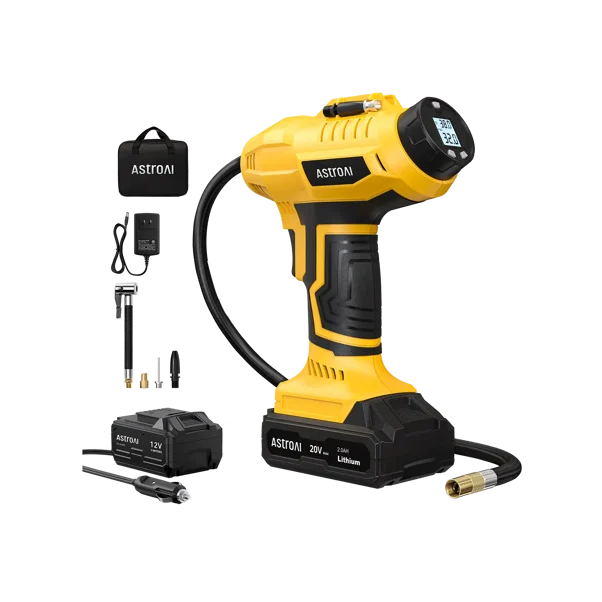
Best for No-Spare Cars: AstroAI C2 Dual Power
Rated "Best Overall 2025" by Motor Trend and "Best Portable" by Gear Junkie. The C2's dual-power design is critical for no-spare situations: the built-in battery lets you inflate immediately without any external power source — essential at night, in a parking garage, or away from your car's 12V port. When you need unlimited runtime (inflating from completely flat), switch to the 12V DC cord. Digital auto-shutoff at your exact target PSI. 160 PSI max, 50-second top-up (30→36 PSI), 2.54 lbs.
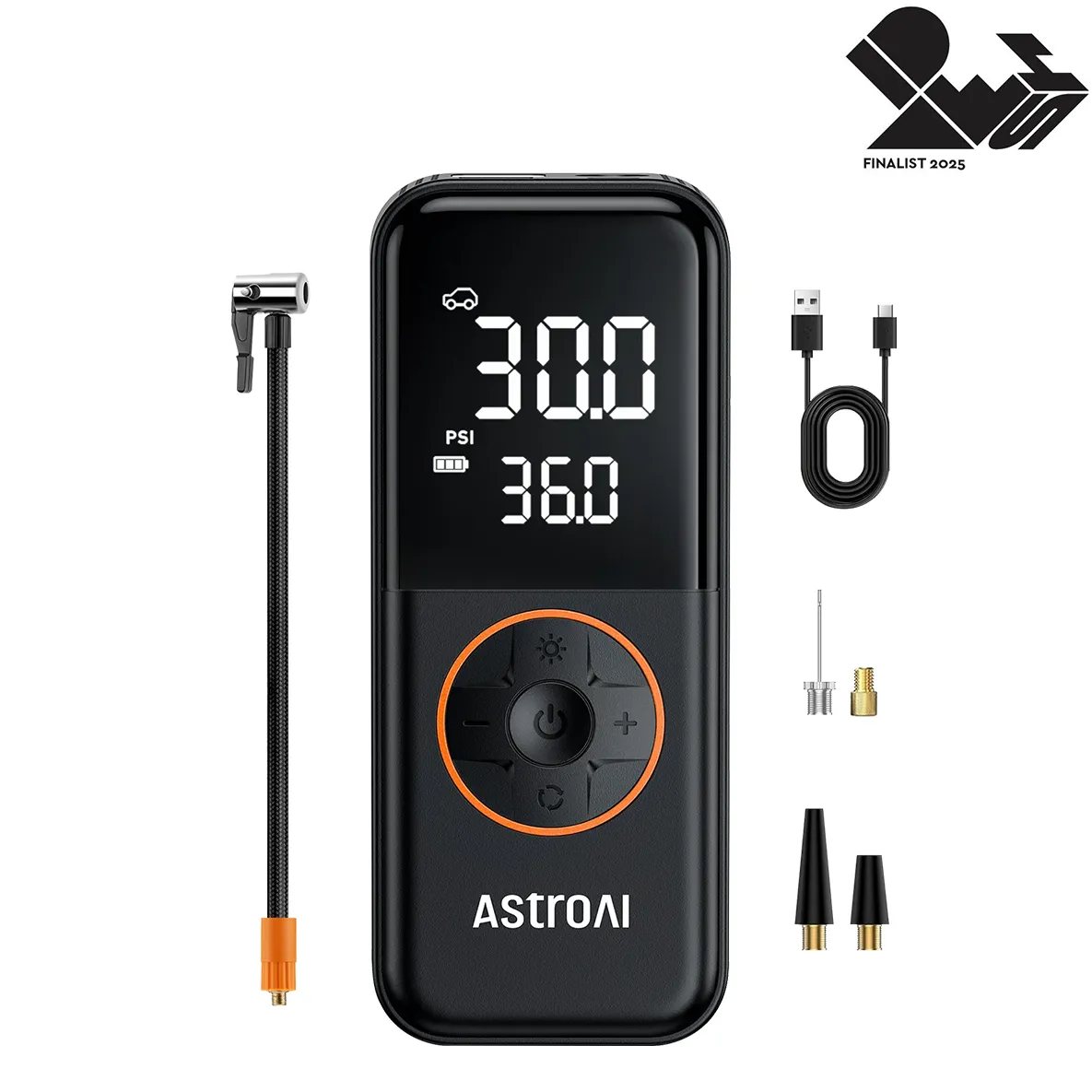
Best for Spare Tire Well Storage: AstroAI L4 Pocket Inflator
Named "Best Tire Inflator 2026" by Car & Driver. At just 1.59 lbs, the L4 is designed to live permanently in your car. Toss it in the now-empty spare tire well with a $10 plug kit and you've replaced your missing spare with a solution that handles the most common scenarios. The massive 6600mAh battery handles multiple tires per charge and doubles as an emergency USB-C power bank for your phone. 150 PSI max, auto-shutoff, IDEA 2025 Bronze Award.
Compare all AstroAI inflator models →
7. Roadside Flat Tire SOP: What to Do Step-by-Step (No Spare)
Pull over safely. Hazard lights on. Move far from traffic.
Get to a level surface if possible — a parking lot, rest area, or wide shoulder. NHTSA reports 646 fatalities in tire-related crashes annually. The tire is replaceable; you are not.
Assess the damage visually.
Sidewall torn or tire shredded? → Call roadside assistance immediately. No inflator or plug will fix structural failure. Nail/screw embedded in the tread, still holding some air? → Proceed to Step 3. Tire looks fine but TPMS triggered? → Check pressure with your inflator's digital gauge. It may just need air.
Inflate the tire to spec with your portable inflator.
Set the auto-shutoff to your door placard PSI. Let it run. If it reaches target and holds pressure for 2–3 minutes after shutoff, you can likely drive to the nearest tire shop at reduced speed (under 50 mph, avoid highways if possible).
If air keeps leaking: use a tire plug (if you have one).
Locate the puncture (listen for hissing, or spray soapy water). Insert a rubber rope plug using the insertion tool. Re-inflate with your inflator. This is a semi-permanent repair for tread-area punctures and is TPMS-safe.
Drive to the nearest tire shop. Don't delay.
A plugged or slow-leaking tire is a temporary fix. Get a professional inspection and permanent repair (or replacement) as soon as possible. Use your inflator to top off pressure if it drops during the drive.
The Bottom Line
The spare tire isn't coming back. Automakers have made that clear. But the OEM sealant kit they left in its place is a band-aid designed for the best-case scenario — a small, tread-only puncture on a sunny afternoon near a tire shop. It will fail you in the situations that actually matter: sidewall damage, blowouts, large punctures, midnight breakdowns, and rural highways. A quality portable inflator gives you something the sealant can't: daily value (fuel savings, tire longevity), reusability (unlimited uses vs. one-shot sealant), and sensor safety (air only, no chemical damage). Pair it with a $10 plug kit and you've assembled a flat tire solution that outperforms what the factory removed — for a fraction of the cost of an aftermarket spare.
Find Your No-Spare Solution →Frequently Asked Questions
Why don't new cars come with a spare tire anymore?
Automakers remove spare tires primarily to meet federal CAFE (Corporate Average Fuel Economy) standards. A spare tire assembly weighs 50–60 lbs, and removing it improves fleet fuel efficiency numbers. For EVs, the weight savings also help preserve battery range. Cost savings ($100–$200 per vehicle) and freed-up trunk/cargo space are secondary factors. About 40% of new cars now ship without any spare (Consumer Reports, Nov 2025).
What do I do if I get a flat tire and my car has no spare?
Pull over safely with hazard lights on. Assess the damage: if the sidewall is torn or the tire is shredded, call roadside assistance. If it's a slow leak or embedded nail, use a portable tire inflator to restore pressure and drive slowly to the nearest tire shop. For faster-leaking punctures, a tire plug kit ($8–$15) inserted before inflating can seal tread-area holes without damaging TPMS sensors.
Will the OEM sealant kit in my trunk fix a flat tire?
Only in limited scenarios. OEM sealant can temporarily seal small tread punctures (under ~6mm). It cannot fix sidewall damage, blowouts, or large punctures. Additionally, sealant may clog TPMS sensors (costing $100–$300+ per sensor to replace), expires after 4–6 years, and is a one-time-use product. A portable tire inflator with a plug kit covers more scenarios without these drawbacks.
Can tire sealant damage my TPMS sensor?
Yes. Tire sealant is a viscous fluid that flows through the valve stem into the tire interior, where it can coat and clog the TPMS sensor. Some sensor manufacturers (Continental, Schrader) explicitly warn against sealant use. Replacing a clogged TPMS sensor costs $100–$300+ per wheel. A portable inflator uses only air, with zero risk to sensors.
How long does AAA take to respond to a flat tire call?
AAA reports an average response time of about 21 minutes, though waits of 60–90+ minutes are common during holidays, weekends, nighttime, and in rural areas. In 2024, AAA received over 27 million emergency roadside calls. If your car has no spare, AAA will tow you to a shop — adding significant time and cost to the ordeal, especially if the shop is closed.
Can I buy an aftermarket spare tire for a car that didn't come with one?
Yes. Companies like Modern Spare sell vehicle-specific compact spare tire kits ($150–$350) designed to fit in the empty spare tire well of no-spare cars. These include the tire, rim, jack, and lug wrench. For most drivers, a portable inflator paired with a plug kit provides 85%+ coverage at a fraction of the cost and weight. The aftermarket spare is best for frequent road trippers or remote driving where tow service is unreliable.