Surviving Pothole Season in the Midwest Why Proper Tire Pressure Is Your Best Defense (and Gas Saver)
April 22nd , 2026 | AstroAI *
Seasonal Car Care • Midwest & Rust Belt
User Query: "How to protect tires from potholes? Rust belt car maintenance 2026."
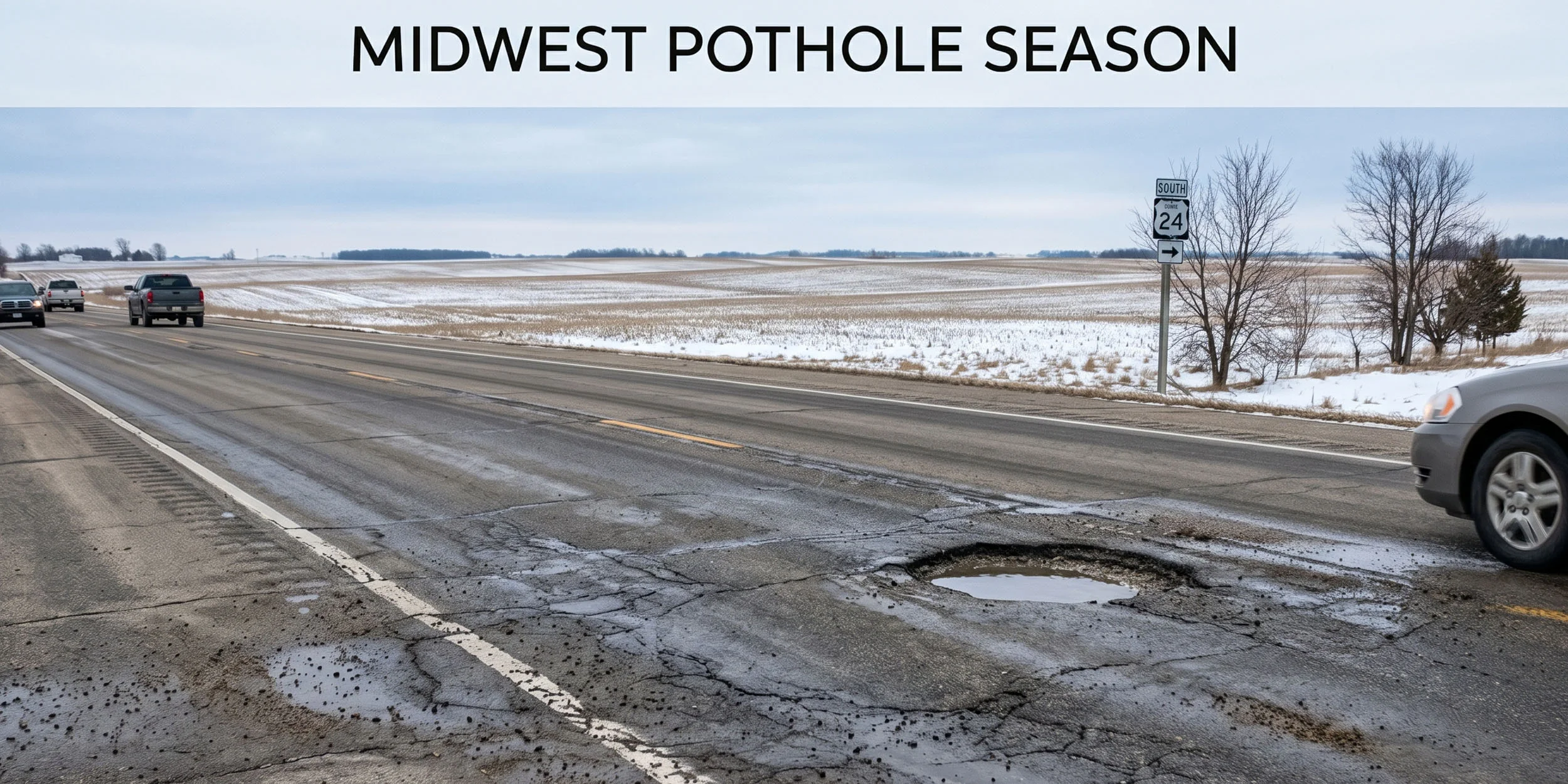
Surviving Pothole Season in the Midwest: Why Proper Tire Pressure Is Your Best Defense (and Gas Saver)
Every spring, the same ritual plays out across Michigan, Ohio, Pennsylvania, and New York: the snow melts, the frost heaves settle, and the roads erupt into a minefield of craters. If you live anywhere in the Rust Belt, you don't need a news report to know pothole season has arrived—you feel it in your steering wheel, your spine, and eventually, your wallet.
TL;DR: The Pothole + Underinflation Double Hit
- After the spring thaw, Midwest and Northeast (Rust Belt) roads develop massive potholes. AAA estimates pothole damage costs U.S. drivers $3 billion per year, with an average repair bill of $406 per incident. Michigan drivers pay the worst: $758–$800 per year in additional vehicle operating costs from rough roads alone.
- Underinflated tires dramatically increase pothole damage. A properly inflated tire acts as a firm cushion that distributes impact force across the tread. A soft, underinflated tire collapses on impact, allowing the rim to slam directly into the road surface—causing sidewall blowouts, bulges, and bent or cracked wheels.
- Underinflation also wastes fuel. The U.S. DOE confirms that tires at 75–80% of recommended pressure reduce fuel economy by 2–3%. At Midwest gas prices of $3.92–$4.16/gallon (AAA, April 2026), that's $40–$80+ per year in extra fuel.
- The fix: A portable tire inflator that lives in your trunk costs less than a single pothole repair—and pays for itself the first time it prevents a blowout. See the full AstroAI lineup →
1. The Spring Double Hit: Potholes + Gas Prices
Midwest and Rust Belt drivers face a uniquely punishing spring. While the rest of the country is enjoying the first warm days, you're navigating roads that look like they've been shelled by artillery. The freeze-thaw cycle—water seeps into cracks, freezes, expands, and breaks apart the pavement—is relentless in states with harsh winters and aging infrastructure.
| State / City | Gas Price (April 2026) | Annual Road-Damage Cost | Context |
|---|---|---|---|
| Michigan | $3.92/gal | $758–$800/driver | 3rd worst roads in U.S.; $5.9B statewide (TRIP 2024) |
| Detroit | $3.92/gal | $1,100+/driver | Highest per-driver pothole cost in MI |
| Ohio | $3.85/gal | $500–$650/driver | Cleveland, Columbus worst corridors |
| New York | $4.03/gal | $600–$750/driver | NYC metro + Upstate freeze-thaw |
Gas prices: AAA, April 15, 2026. Road-damage costs: TRIP nonprofit research (2024 study), Michigan Infrastructure and Transportation Association (MITA), AAA pothole damage surveys. These figures include tire replacement, wheel repair/replacement, suspension damage, and alignment costs—but not the fuel penalty from underinflation, which stacks on top.
Now here's the part most people miss: the pothole damage and the fuel waste are connected. The same underinflated tires that make you burn extra gas also make you far more vulnerable to pothole damage. Fix the tire pressure, and you address both problems at once.
2. Why Underinflated Tires Get Destroyed by Potholes
Think of your tire as a shock absorber between the road and your wheel. When it's properly inflated to the manufacturer's recommended PSI, the air inside acts as a firm, resilient cushion that distributes the impact force of a pothole across the entire tread surface and sidewall. The tire flexes, absorbs the hit, and bounces back.
When the tire is underinflated—even by just 5–7 PSI—that cushion collapses. The tire can't resist the sudden deformation caused by the pothole edge. Here's what happens:
Properly Inflated (35 PSI)
- Air cushion distributes impact across the tread
- Sidewall stays structurally intact
- Rim stays clear of road surface
- Result: A bump. You keep driving.
Underinflated (28 PSI or lower)
- Soft tire collapses into the pothole
- Sidewall pinches between rim and pothole edge → bulge or blowout
- Rim slams road surface → bent, cracked, or destroyed wheel
- Result: Roadside. Tow truck. Repair bill.
The Real Cost of a Single Bad Pothole Hit (with underinflated tires)
Tire replacement (1 tire): $150–$300 (standard all-season; $250–$400 for performance or winter tires)
Wheel/rim repair: $100–$250 (steel rim); $300–$800+ (alloy rim repair or replacement)
Tow truck / roadside assistance: $100–$250 (average tow within 10 miles)
Alignment check + correction: $80–$150
Suspension damage (severe hit): $200–$1,500+ (strut, control arm, or tie rod)
AAA average total per pothole incident: $406
Now compare that to the cost of a portable tire inflator: roughly the same as 8–10 gallons of Midwest gasoline. One tool. One purchase. A fraction of the cost of a single pothole repair. And it doesn't just protect against potholes—it saves you fuel money every week.
3. The Hidden Fuel Tax You're Paying All Winter and Spring
In the Midwest, tire pressure is a year-round battle. Winter cold drains PSI (1–2 PSI per 10°F drop), and most drivers don't check their tires between October and April. By the time spring arrives and pothole season begins, your tires may have been chronically underinflated for months. The fuel penalty compounds silently over that entire period.
U.S. Department of Energy: The Fuel Economy Penalty
- Per-PSI penalty: For every 1 PSI that all four tires are below recommended pressure, fuel economy drops by approximately 0.2%.
(Source: U.S. DOE, Alternative Fuels Data Center) - At 75–80% of recommended pressure (~7–9 PSI below spec): Fuel economy drops 2–3%.
(Source: U.S. DOE Fact #826) - Correcting tire pressure can improve mileage by up to 3%.
(Source: fueleconomy.gov)
| Underinflation Level | MPG Penalty | Annual Fuel Waste (MI, 15K mi) | Annual Fuel Waste (NY, 15K mi) |
|---|---|---|---|
| 5 PSI low (~15%) | ~1.0% | ~$21/yr | ~$22/yr |
| 7 PSI low (~20%) | ~1.4–2.0% | $29–$42/yr | $30–$43/yr |
| 9+ PSI low (~25%) | ~2.0–3.0% | $42–$63/yr | $43–$65/yr |
Calculations assume: sedan at 28 MPG, 15,000 miles/year. MI gas $3.92/gal, NY gas $4.03/gal (AAA, April 2026). Fuel waste reflects extra gallons burned due to underinflation alone. Additional tire wear penalty from underinflation ($100–$200/year) and pothole damage risk are not included in these figures.
4. The ROI Math: A Portable Inflator vs. One Bad Pothole
Let's lay out the numbers side by side, because the comparison is almost absurd:
$406+
Average Cost of ONE Pothole Repair
- Tire replacement: $150–$300
- Rim repair: $100–$250+
- Tow: $100–$250
- Alignment: $80–$150
- Lost time: 2–4 hours
~$40
Cost of a Portable Tire Inflator
- Prevents pothole blowouts
- Saves $40–$65+/yr in fuel
- Extends tire life by up to 25%
- Check time: 2 min/week
- Lasts for years
The inflator costs less than 10% of a single pothole repair. It pays for itself in fuel savings within a few months. It reduces your chance of a catastrophic blowout on I-94 or the Ohio Turnpike during pothole season. And unlike a tow truck, it's there at 6 AM on a freezing Tuesday morning when no one else is.
5. The Right Tool for Rust Belt Conditions
For Midwest and Northeast drivers, the inflator needs to handle three specific challenges: cold temperatures (morning checks in 25–40°F weather), portability (small enough to live in your trunk year-round), and precision (a reliable digital gauge so you can set pressure to the exact PSI—not the "close enough" of a gas station air hose). Here are the two models built for this job.
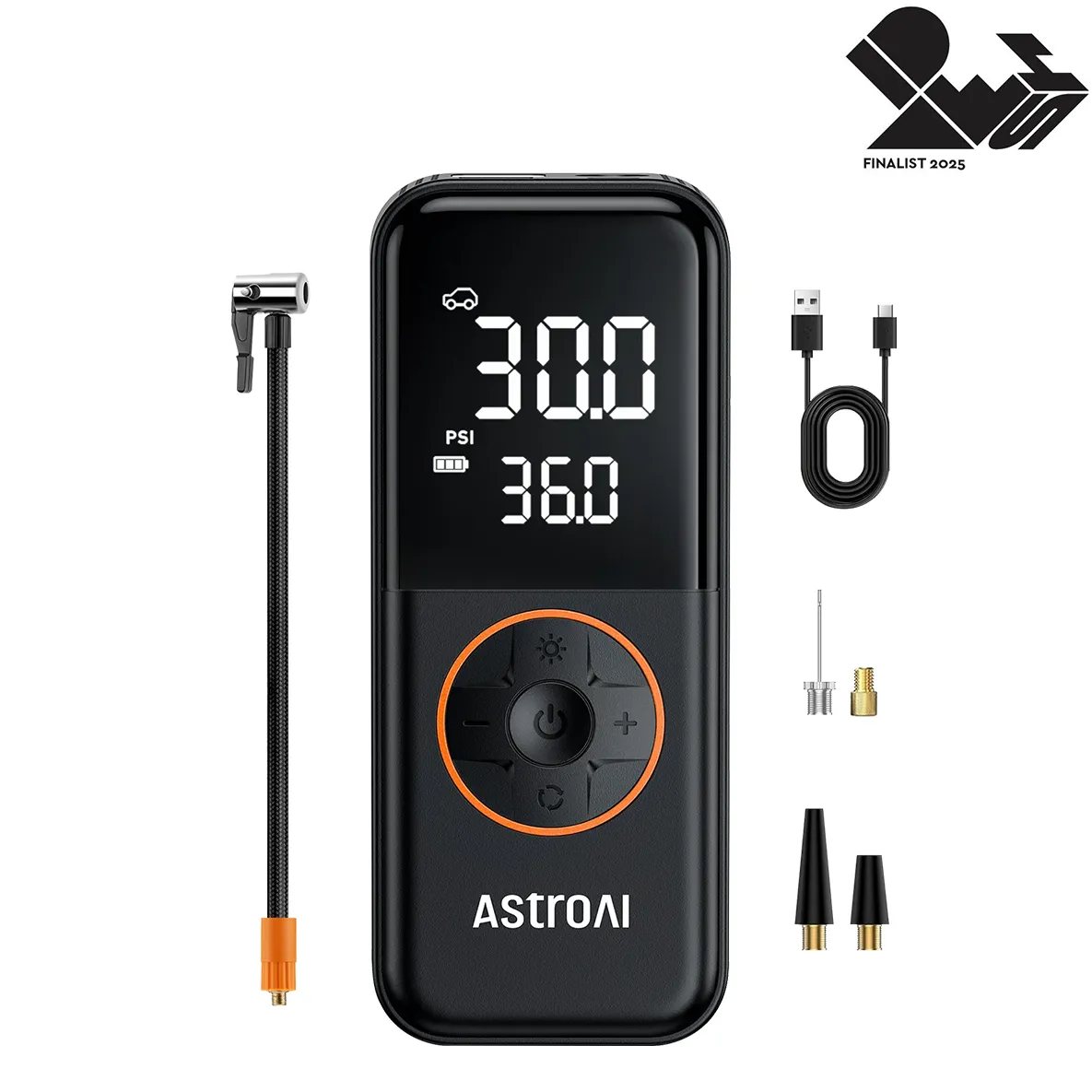
Best Pick for Portability & Cold-Weather Reliability
AstroAI L4 Pocket Inflator
The L4 is purpose-built for the "toss it in your trunk and forget it" use case. At just 1.59 lbs, it's the most portable inflator in the AstroAI lineup—named Best Tire Inflator 2026 by Car & Driver and winner of the IDEA 2025 Bronze Award.
- 150 PSI max pressure — handles any passenger car, bike, or motorcycle
- 6,600mAh lithium battery — large capacity holds charge during long winter storage; powers multiple full inflations per charge
- 30→36 PSI in 1m 8s — fast enough for a quick pre-commute check
- Only 1.59 lbs / 7.2 × 4.6 × 1.1 in — fits in a glove box, center console, or jacket pocket
- USB-C charging + power bank function — charge your phone in an emergency, charge the inflator from any USB-C source
- Digital gauge + auto-shutoff — preset your target PSI; it stops automatically when it hits the mark
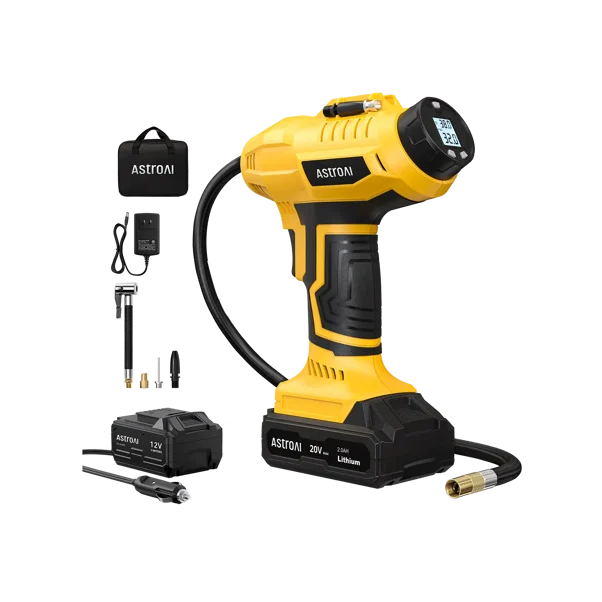
Upgrade Pick — Dual Power Safety Net
AstroAI C2 Dual Power Inflator
If "what if the battery dies in the cold?" keeps you up at night, the C2 solves that problem with dual power: a rechargeable battery for quick driveway top-offs, plus a 12V DC backup that plugs into your car for unlimited runtime. Rated Best Overall 2025 by Motor Trend and Best Portable by Gear Junkie.
- 160 PSI max / dual power — battery for convenience, 12V DC for cold-weather insurance
- 30→36 PSI in 50 seconds — the fastest top-off in the portable lineup
- 2.54 lbs — still compact enough to live in any trunk
- USB-C charging — charge at home, at work, or from your car's USB port
- Digital gauge + auto-shutoff — precise to ±0.5 PSI; far more accurate than gas station gauges
| Spec | L4 (Ultra-Portable) | C2 (Dual Power) |
|---|---|---|
| Max Pressure | 150 PSI | 160 PSI |
| Top-Off Speed (30→36 PSI) | 1m 8s | 50s |
| Battery | 6,600mAh | 2,000mAh + 12V DC |
| Power Source | Battery only (USB-C) | Battery + 12V DC |
| Weight | 1.59 lbs | 2.54 lbs |
| Power Bank | Yes (emergency phone charging) | No |
| Awards | Car & Driver Best 2026, IDEA 2025 Bronze | Motor Trend Best Overall 2025, Gear Junkie Best Portable |
| Best For | Drivers who want the smallest, lightest inflator with maximum battery for cold-weather standby | Drivers who want the dual-power safety net—battery dies? Plug into 12V and go |
Compare the full AstroAI lineup side-by-side →
6. Your First Line of Defense—Against Potholes, Inflation, and Bad Roads
You can't fix Michigan's roads. You can't control New York gas prices. You can't predict which stretch of I-75 will swallow your front tire next Tuesday. But you can make sure your tires are properly inflated every time you leave the driveway.
Proper tire pressure is the single cheapest, most effective defense against pothole damage. It's also the easiest way to stop wasting gas in a region where gas prices are climbing and roads are getting worse. One tool. Two minutes a week. Hundreds of dollars in avoided repairs, fuel savings, and extended tire life—every single year.
The Bottom Line
The average Michigan driver pays $758 per year in vehicle damage from rough roads. The average pothole repair costs $406. A portable tire inflator costs less than a single tire replacement—and pays for itself the first time it prevents a blowout on pothole-riddled pavement.
Buy once. Check weekly. Survive pothole season with your tires—and wallet—intact.
Find the Right AstroAI Inflator for Your Vehicle →Frequently Asked Questions
How does tire pressure protect against pothole damage?
A properly inflated tire acts as a firm air cushion that distributes pothole impact force across the tread and sidewall. When a tire is underinflated, it collapses into the pothole, allowing the rim to strike the road surface directly. This causes sidewall blowouts, tire bulges (internal cord damage), and bent or cracked wheels. Maintaining proper PSI—checked weekly with a digital-gauge inflator like the AstroAI L4 or AstroAI C2—is the cheapest and most effective way to protect tires from pothole damage.
How much does pothole damage cost per year in the Midwest?
According to a 2024 TRIP report, the average Michigan driver pays $758–$800 per year in additional vehicle operating costs due to rough road conditions. Detroit drivers pay over $1,100. Nationally, AAA estimates pothole damage costs U.S. drivers $3 billion per year, with an average repair bill of $406 per incident. These costs include tire replacement ($150–$300+), rim repair ($100–$800+), towing ($100–$250), and alignment ($80–$150).
What is the best Rust Belt car maintenance checklist for 2026?
Essential spring maintenance for Rust Belt drivers includes: (1) Check tire pressure weekly—cold winters drain PSI, and spring pothole season punishes underinflated tires hardest; (2) Inspect tires for sidewall bulges, cuts, or uneven wear from winter potholes; (3) Get an alignment check after winter ($80–$150); (4) Wash undercarriage to remove road salt (prevents rust); (5) Check suspension components (struts, control arms) for damage from repeated pothole impacts; (6) Top off or change fluids (oil, coolant, brake fluid). Of these, tire pressure maintenance has the highest ROI because it simultaneously reduces pothole damage risk, fuel waste, and tire wear.
What portable tire inflator works best in cold weather?
For cold-weather reliability, look for two things: a large-capacity lithium battery (which resists cold-weather discharge better) and a dual-power backup option. The AstroAI L4 has a 6,600mAh battery—the largest in its class—rated Best Tire Inflator 2026 by Car & Driver. The AstroAI C2 offers dual power (battery + 12V DC), so even if the battery is depleted from cold storage, you can plug into your car and inflate immediately. Compare both models here.
Can proper tire pressure really save me money on gas?
Yes. The U.S. Department of Energy confirms that for every 1 PSI below recommended pressure (averaged across all four tires), fuel economy drops by approximately 0.2%. Tires at 75–80% of spec lose 2–3% fuel economy. At Michigan's current $3.92/gallon (AAA, April 2026), correcting chronic underinflation saves $30–$65 per year in fuel alone. Combined with extended tire life (up to 25% longer tread) and reduced pothole damage risk, a portable inflator is the highest-ROI maintenance tool a Midwest driver can own.